- Plants
- ›Vascular Plants
- ›flowering plants
- ›Dicots
- ›Soapberries, Cashews, Mahoganies, and Allies
- ›mahogany family
- ›Owenia
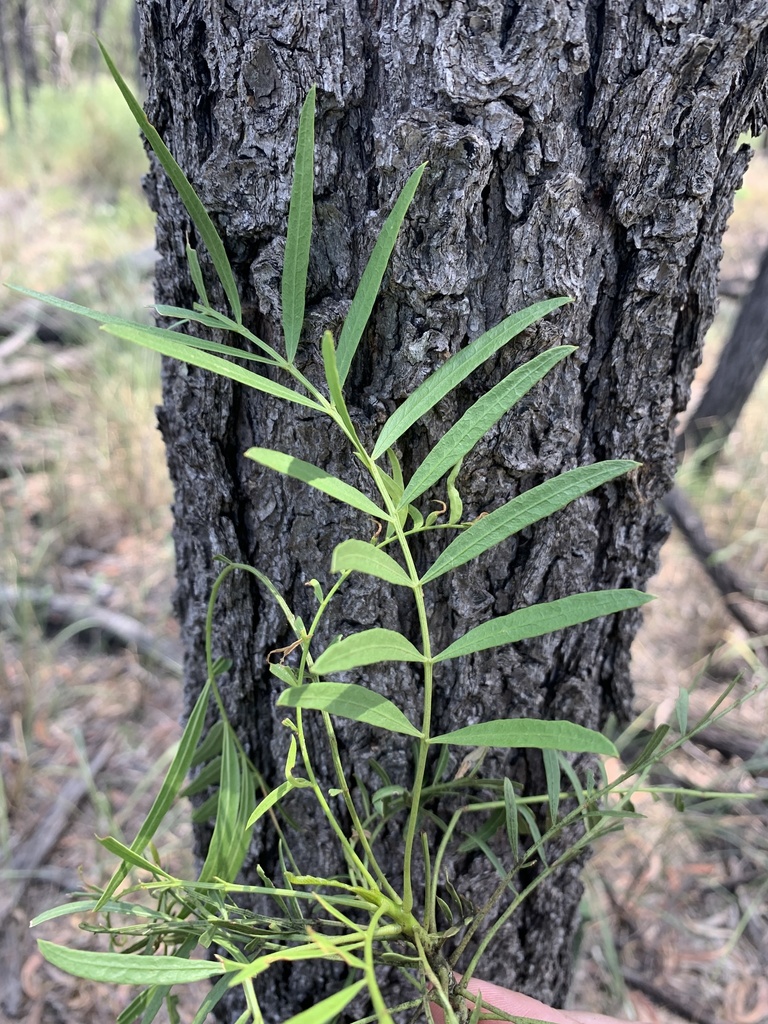
Emu Apple
Owenia acidula
Owenia acidula, commonly known as emu apple, is a small to medium-sized Australian native tree that can be found in South Australia, Queensland, New South Wales and to a lesser extent, Western Australia and the Northern Territory. This species favours sandy soil, and is typically found on plains or in dry sclerophyll forest.
From the article Owenia acidula on Wikipedia (CC BY-SA), quoted section by section
Description
Owenia acidula can grow from three up to ten metres tall. The branches typically hang downwards and away from the trunk. When the twigs are broken, they ooze a sticky, milky sap. The hairless pinnate leaves are a vibrant green, two to five centimetres in length, with a shiny coating. The buds of O. acidula are viscous. The cream coloured flowers have a loosely arranged structure, with four millimetre long petals and three millimetre long stamen. Owenia acidula fruits prolifically. The fruit ripens after it falls off the tree, and is slightly sour in taste. The fruits are a purplish red in colour, with faded speckles, and is spherical in shape. The seeds of the fruit have a diameter of two to four centimetres, and contain chemical compounds which have also have been found in the timber of Aglaia ferruginea, including a simple limonoid and a derivative of the cyclopropane protolimonoid glabretal.
What it does
Owenia acidula is dioecious. A plant is classified as dioecious when the male and female reproductive units develop on completely different organisms. Therefore, a male and female O. acidula specimen is required for reproduction to occur.
Wikipedia: “Reproduction”
At the table
The fruit of O. acidula can be eaten, and the pulp is an Aboriginal bushfood which is believed to cause hallucinations. The leaves and branches are sometimes used as stock fodder. In goats, O. acidula has a high level of digestibility of 53.29%, making it a favourable forage resource for goat producers. The seed of Owenia acidula is commonly requested for coal mine rehabilitation.
Wikipedia: “Uses”
In human culture
Owenia acidula derives its' name from Sir Richard Owen (Owenia) and the latin name, acidula meaning a little sour. Sir Richard Owen was a 19th century scientist who contributed significantly to the field of palaeontology and wrote multiple papers on Australian mammal fossils
Wikipedia: “Etymology and naming”
Where it lives
Recorded sightings
—
geo-referenced records in GBIF, from museums, herbaria and field observers.
Drag the globe to turn it. Dots are where records exist, not a range map; darker means more records.
In the stacks
Searching the stacks…
Every page naming Owenia acidula in the Biodiversity Heritage Library →
This page is assembled live from iNaturalist, GBIF, Wikipedia, the Source Library and the Internet Archive. It is not yet part of the hand-edited codex. iNaturalist taxon 207944.