On eBird ↗
Red-headed Trogon
Live sightings near you, the range map, bar charts of when it is seen, and Macaulay Library photos and recordings.
Red-headed Trogon
Harpactes erythrocephalus
The red-headed trogon (Harpactes erythrocephalus) is a species of bird in the family Trogonidae.
From the article Red-headed trogon on Wikipedia (CC BY-SA), quoted section by section
Description
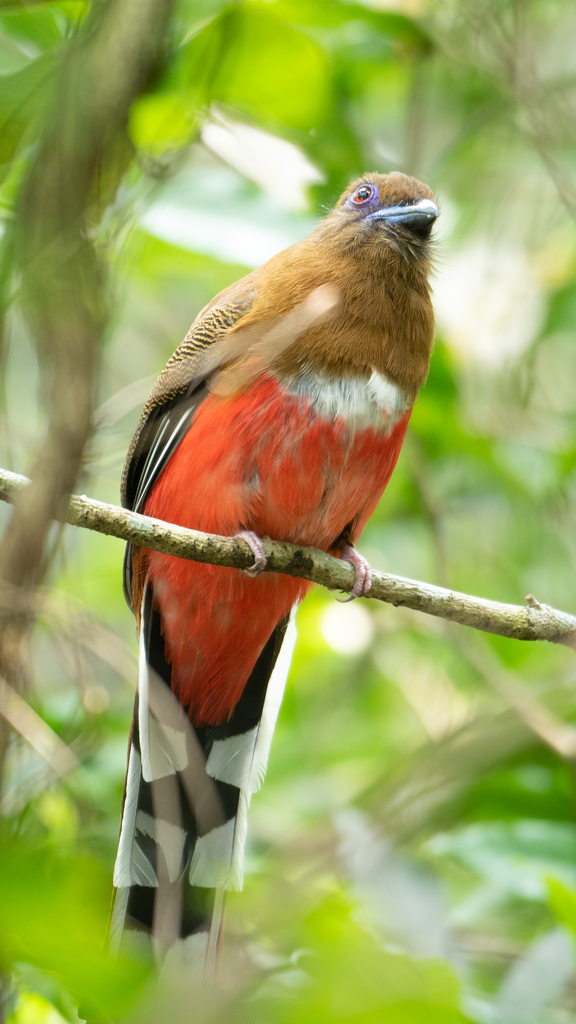
The red-headed trogon is on average 34 cm (13 in) in length. The male has a red head and breast, a unique feature in the Trogon group. The female resembles the Diard's trogon without a speckled undertail. The head, neck and upper breast of an adult male is dull crimson. A narrow white band crosses the mid breast, underneath which the lower breast to abdomen is light red to pink. Pale red can be observed on the flanks whereas the mantle and back of the bird are rusty brown. The male perches on branches with the support of mauve-blue legs. Regarding wing colouration, the lesser and median wing coverts, secondary coverts, as well as outer webs of tertials and secondaries are vermiculated black and white. The primary feathers also appear black and white. As for the bird's long tail, the central feathers are dark brown with a black tip, the second and third pairs are black and the outer pairs are white with black bases. Finally, a black-tipped cobalt blue bill, a deep mauve-blue gape and eyering and reddish-brown irises shape the bird's face. The head, neck and upper breast of an adult female are olive-brown. Just like the male, a narrow white band crosses the mid breast, underneath which the lower breast to abdomen is light red to pink. The mantle and back appear orange to brown in colour. The wings are vermiculated dark brown and yellowish brown. …
Range & habitat
The red-headed trogon is widely distributed from central Nepal, Southeast Asia, southern China to Sumatra. It is uncommon to scarce in Nepal where habitat destruction most certainly explains a rapid decline in population numbers. It is fairly common in northeastern India, frequent in Bhutan, and locally dispersed in Bangladesh. It prefers upland forests and lives in dense broadleaved forests and in tropical and subtropical zones in the Himalayan foothills. In Southeast Asia, it frequents broadleaved evergreen forests from 300 to 2,600 m (980 to 8,530 ft). In Myanmar, it lives in bamboo and oak forests at an elevation of 2,500 m (8,200 ft). In Laos, it occurs in evergreen forests and adjacent plains 1,700 m (5,600 ft). The forests in Vietnam appear to be a stronghold. In northern, western and southern Thailand, it favours climax broadleaved evergreen forests between 400 and 2,000 m (1,300 and 6,600 ft). On the Malay Peninsula, it inhabits evergreen lowland, lower montane and taller upper montane forests at elevations ranging from 300 to 1,680 m (980 to 5,510 ft). Farther south, it is rarely seen below 700 m (2,300 ft).
Wikipedia: “Distribution and habitat”
What it does
The red-headed trogon has often been observed perching on shaded branches waiting for prey, alone or in pairs. Its flight between trees is often sluggish and very low, only a few meters above the ground. It is most active in the early morning hours and at night, when pursuing moths at the edges of forest clearings. In central southern Thailand, it shares habitat with the Orange-breasted trogon (Harpactes oreskios). The two species often follow flocks of foraging birds taking advantage of the insects they flush out. In most regions, it is sedentary, but also been observed to migrate between different elevations in northern and southern Laos.
Calls. The male's call resembles that of the Eurasian golden oriole (Oriolus oriolus): a sequence of usually five to six, well-spaced mellow "tyaup" notes, repeated every minute. Occasionally the male calls an extended "pluu-du" note marked by a significant terminal drop in pitch. The call is repeated every 3–6 seconds.
Diet. The red-headed trogon feeds primarily on insects and their larvae, including green orthopterans, stick-insects, cicadas, millipedes, flies, beetles, centipedes, woodlice and moths. It also feeds on leaves and fruits.
Reproduction. The red-headed trogon usually builds nests in a natural tree cavity 1.5 to 5 m (4 ft 11 in to 16 ft 5 in) above the ground. …
Wikipedia: “Behaviour and ecology”
In human culture
H. erythrocephalus comes from the Ancient Greek terms ἐρυθρός eruthros meaning red and κεφαλή, kephalē meaning head.
Wikipedia: “Etymology”
Listen
Looking for field recordings…
Where it lives
Recorded sightings
—
geo-referenced records in GBIF, from museums, herbaria and field observers.
Drag the globe to turn it. Dots are where records exist, not a range map; darker means more records.
In the stacks
Searching the stacks…
Every page naming Harpactes erythrocephalus in the Biodiversity Heritage Library →
This page is assembled live from iNaturalist, GBIF, Wikipedia, the Source Library and the Internet Archive. It is not yet part of the hand-edited codex. iNaturalist taxon 20812.