- Plants
- ›Vascular Plants
- ›flowering plants
- ›Dicots
- ›myrtles, evening primroses, and allies
- ›myrtle family
- ›Myrtoideae
- ›gum trees
- ›Eucalyptus
- ›Symphyomyrtus
- ›Exsertaria
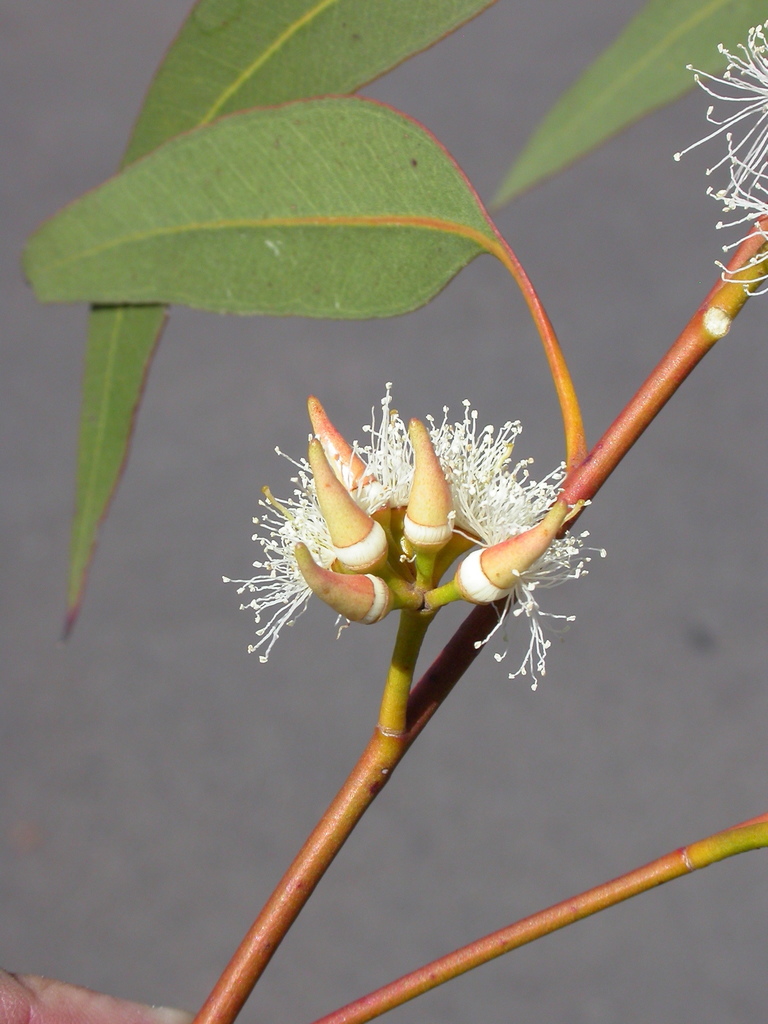
cabbage gum
Eucalyptus amplifolia
Eucalyptus amplifolia, commonly known as the cabbage gum, is a tree that is endemic to eastern Australia. It has smooth bark on its trunk and branches, lance-shaped leaves, and buds in groups of between seven and fifteen or more. The flowers are white and the fruit are woody hemispherical capsules. It is common on the coastal areas and tablelands of New South Wales and adjacent areas in south eastern Queensland, occurring as far south as Bega.
From the article Eucalyptus amplifolia on Wikipedia (CC BY-SA), quoted section by section
Description
Eucalyptus amplifolia is a tree that can grow to 30 m (100 ft) in height in forest situations, though it is often shorter in sparser woodland areas. It has smooth, often blotchy, white, cream, yellow, grey, pink or blue-grey bark throughout the trunk and branches, usually with loose, flaking grey slabs persistent at the base and lower trunk. The leaves on young plants are rounded, egg-shaped or triangular, green, 50–220 mm (2–9 in) long, 35–180 mm (1–7 in) and predominately held horizontal to the ground. Adult leaves are arranged alternately, broadly lance-shaped, 75–250 mm (3–10 in) long and 16–70 mm (0.6–3 in) wide on a petiole 10–30 mm (0.4–1 in) long. Side-veins are 45° or greater to the midrib, and the leaves are of a dull or glossy green of the same hue both sides of the leaf. The flowers are arranged in groups of seven to fifteen or more, the groups on a flattened or angular peduncle 7–15 mm (0.3–0.6 in) long, the individual flowers sometimes on a pedicel up to 8 mm (0.3 in) long, or sessile. The buds are cone-shaped, the floral cup hemispherical 2–3 mm (0.08–0.1 in) long, the operculum conical, 7–9 mm (0.3–0.4 in) long and about 4 mm (0.2 in) wide at the join. Flowering occurs between November and January and the fruit is a woody, hemispherical capsule 2–5 mm (0.08–0.2 in) long and 4–6 mm (0.16–0.24 in) wide on a pedicel 1–5 mm (0.04–0.2 in) long. …
Range & habitat
Cabbage gum grows in grassy woodland and forest, often in depressions and on river flats.
Subspecies amplifolia is found on the coastal plains of New South Wales from Taree to Batemans Bay with disjunct populations as far north as Coffs Harbour as well as in the Megalong Valley and on the Southern Tablelands near Goulburn. Subspecies sessiliflora grows in northern New South Wales, occurring in the Tenterfield, Armidale and Casino districts and in adjacent areas in Queensland.
Wikipedia: “Distribution and habitat”
Where it lives
Recorded sightings
—
geo-referenced records in GBIF, from museums, herbaria and field observers.
Drag the globe to turn it. Dots are where records exist, not a range map; darker means more records.
In the stacks
Searching the stacks…
Every page naming Eucalyptus amplifolia in the Biodiversity Heritage Library →
This page is assembled live from iNaturalist, GBIF, Wikipedia, the Source Library and the Internet Archive. It is not yet part of the hand-edited codex. iNaturalist taxon 208135.