- Animals
- ›Arthropods
- ›Hexapods
- ›Insects
- ›Winged and Once-winged Insects
- ›True Bugs, Hoppers, Aphids, and allies
- ›True Hoppers
- ›Spittlebugs, Cicadas, Leafhoppers and Treehoppers
- ›Cicadas
- ›Typical Cicadas
- ›Cicadinae
- ›Tamasini
- ›Tamasa
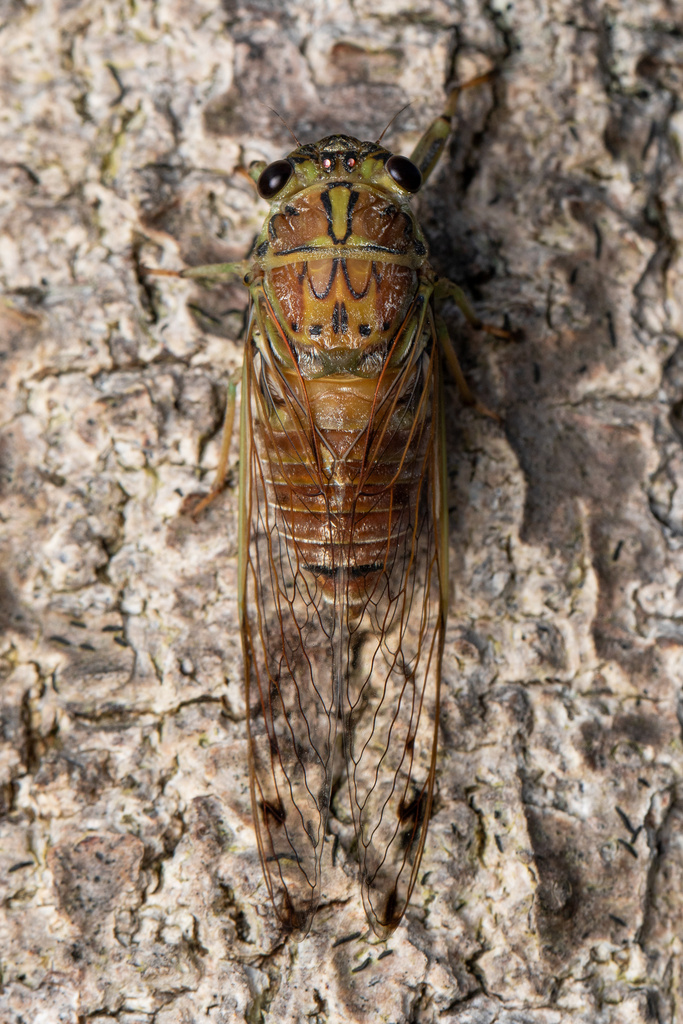
Brown Bunyip
Tamasa tristigma
Tamasa tristigma, also known as the brown bunyip or eastern bunyip, is a species or species complex of cicadas in the true cicada family. It is endemic to Australia. It was described in 1834 by German entomologist Ernst Friedrich Germar.
Common names given to the various forms include: small brown bunyip, blue-green bunyip, heathlands bunyip, Eungella bunyip, Atherton bunyip, Paluma bunyip and Whitsunday bunyip.
From the article Tamasa tristigma on Wikipedia (CC BY-SA), quoted section by section
Description
The length of the forewing is 22–36 mm. Colours within the species complex vary from rich brown through grey-brown to green and blue-green.
Range & habitat
The species occurs in eastern coastal Australia from the Cape York Peninsula in Far North Queensland to Ulladulla on the south coast of New South Wales, as well as inland at the Blackdown Tableland, Monto and Carnarvon Gorge. The associated habitat comprises rainforests and vine thickets, open forest, heathland and mangroves. Favoured trees include Casuarina glauca, Allocasuarina torulosa and Acacia prominens.
Wikipedia: “Distribution and habitat”
What it does
Adults are heard from September to June, clinging to the trunks and main branches of trees, uttering coarse, monotonous buzzing and rattling calls, covering a wide range of frequencies.
== References ==
Wikipedia: “Behaviour”
Listen
Looking for field recordings…
Where it lives
Recorded sightings
—
geo-referenced records in GBIF, from museums, herbaria and field observers.
Drag the globe to turn it. Dots are where records exist, not a range map; darker means more records.
In the stacks
Searching the stacks…
Every page naming Tamasa tristigma in the Biodiversity Heritage Library →
This page is assembled live from iNaturalist, GBIF, Wikipedia, the Source Library and the Internet Archive. It is not yet part of the hand-edited codex. iNaturalist taxon 208193.