On eBird ↗
Red-naped Trogon
Live sightings near you, the range map, bar charts of when it is seen, and Macaulay Library photos and recordings.
Red-naped Trogon
Harpactes kasumba
The red-naped trogon (Harpactes kasumba) is a species of bird in the family Trogonidae. It is found in Brunei, Indonesia, Malaysia, and Thailand. Its natural habitat is subtropical or tropical moist lowland forests. It is threatened by habitat loss.
From the article Red-naped trogon on Wikipedia (CC BY-SA), quoted section by section
Description
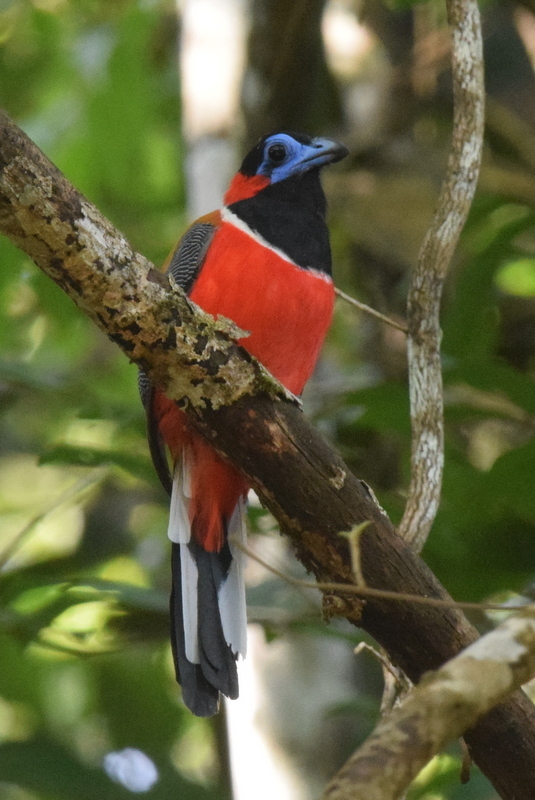
The red-naped trogon is a strongly sexually dimorphic species, with the females generally being duller than the males. The male red-naped trogon is physically defined by a black head and upper breast, blue bill and eye ring with a bright blue coloured face. He has yellow-brown upperparts and upper tail with black outlines, a white breast-line, bright red underparts and the under-tail is black and white. The most defining physical characteristic of the red-naped trogon is a band of bright red feathers around the back of the head, which gives the species its name. The females are blander in colour than the males, consisting of a grey-brown head and upper breast with yellow underparts.
Both the males and females grow in height up to 32 centimetres, or 12.5 inches. They have a life span of approximately 7.3 years. Their legs and feet are short and weak which makes them unable to walk, instead they are limited to the occasional shuffle along a branch. The ratio of leg muscle to body weight in all Trogonidae species is only 3%, the lowest known ratio of any bird. The arrangement of the toes on Trogonidae species feet is also unique among birds and are arranged with the third and fourth toes projecting forward and the first and second toes projecting backwards, an arrangement known as heterodactylous. …
Wikipedia: “Morphology and flight”
Range & habitat
The red-naped trogon is presumed to be a permanent resident or sedentary bird. Sedentary is "commonly used in the special sense of 'non-migratory,'" and resident is defined as "remaining throughout the year in the area under reference". At least 4,000 species of bird are regular migrants, which is approximately 40 percentage of the world's population of birds, however the red-napped trogon is not one of these. It does not migrate, but instead remains in the same location all year round. Red-naped trogons are confined to the Sundaic regions lowlands, also known as Sundaland, with a distribution size of 989,000 km2. The Sundaic lowlands is a biogeographical region of South-eastern Asia which encompasses the Sunda shelf, Malay Peninsula of the Asian mainland, and the large islands of Borneo, Java and Sumatra, including their surrounding islands. The eastern boundary of the Sundaic region is the Wallace Line which separates the Indomalaya and Australasia ecotones.
The global population size has not been quantified, but the species is described as rare in Thailand, fairly common in Peninsular Malaysia and Sumatra, rather scarce in Sarawak and uncommon in Singapore, Indonesia, Sarawak, Sabah and Brunei. …
Wikipedia: “Distribution and population”
What it does
Red-naped trogons are generally inactive outside of their regular feeding patterns. Because of this, birdwatchers and biologists have noted that "apart from their general beauty, they are notorious for their lack of other immediately engaging qualities". Their lack of activity has been considered a defence against predation. As with other Trogonidae species, red-naped trogons have been reported to shift along branches to keep their dull coloured backs turned towards observers, while their heads, which can rotate at 180 degrees like owls, are turned to keep watch on any potential predators. They are preyed upon by hawks and predatory mammals.
Diet and feeding. The red-naped trogon is mainly insectivorous, feasting on arthropods with a preference for stick insects and spiders. This regime is embellished with small lizards, fruits and seeds. The word "Trogon" is Greek for "to gnaw or eat" and refers to the structure and function of their beaks. The cutting edges of the maxilla and mandible are serrated which aids in securing live prey and fruit. These serrations, along with the decurved tip of the bill, are also useful in cutting food items into smaller pieces. Prey is mostly obtained on the wing, with the most commonly used foraging technique known as sally-glean flight. …
Wikipedia: “Behaviour”
In human culture
The red-naped trogon was discovered in 1822 by Sir Stamford Raffles, a military and British naturalist (1781-1826) best known for having founded Singapore in 1817.
Wikipedia: “Life history”
Listen
Looking for field recordings…
Where it lives
Recorded sightings
—
geo-referenced records in GBIF, from museums, herbaria and field observers.
Drag the globe to turn it. Dots are where records exist, not a range map; darker means more records.
In the stacks
Searching the stacks…
Every page naming Harpactes kasumba in the Biodiversity Heritage Library →
This page is assembled live from iNaturalist, GBIF, Wikipedia, the Source Library and the Internet Archive. It is not yet part of the hand-edited codex. iNaturalist taxon 20822.