- Animals
- ›Molluscs
- ›Bivalves
- ›Autobranchia
- ›Heteroconchia
- ›Euheterodonta
- ›Imparidentia
- ›Lucinida
- ›Lucinoidea
- ›Lucine Clams
- ›Leucosphaerinae
- ›Anodontia
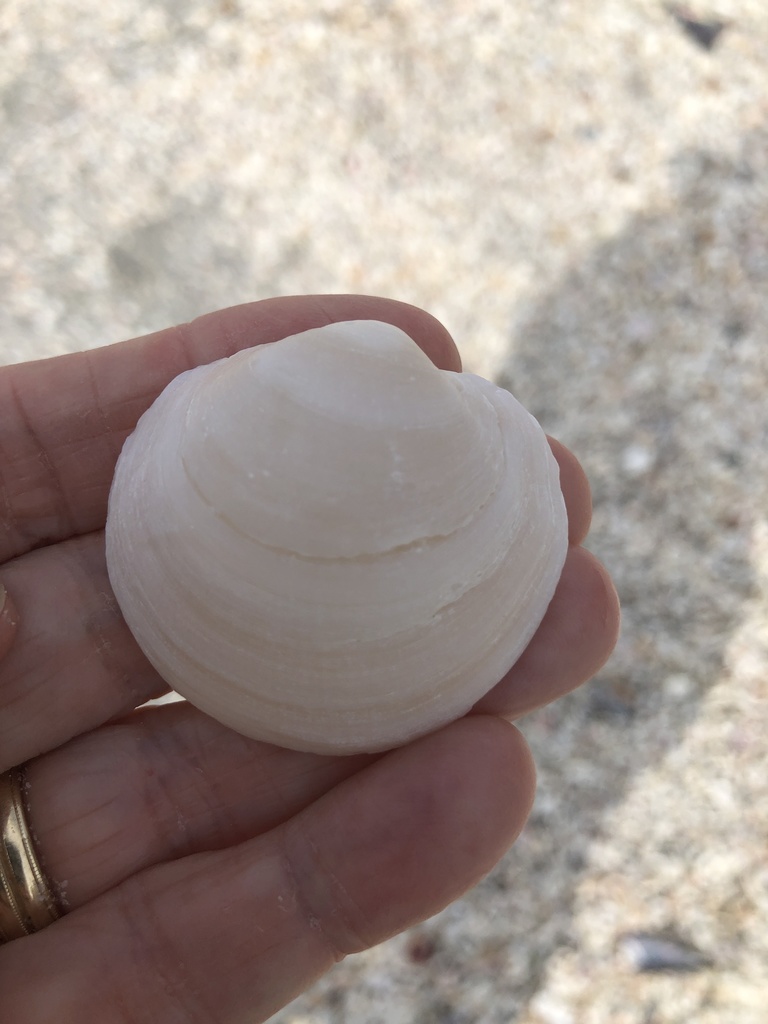
Buttercup Lucine
Anodontia alba
Anodontia alba, or the buttercup lucine, is a species of bivalve mollusc in the family Lucinidae. It can be found along the Atlantic coast of North America, its range extending from North Carolina in the United States to the West Indies.
From the article Anodontia alba on Wikipedia (CC BY-SA), quoted section by section
Description
The buttercup lucine grows to a length of up to 6 centimetres (2.4 in). It has a pair of equal sized, nearly circular, inflated valves joined at a many-toothed hinge. The exterior is smooth and white and is etched with fine concentric lines running parallel with the margin which show the animal's annual growth stages. The interior of the valves is buttercup yellow. When examining an empty valve, the pallial line (formed by the attachment of the mantle muscles) can be seen running parallel with the margin with the two muscle scars nearer the hinge. These show where the strong adductor muscles that held the valves together were attached. The anterior scar (nearer the animal's head) is parallel with the pallial line, a fact that distinguishes this species from the otherwise similar chalky buttercup (Anodontia philippiana).
Range & habitat
The buttercup lucine is found in shallow waters in the western Atlantic and the Caribbean Sea. Its range extends from Bermuda and North Carolina southwards to the Gulf of Mexico and Costa Rica, and eastwards to Barbados. It burrows in soft sediment to depths of 22 cm (9 in) and is found in lagoons, inlets and bays just below low water mark. It tolerates high salinities and seems to prefer fine-grained or muddy sand.
Wikipedia: “Distribution and habitat”
Where it lives
Recorded sightings
—
geo-referenced records in GBIF, from museums, herbaria and field observers.
Drag the globe to turn it. Dots are where records exist, not a range map; darker means more records.
In the stacks
Searching the stacks…
Every page naming Anodontia alba in the Biodiversity Heritage Library →
This page is assembled live from iNaturalist, GBIF, Wikipedia, the Source Library and the Internet Archive. It is not yet part of the hand-edited codex. iNaturalist taxon 208810.