- Plants
- ›Vascular Plants
- ›flowering plants
- ›monocots
- ›Agaves, Orchids, Irises, and Allies
- ›agave and allies
- ›Century plant subfamily
- ›Polianthes
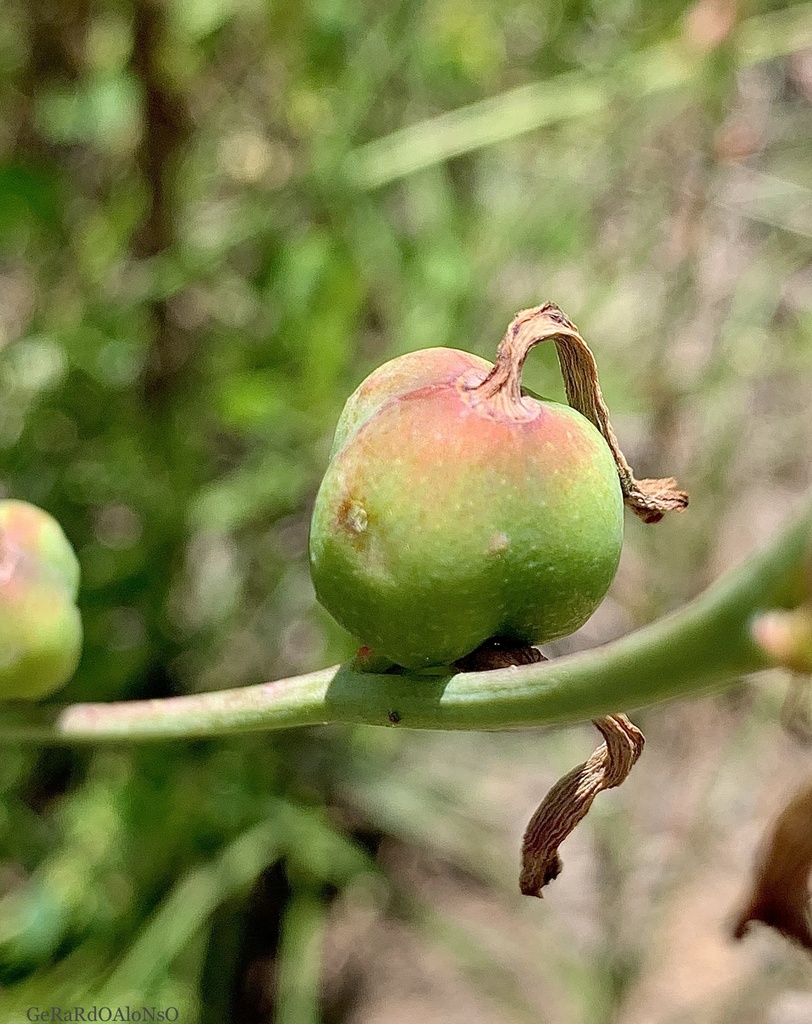
Polianthes geminiflora
Polianthes geminiflora is a species of plant in the Asparagaceae. It is native to central and southern Mexico but sometimes cultivated in other regions as an ornamental.Pacific Bulb Society In the APG III classification system, it is placed in the family Asparagaceae, subfamily Agavoideae (formerly the family Agavaceae).
From the article Agave coetocapnia on Wikipedia (CC BY-SA), quoted section by section
Description
Agave coetocapnia grows from a tuber. The leaves grow mainly as a basal rosette, and have a broad base, tapering to become linear. The flowering stem (scape) is about 30 cm (12 in) tall, and has small leaves which gradually turn into bracts within the inflorescence, which is a terminal raceme. Individual flowers are orange-red in colour, drooping, with six tepals about 32 mm (1.25 in) long. At the base of the raceme, the flowers are borne individually; higher up, a pair of pedicels, each bearing a single flower, emerges from the same three bracts. There are six stamens and a style that protrudes from the flower and is terminated by a three-lobed stigma.
Range & habitat
Agave coetocapnia is native to central Mexico, northeastern Mexico and southwestern Mexico. The original description described its habitat only as "montibus Micciacanis" ('in Mexican mountains'). It has been described as growing in "winter-dry oak forests".
Wikipedia: “Distribution and habitat”
How it is grown
Agave coetocapnia (under several of its synonyms) has been cultivated as an ornamental bulbous plant since before 1853, when it was described as a "beautiful plant", flowering in July, and easy to cultivate in a warm greenhouse in England. It has been grown outside in North Carolina where it has survived temperatures down to about −14 °C (6 °F). It is reported to winter successfully outside in a warm position in southern England. It is recommended that it be kept dry in winter.
== References ==
Wikipedia: “Cultivation”
Where it lives
Recorded sightings
—
geo-referenced records in GBIF, from museums, herbaria and field observers.
Drag the globe to turn it. Dots are where records exist, not a range map; darker means more records.
In the stacks
Searching the stacks…
Every page naming Polianthes geminiflora in the Biodiversity Heritage Library →
This page is assembled live from iNaturalist, GBIF, Wikipedia, the Source Library and the Internet Archive. It is not yet part of the hand-edited codex. iNaturalist taxon 209118.