- Animals
- ›Arthropods
- ›Crustaceans
- ›Typical Crustaceans
- ›Malacostracans
- ›Decapods, Isopods, and allies
- ›Amphipods, Isopods, and Allies
- ›Isopods
- ›Seapills and allies
- ›Seapills
- ›Typical Seapills
- ›Paracerceis
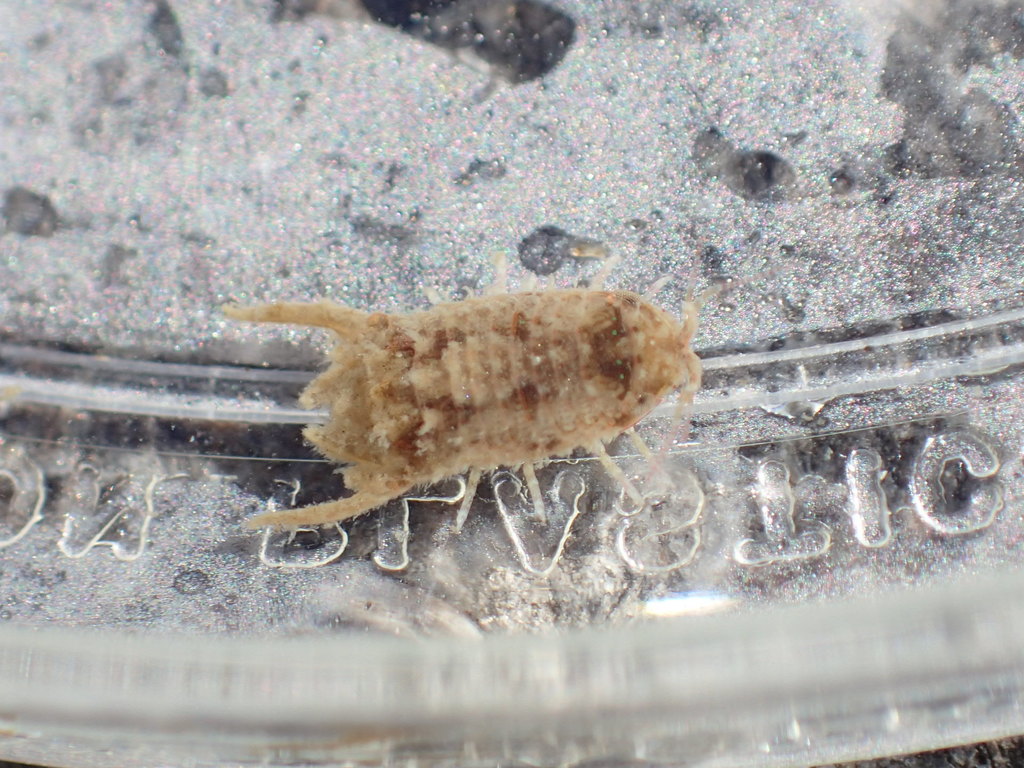
Sponge Isopod
Paracerceis sculpta
Paracerceis sculpta or sponge isopod is a species of marine isopod between 1.3 millimetres (0.05 in) and 10.3 mm (0.41 in) in length. The species lives mainly in the intertidal zone, and is native to the Northeast Pacific from Southern California to Mexico, but has since been introduced to many other countries. Adults are herbivorous and consume algae but juveniles are carnivorous and consume moulting females. They reproduce in sponges but do not feed near them.
From the article Paracerceis sculpta on Wikipedia (CC BY-SA), quoted section by section
What it does
Their reproductive strategy is of interest, as both males and females are unusual among animals. Males are polymorphic and exist in 3 forms, α, β, and γ of different sizes. Of the three, α males are the largest and most dominant; they mate with multiple females in a harem. The β males mimic the females and therefore manage to mate with some of the females in an α male's harem. The γ form is much smaller and mimics the juvenile form, also allowing it to escape detection. Relatively speaking, the γ males invest the most energy in their testes, followed by the β males and the α males. Other species in which alternative reproductive strategies caused by a genetic polymorphism occur are the swordtail (Xiphophorus nigrensis), the tree lizard (Urosaurus ornatus), the ruff (Philomachus pugnax) and the side-blotched lizard (Uta stansburiana). The α males guard a spongocoel into which females (as many as 19) enter to mate. Females brood their offspring internally within a brood pouch and use their bodies to provide nutrition to their developing young before they are released. Females only reproduce once, with larger females producing more eggs. Shortly before females become fertile, they can be cannibalistic. They then undergo a sexual moult, losing their mouthparts in the process. …
Wikipedia: “Reproduction”
Where it lives
Recorded sightings
—
geo-referenced records in GBIF, from museums, herbaria and field observers.
Drag the globe to turn it. Dots are where records exist, not a range map; darker means more records.
In the stacks
Searching the stacks…
Every page naming Paracerceis sculpta in the Biodiversity Heritage Library →
This page is assembled live from iNaturalist, GBIF, Wikipedia, the Source Library and the Internet Archive. It is not yet part of the hand-edited codex. iNaturalist taxon 209127.