- Animals
- ›Arthropods
- ›Hexapods
- ›Insects
- ›Winged and Once-winged Insects
- ›True Bugs, Hoppers, Aphids, and allies
- ›True Bugs
- ›Pentatomomorph Bugs
- ›Stink Bugs, Shield Bugs, and Allies
- ›Plataspidae
- ›Coptosomatinae
- ›Megacopta
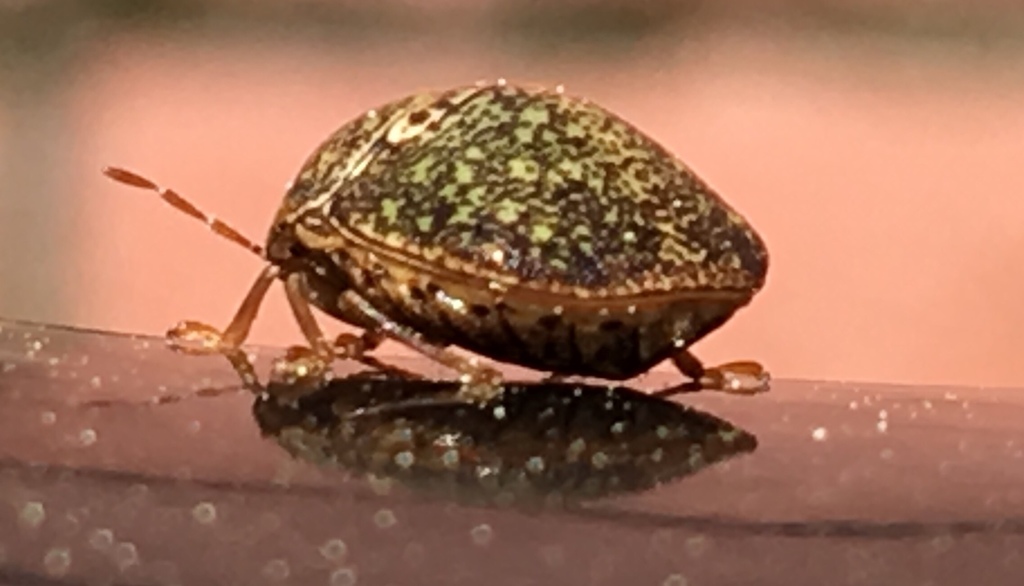
Kudzu Bug
Megacopta cribraria
Megacopta cribraria, also called the bean plataspid, kudzu bug, globular stink bug and lablab bug, is a shield bug native to India and China, where it is an agricultural pest of lablab beans and other legumes. The bug, while harmless to houseplants and people, often enters houses. It is attracted to white surfaces such as the walls of houses or white vehicles, because of the high reflectance of the white surfaces as it relates to the bugs' simple eyes. As a defense mechanism, they emit a foul-smelling pheromone that also acts as a congregation pheromone. Aside from smelling foul, the liquid also creates a burning sensation and sometimes leaves a red welt on bare skin. It is similar to other Plataspidae in having a somewhat unusual symbiotic relationship with its gut bacteria. Before laying eggs, females deposit particles containing the symbiont, which are then eaten by newly hatched nymphs under natural conditions. Nymphs experimentally deprived of access to the symbiont exhibited slower growth, smaller body sizes and higher mortality.
Megacopta punctatissima, the Japanese common stinkbug, is a name applied to Japanese populations of M. cribraria. It has a gut bacteria that allows it to consume crops such as soybean plants. The two used to be treated as distinct species, but phylogenetic work has found the two to be not distinct. What is called M. cribraria in the United States likely descends from a population of "M. punctatissima" from Kyushu, Japan. The Japanese (JA) population is closest to the East Asian continental (EAC) population.
From the article Megacopta cribraria on Wikipedia (CC BY-SA), quoted section by section
Description
Like other plataspid stinkbugs, this bug has a peculiar anatomy where the digestive tract is disconnected midway. The gut is normally organized in nymphs, but the midgut becomes disconnected during development. The anterior midgut is where food digestion occurs and the posterior midgut becomes enlarged as an organ specialized for holding symbiotic bacteria. Waste is excreted through the Malpighian tubules into the hindgut.
Wikipedia: “Anatomy”
What it does
In 2011 in its invasive range in Georgia, M. cribraria's aggregation score - Taylor's Power Law/Taylor's Law b - had an extremely high slope for adults. The badults was 3.27 ± 0.115 and badults > bnymphs > beggs. By the next year - and continuing at least into 2013 - the adult score was much lower and the order was reversed, with beggs > bnymphs > badults.
Hosts. Populations harboring "M. punctatissima"-type microbiomes (Japan; North American invasive) are able to infest Glycine max (soybean) and a few other crop species. North American populations also feed on kudzu, which acts as a major food source and reservoir. Various populations are able to feed on Cajanus cajan (pigeon pea), Vigna unguiculata (cowpea), Lablab purpureus (lablab), Cyamopsis tetragonoloba (guar), and Sesbania bispinosa (danchi).
Microbiome. Females are found by Hosokawa et al. (2008) to produce pellets with their own microbiome species and deposit them near their eggs. Larvae then search for and consume these. If these pellets are absent they will search more than those successfully finding pellets, suggesting that microbiome provision is indeed the purpose of this entire process and this is not accidental. The bugs carry Wolbachia and "Ca. Ishikawella" symbioants. Some also carry Arsenophonus.
Ishikawella. M. …
Wikipedia: “Ecology”
Listen
Looking for field recordings…
Where it lives
Recorded sightings
—
geo-referenced records in GBIF, from museums, herbaria and field observers.
Drag the globe to turn it. Dots are where records exist, not a range map; darker means more records.
In the stacks
Searching the stacks…
Every page naming Megacopta cribraria in the Biodiversity Heritage Library →
This page is assembled live from iNaturalist, GBIF, Wikipedia, the Source Library and the Internet Archive. It is not yet part of the hand-edited codex. iNaturalist taxon 209176.