- Animals
- ›Arthropods
- ›Hexapods
- ›Insects
- ›Winged and Once-winged Insects
- ›Beetles
- ›Water, Rove, Scarab, Long-horned, Leaf, and Snout Beetles
- ›Cucujiform Beetles
- ›Lady, Fungus, Scavenger, and Bark Beetles
- ›Lady Beetles
- ›Common Lady Beetles
- ›Black-spotted Lady Beetles
- ›Paranaemia
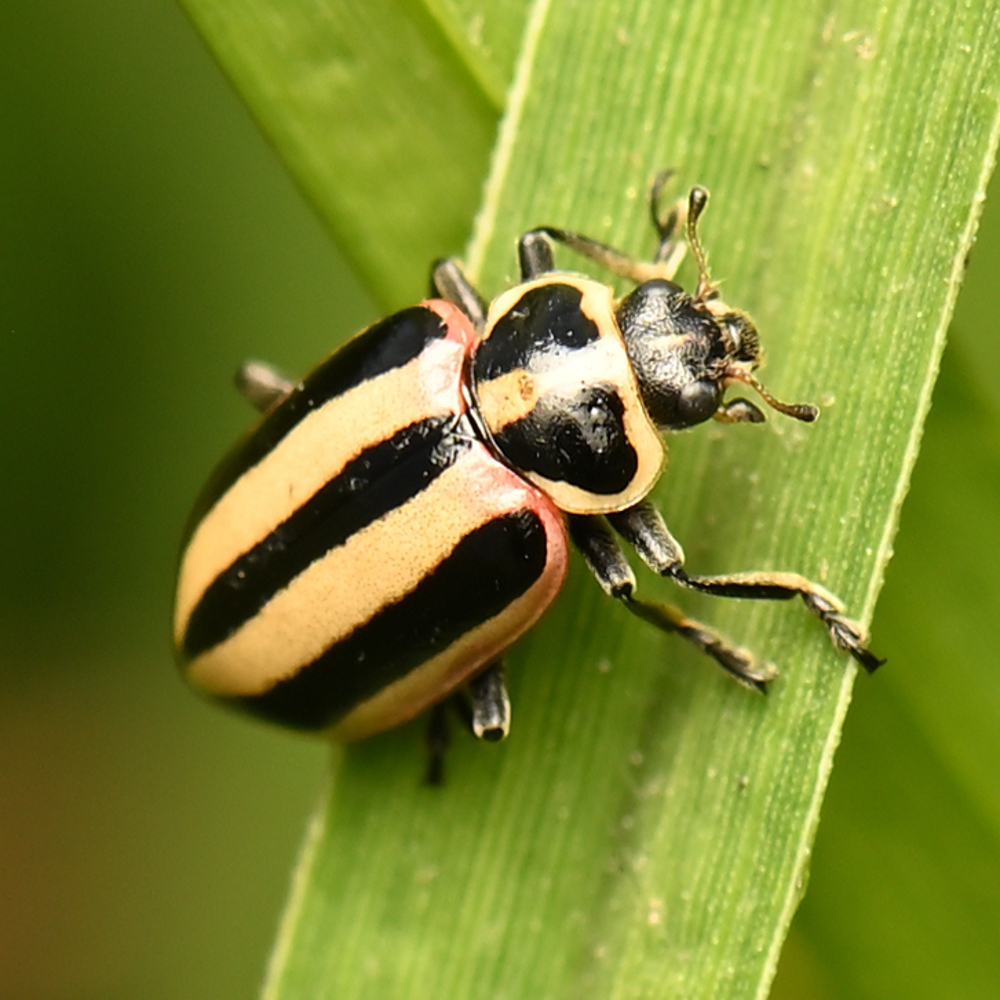
Broad-striped Lady Beetle
Paranaemia vittigera
Paranaemia is a genus of lady beetles in the family Coccinellidae. There is one described species in Paranaemia, P. vittigera, the broad-striped lady beetle. The broad-striped lady beetle is native to western North America. Like other ladybugs, it preys on aphids.
From the article Paranaemia on Wikipedia (CC BY-SA), quoted section by section
Description
Adults have an elongate, dorsoventrally flattened body that reaches a length of about 4.5-6.6 mm. They have elytra that can range from yellow to pink with three black vittae and a black head. The pronotum matches the color of the elytra has two large triangular black spots. An adult's characteristic vittae can result in confusion with Hippodamia and Macronaemia specimens. However, they can be distinguished by their margined pronotal base.
Range & habitat
Its habitat can range from plants near riverbanks, streams, and other wetlands to meadows, grasslands and among agricultural field crops. It has been recorded from Alberta to western Texas, west to British Columbia and California as well as the Mexican states of Michoacán and Guanajuato. In addition to western North America, it has also been introduced to Hawai'i.
Wikipedia: “Habitat and distribution”
What it does
P. vittigera is omnivorous, feeding on plant matter as well as aphids and other soft-bodied insects. However, it has been found in Mexico to be less voracious and a slower forager when compared to other nearby native lady beetle species such as Hippodamia convergens and Cycloneda sanguinea as well as invasive lady beetles like Harmonia axyridis. The adults are known to be parasitized by nematodes of the family Mermithidae and mites of the genus Coccipolipus. They are also known to show strong tendencies of monospecific aggregation.
Wikipedia: “Ecology and behavior”
Listen
Looking for field recordings…
Where it lives
Recorded sightings
—
geo-referenced records in GBIF, from museums, herbaria and field observers.
Drag the globe to turn it. Dots are where records exist, not a range map; darker means more records.
In the stacks
Searching the stacks…
Every page naming Paranaemia vittigera in the Biodiversity Heritage Library →
This page is assembled live from iNaturalist, GBIF, Wikipedia, the Source Library and the Internet Archive. It is not yet part of the hand-edited codex. iNaturalist taxon 209828.