- Plants
- ›Vascular Plants
- ›flowering plants
- ›Dicots
- ›Legumes, Milkworts, and Allies
- ›Legumes
- ›Dialioideae
- ›Dialium
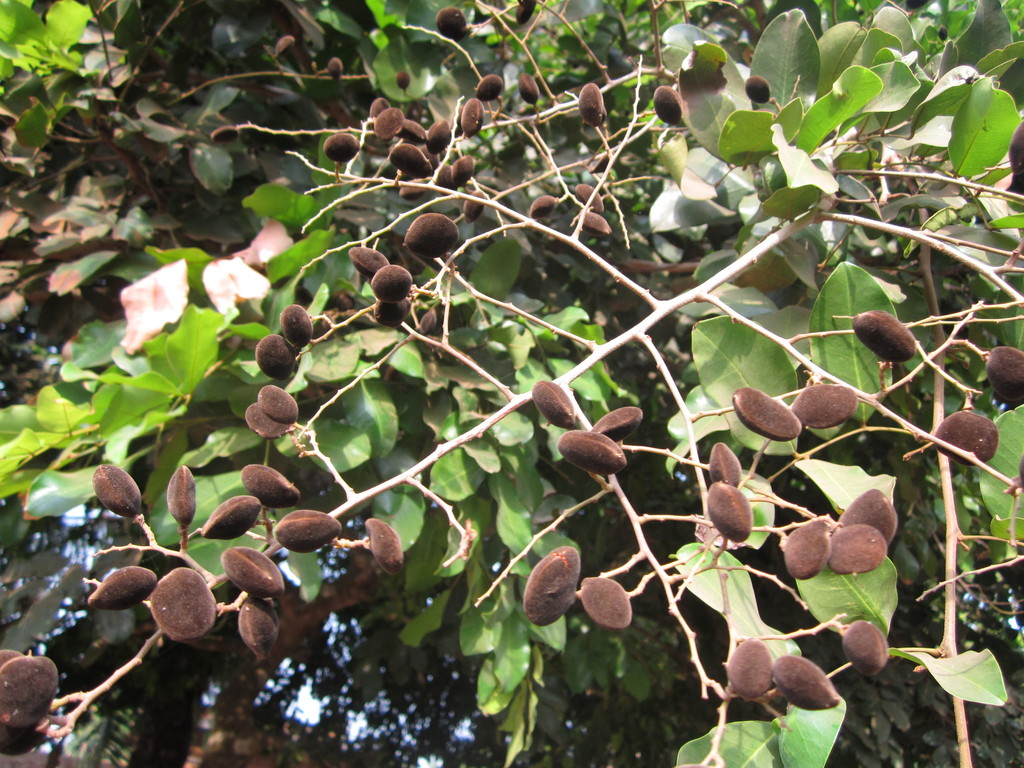
Dialium guineense
Dialium guineense, velvet tamarind, is a tall, tropical, fruit-bearing tree. It belongs to the Leguminosae family, and has small, typically grape-sized edible fruits with brown hard inedible shells.
From the article Dialium guineense on Wikipedia (CC BY-SA), quoted section by section
Range & habitat
Dialium guineense is native to West Africa, from Senegal east to the Democratic Republic of the Congo. It grows in dense forests along the southern edge of the Sahel.
Wikipedia: “Distribution and habitat”
At the table
The bark and leaves have medicinal properties and are used against several diseases. For example, it is a component of the Nigerian mixture Aju Mbaise, and it helps soothe coughs and toothaches.
Fruit. Each fruit typically has one hard, flat, round, brown seed, typically 7–8 mm (0.28–0.31 in) across and 3 mm (0.12 in) thick. The seed somewhat resembles a watermelon seed (Citrullus lanatus). Some have two seeds. The seeds are shiny, coated with a thin layer of starch. The pulp is edible and may be eaten raw or soaked in water and consumed as a beverage. The bitter leaves are ingredients in a Ghanaian dish called domoda.
Timber. Wood is hard and heavy and used for construction. The wood is also used for firewood and charcoal production.
Wikipedia: “Uses”
Where it lives
Recorded sightings
—
geo-referenced records in GBIF, from museums, herbaria and field observers.
Drag the globe to turn it. Dots are where records exist, not a range map; darker means more records.
In the stacks
Searching the stacks…
Every page naming Dialium guineense in the Biodiversity Heritage Library →
This page is assembled live from iNaturalist, GBIF, Wikipedia, the Source Library and the Internet Archive. It is not yet part of the hand-edited codex. iNaturalist taxon 209907.