- Plants
- ›Vascular Plants
- ›flowering plants
- ›monocots
- ›Aroids, Water Plantains, Seagrass, and allies
- ›Arum Family
- ›Lasioideae
- ›Cyrtosperma
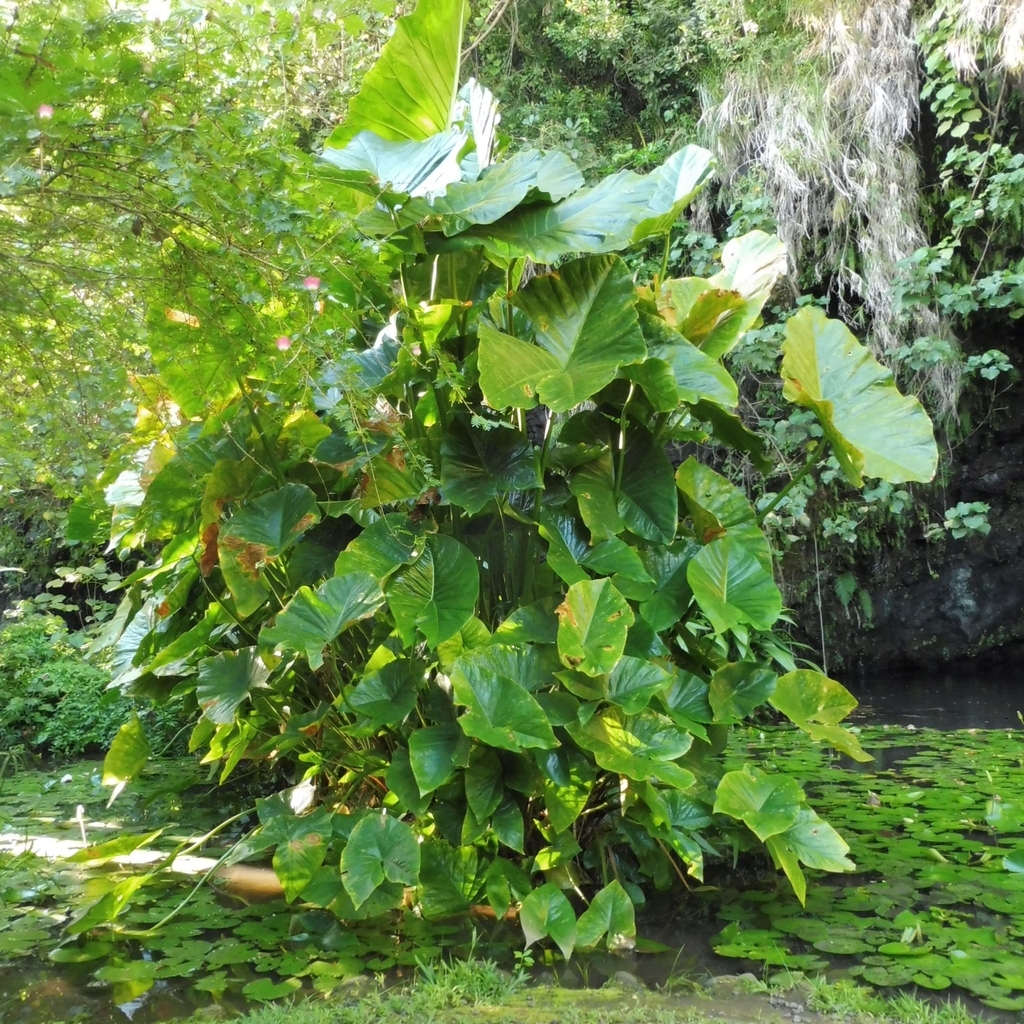
giant swamp taro
Cyrtosperma merkusii
Cyrtosperma merkusii or giant swamp taro, is a crop grown throughout Oceania and into South and Southeast Asia. It is a riverine and "swamp crop" similar to taro, but "with bigger leaves and larger, coarser roots." There are no demonstrably wild populations today, but it is believed to be native to Indonesia. It is known as puraka in Cook Islands, lak in Yap (Federated States of Micronesia), babai in Kiribati, iaraj in the Marshall Islands, brak in Palau, babaʻ in the Marianas Islands, pula’a in Samoa, via kana, Pulaka in Lau, Lovo in Fiji, pulaka in Tokelau and Tuvalu, mwahng in Pohnpei, pasruk in Kosrae, simiden in Chuuk, swam taro in Papua New Guinea, 'kakake' in Solomon Islands, navia in Vanuatu and galyang or palawan in the Philippines.
The same species is also known by the names Cyrtosperma lasioides, Cyrtosperma chamissonis and Cyrtosperma edule.
From the article Cyrtosperma merkusii on Wikipedia (CC BY-SA), quoted section by section
How it is grown
Giant swamp taro is not suitable for growing in upland or rainfed conditions; it has adapted to growth within fresh water and coastal swamps. It exhibits some shade tolerance and is considered mildly tolerant of saline growing conditions compared to other taro species; that is, it can be grown in mildly brackish water. It is a slow growing crop which can take up to 15 years to mature. Giant swamp taro is nearly the only carbohydrate crop that can be cultivated on low-lying coral atolls, where it is grown in purpose-built swamp pits dug to below the level of the freshwater lens. The cultivation of Pulaka in Tuvalu, and of babai in Kiribati, has deep cultural significance. In these harsh environments, its cultivation is increasingly threatened by rising sea levels caused by global warming: the plant does not thrive in brackish water, which rots the roots, turns the leaves yellow, and stunts the plant's growth. Climate change is affecting its cultivation in two ways; more frequent droughts increase the salinity of the freshwater lens, and more extreme high tides and coastal erosion lead to saltwater intrusions where seawater enters the cultivation pits. In the Philippines, giant swamp taro is known as palawan (or palauan), palaw (or palau), or payaw (also applied to Homalomena philippinensis). …
Wikipedia: “Cultivation”
Where it lives
Recorded sightings
—
geo-referenced records in GBIF, from museums, herbaria and field observers.
Drag the globe to turn it. Dots are where records exist, not a range map; darker means more records.
In the stacks
Searching the stacks…
Every page naming Cyrtosperma merkusii in the Biodiversity Heritage Library →
This page is assembled live from iNaturalist, GBIF, Wikipedia, the Source Library and the Internet Archive. It is not yet part of the hand-edited codex. iNaturalist taxon 210278.