- Plants
- ›Vascular Plants
- ›flowering plants
- ›Dicots
- ›Gentians, Dogbanes, Madders, and Allies
- ›madder family
- ›Ixoroideae
- ›Gardenieae
- ›Gardenia
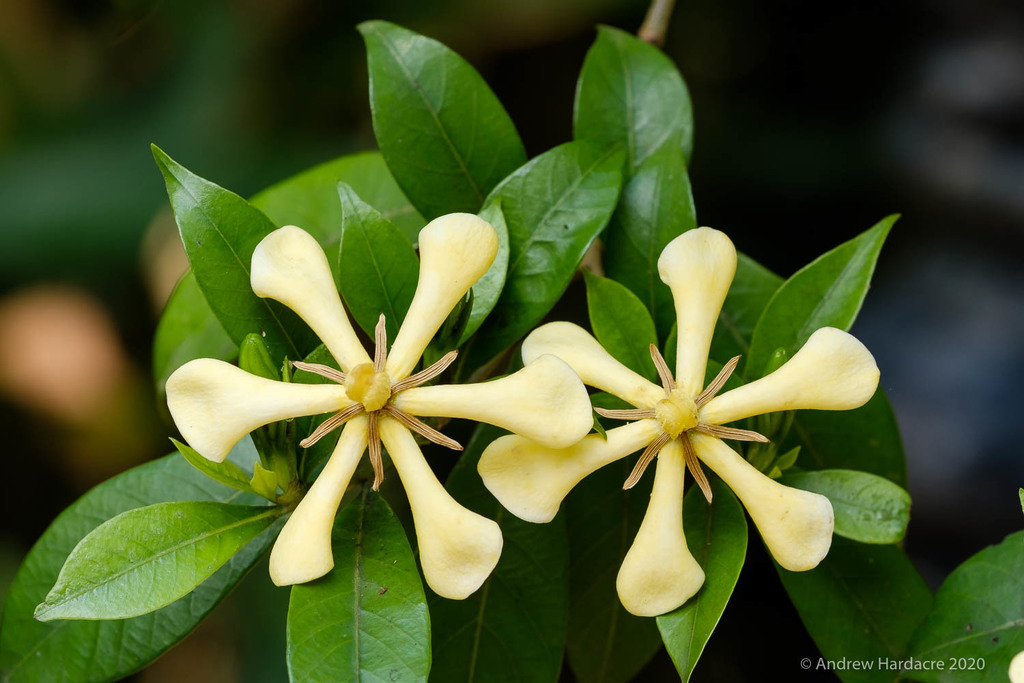
common gardenia
Gardenia jasminoides
Gardenia jasminoides, commonly known as gardenia and cape jasmine, is an evergreen flowering plant in the coffee family Rubiaceae. It is native to the subtropical and northern tropical parts of the Far East. Wild plants range from 30 centimetres to 3 metres (about 1 to 10 feet) in height. They have a rounded habit with very dense branches with opposite leaves that are lanceolate-oblong, leathery or gathered in groups on the same node and by a dark green, shiny and slightly waxy surface and prominent veins.
With its shiny green leaves and heavily fragrant white summer flowers, it is widely used in gardens in tropical, subtropical, and warm temperate climates. It also is used as a houseplant in temperate climates. It has been in cultivation in China for at least a thousand years, and it was introduced to English gardens in the mid-18th century. Many varieties have been bred for horticulture, with low-growing, and large, and long-flowering forms.
From the article Gardenia jasminoides on Wikipedia (CC BY-SA), quoted section by section
Description
Gardenia jasminoides is a shrub that ranges from 30 cm to 3 m (1–10 ft) high in the wild, with cylindrical to flat branches that at first are covered with caducous hairs that fall early, leaving the branch smooth. The leaves are in opposite pairs or rarely in groups of three along the branches. They are either subsessile (almost without a petiole) or on short 0.5–1 centimetre (0.2–0.4 inches) petioles. The leaves themselves are 3–25 cm (1.2–9.8 in) long by 1.5–8 cm (0.6–3.1 in) wide and can be oblong-lanceolate, obovate-oblong, obovate, oblanceolate, or elliptic in shape. Their upper surface is smooth and shiny, or slightly hairy along the primary veins, while the undersurface is sparsely hairy to smooth. Each leaf has 8 to 15 pairs of secondary veins. The flowers are solitary and terminal, arising from the ends of the stems. The white flowers have a matte texture, in contrast to the glossy leaves. They gradually take on a creamy yellow color and a waxy surface. They can be quite large, up to 10 cm (4 in) in diameter, loosely funnel-shaped, and there are double-flowered forms. Blooming in summer and autumn, they are among the most strongly fragrant of all flowers. They are followed by small and oval fruits.
The flowers of jasmine gardenia are all simultaneous hermaphrodites.
Range & habitat
Gardenia jasminoides is native to southern East Asia, mainland Southeast Asia, and northeastern South Asia, including Nepal, Bangladesh, Cambodia, East Himalaya, Hainan, Japan, Laos, mainland China, Taiwan, Thailand and Vietnam, where its native habitat is forest and undergrowth along streams, and on sloping and hilly terrain to an altitude of 1,500 metres (4,900 feet). The species has been introduced to other areas with suitable climate and habitat, including Caroline Islands, Comoros, Korea, Marianas, Marshall Islands, Society Islands and Tubuai Islands.
Wikipedia: “Distribution and habitat”
At the table
Gardenia flowers can be eaten raw, pickled, or preserved in honey. In China, the petals are used in tea for their aroma, while a yellow-red dye used in textiles and sweets has been extracted from the pulp of the fruit. Gardenia jasminoides fructus (fruit) is used in traditional Chinese medicine to "drain fire" and treat certain febrile conditions. It has anti-inflammatory and antipyretic effects. Shishihakuhito is a Chinese herbal medicine mainly composed of gardenia fruit and is used to treat atopic dermatitis. It inhibits Immunoglobulin E (IgE) mediated histamine release. In 2020, a case of someone who had developed blue-gray discoloration of the skin as a result of chronic intake of gardenia fruit extract was published.
Chemistry. As of 2020, at least 162 compounds have been identified in Gardenia jasminoides. The iridoids genipin and geniposidic acid can be found in G. jasminoides fruit. Crocetin, a chemical compound usually obtained from Crocus sativus, also can be obtained from the fruit of Gardenia jasminoides. The fully matured fruit were found to contain crocin in a concentration of 4.5 mg of total crocetin derivatives per gram (dry weight), and can be used as a yellow dye to color clothing and food.
Wikipedia: “Uses”
How it is grown
Evidence of G. jasminoides in cultivation in China dates to the Song dynasty (960–1279 AD), where both single- and double-flowered forms have been depicted in paintings, such as those of the Song emperor Huizong, and the tenth-century artist Xu Xi. The Yuan dynasty (1271–1368) saw it on lacquerware, and the Ming dynasty on porcelain (1368–1644). Called zhi-zi in traditional Chinese medicine, it was a folk remedy for jaundice, oedema and fevers. English statesman Sir John Barrow saw gardenias in nurseries in Guangzhou, China, in 1794. G. jasminoides came to Europe via the Cape Colony in southern Africa, which had been founded in 1652 as a way-station between the Netherlands and Asia. There, Daniel Des Marets, Superintendent of the Dutch estates of William III, collected material that ended up in the herbarium of English naturalist Hans Sloane in the 1680s. Swedish naturalist Daniel Solander reported that the living species was brought to the United Kingdom (UK) from the Cape Colony in 1744 on the British East India Ship Godolphin by Captain William Hutchenson, who gave it to botanist Richard Warner of Woodford Row, Essex. The plant reportedly remained in flower for much of voyage. Warner, however, was unable to propagate it until the botanist John Ellis recommended James Gordon, a gardener at Mile End. Gordon was successful in August 1757, and plants sold well thereafter. …
Wikipedia: “Cultivation”
In human culture
Giving reference to Meitei King Khagemba and the Manipur Kingdom, the beauty and grace of Lei Kabok, also called Kabok Lei (Gardenia jasminoides), is described by Meitei King Charairongba, in his literary work, "Leiron" (Meitei: ꯂꯩꯔꯣꯟ) which is an account on the description of 100 flowers and orchids, endemic as well as exotic species in Kangleipak, as follows:
It is a flower that remains ever fresh as not eaten by worms and is fondly sought after in the four corners of the country, eight directions, nay in all quarters. It is distinct for its beautiful shape, its tender stalk and for its pure white colour. It is a flower once nurtured by King Khagemba who preferred to take it with him even for his long home. It is a flower that comes handy to both boys and girls as a present of love. Such a luscious flower has blossomed forth in an unending array of white and definitely the season is of this flower.
Wikipedia: “Meitei culture”
Where it lives
Recorded sightings
—
geo-referenced records in GBIF, from museums, herbaria and field observers.
Drag the globe to turn it. Dots are where records exist, not a range map; darker means more records.
In the old herbals & bestiaries


In the stacks
Searching the stacks…
Every page naming Gardenia jasminoides in the Biodiversity Heritage Library →
This page is assembled live from iNaturalist, GBIF, Wikipedia, the Source Library and the Internet Archive. It is not yet part of the hand-edited codex. iNaturalist taxon 210990.