On eBird ↗
Bogota Rail
Live sightings near you, the range map, bar charts of when it is seen, and Macaulay Library photos and recordings.
Bogotá Rail
Rallus semiplumbeus
The Bogotá rail (Rallus semiplumbeus) is a Vulnerable species of bird in subfamily Rallinae of family Rallidae, the rails, gallinules, and coots. It is endemic to Colombia. The bird is a typical medium-sized rail with a plump body that is laterally compressed ("skinny as a rail"), a short tail and an elongated bill.
From the article Bogotá rail on Wikipedia (CC BY-SA), quoted section by section
Description
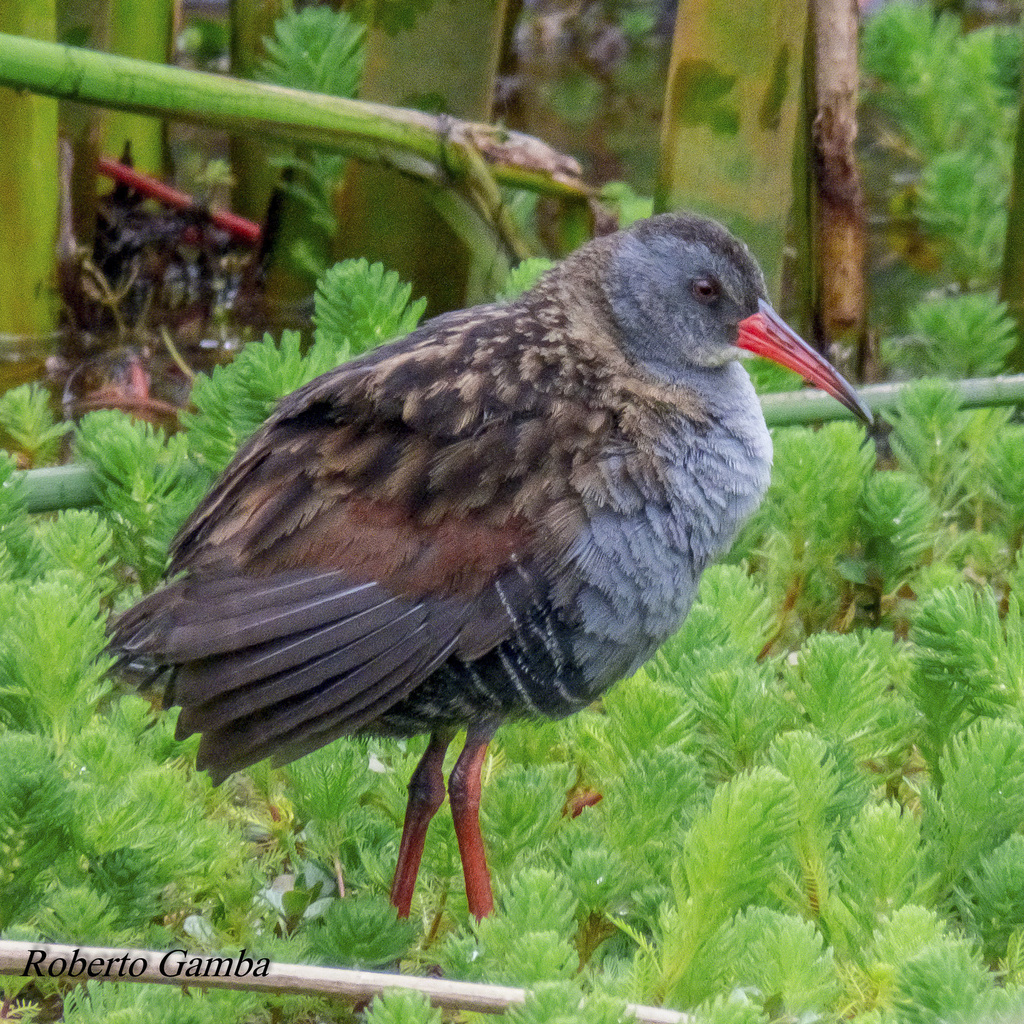
The Bogotá rail is a typical member of the genus Rallus, with a long and slightly decurved bill, a plump body, and a short tail. It is 25 to 30 cm (9.8 to 12 in) long. Its bill is dull red, shading to dusky black on the culmen and tip. Its eyes are red with a black pupil, and its legs are dull coral red. The sexes are alike. Adults have a sepia brown crown and nape and plumbeous gray face, breast, and belly. Their back, tertials, secondaries, and the upper side of the tail are dull brown, with black streaks on the back. Their primaries are black with chestnut fringing, and a rufous patch is usually evident on the wing coverts. The rear parts of their flanks are black with fine white vertical barring and their undertail coverts are white. There is a small patch of white on the throat just below the bill. Juveniles are similar to adults with the addition of sooty tips on the breast feathers and a whitish throat.
Range & habitat
The Bogotá rail is a scarce species endemic to the departments of Cundinamarca and Boyacá in the Eastern Andes of Colombia. It inhabits wetlands, ponds, and wet meadows on montane slopes and in the páramo, at elevations ranging from 2,000 to 4,100 m (6,600 to 13,500 ft) meters. The species is typically found in dense reedbeds dominated by the sedge Schoenoplectus californicus, but also including emergent vegetation such as Juncus effusus, Polygonum punctatum, Rumex obtusifolius, Bidens laevis, Hydrocotyle ranunculoides, and Carex acutata. Reedbeds bordered by dwarf Chusquea bamboo or other dense vegetation seem to be favored. A study of Bogotá rails in the wetland of La Conejera found that they spent on average 84% of their time within this type of habitat. The birds were also observed in wet grasslands, although it seems that they mainly ventured into this more open (and predator-friendly) habitat while moving between patches of wetland. They were only occasionally seen on floating vegetation.
Wikipedia: “Distribution and habitat”
What it does
The Bogotá rail forages mostly at dawn and dusk. It seeks prey at the edges of reedbeds and marshes, in flooded grassy areas, in shallow water with floating plants, and among waterlogged dead vegetation. Its diet is principally aquatic invertebrates including insect larvae, and also includes worms, molluscs, amphibians, and plant material.
Wikipedia: “Feeding”
Listen
Looking for field recordings…
Where it lives
Recorded sightings
—
geo-referenced records in GBIF, from museums, herbaria and field observers.
Drag the globe to turn it. Dots are where records exist, not a range map; darker means more records.
In the stacks
Searching the stacks…
Every page naming Rallus semiplumbeus in the Biodiversity Heritage Library →
This page is assembled live from iNaturalist, GBIF, Wikipedia, the Source Library and the Internet Archive. It is not yet part of the hand-edited codex. iNaturalist taxon 213.