- Animals
- ›Arthropods
- ›Hexapods
- ›Insects
- ›Winged and Once-winged Insects
- ›Beetles
- ›Water, Rove, Scarab, Long-horned, Leaf, and Snout Beetles
- ›Cucujiform Beetles
- ›Darkling Beetles and Allies
- ›Ant-like Flower Beetles
- ›Anthicinae
- ›Anthicini
- ›Amblyderus
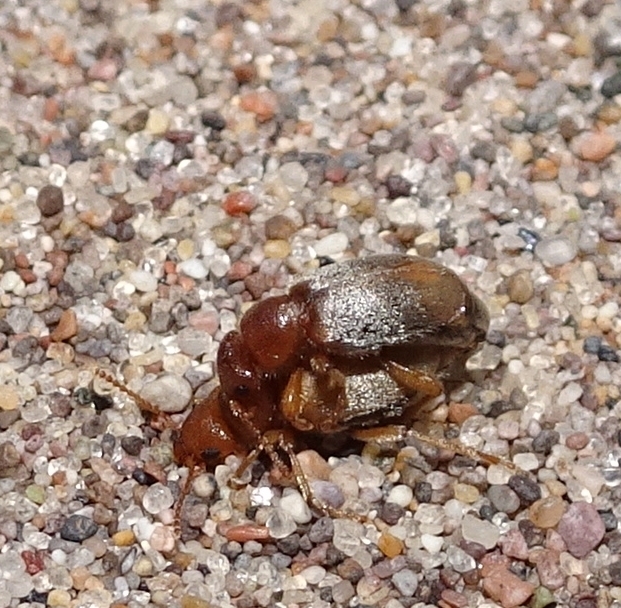
Amblyderus triplehorni
Amblyderus triplehorni is a species of ant-like flower beetle in the family Anthicidae. It is an endemic species that is only found in the Great Sand Dunes National Monument, Colorado, USA, and in the nearby sand dune habitats in Alamosa and Saguache Counties. This species is also sometimes referred to as Triplehorn's Ant-like Flower Beetle. Amblyderus triplehorni is a small flightless beetle that inhabits barren dunes and is considered critically imperiled in Colorado by NatureServe.
From the article Amblyderus triplehorni on Wikipedia (CC BY-SA), quoted section by section
Description
Amblyderus triplehorni is the largest North American Amblyderus species with its length ranging from 4.5 to 6.1 mm. This light yellowish brown beetle varies in colour from yellow to orange-brown, with males typically darker than the females. It can also have a large brown blotch centered on each elytron occasionally. For the males, generally most of the head, pronotum, and abdomen are dark, with the anterior margins of these parts being lighter coloured. The ventral abdomen is the darkest. The antennae, legs, anterior portion of the head, and ventral region of the prothorax are the lightest coloured. The hairs are white to silvery. For the females, they are a lighter colour overall. Usually the head has a uniform colour and the central thorax is light coloured, which differs from the males.
Technical description. The head is triangular, wider than it is long. Its eyes are large, black, and oval. The head is light brown anteriorly and dark brown posteriorly. Generally the surface of the head integument is coarsely tuberculate over entire disc with the exception of the median smooth line. The antennae are almost double the length of the head, with the last antennomere conical and pubescent on distal 2/3. The prothorax is wider than the base of the head, and tapers evenly to base. The width of the prothorax at the base is approximately 2/3 the width of the prothorax apex. …
Range & habitat
Amblyderus triplehorni is a sand dune specialist, preferring to inhabit the most barren dunes. This species can usually be observed on high bare dune ridges, especially in windswept debris pockets.
Wikipedia: “Habitat”
What it does
Adults are scavengers that feed on dead insects. They forage in the evenings near the dune crest or in debris pockets further down the dunes. Debris pockets trap small dead insects, such as aphids and cicadellids that the adults feed on. When the wind is calm, the adults travel quickly in a circuitous pattern in search of food. When there are strong gusts of wind, they lie flat against the sand to prevent being picked up by the wind. Two feeding methods are known. The first method uses their middle and hind legs to anchor themselves to the ground and their forelegs and palps to manipulate their food. The second method is to feed while on its back and use all six legs to manipulate the food. Occasionally, these beetles hold their food with their mouths and forelegs, and travel erratically. The adults are most active in early summer, but have been detected up to September.
Wikipedia: “Behaviour”
In human culture
Amblyderus triplehorni was named after Charles A. Triplehorn due to his work with W.A. and B.W. Triplehorn that collected the type specimens in 1974 in Great Sand Dunes National Monument.
== References ==
Wikipedia: “Etymology”
Listen
Looking for field recordings…
Where it lives
Recorded sightings
—
geo-referenced records in GBIF, from museums, herbaria and field observers.
Drag the globe to turn it. Dots are where records exist, not a range map; darker means more records.
In the stacks
Searching the stacks…
Every page naming Amblyderus triplehorni in the Biodiversity Heritage Library →
This page is assembled live from iNaturalist, GBIF, Wikipedia, the Source Library and the Internet Archive. It is not yet part of the hand-edited codex. iNaturalist taxon 213327.