- Animals
- ›Arthropods
- ›Hexapods
- ›Insects
- ›Winged and Once-winged Insects
- ›Beetles
- ›Water, Rove, Scarab, Long-horned, Leaf, and Snout Beetles
- ›Cucujiform Beetles
- ›Darkling Beetles and Allies
- ›Ant-like Flower Beetles
- ›Anthicinae
- ›Anthicini
- ›Amblyderus
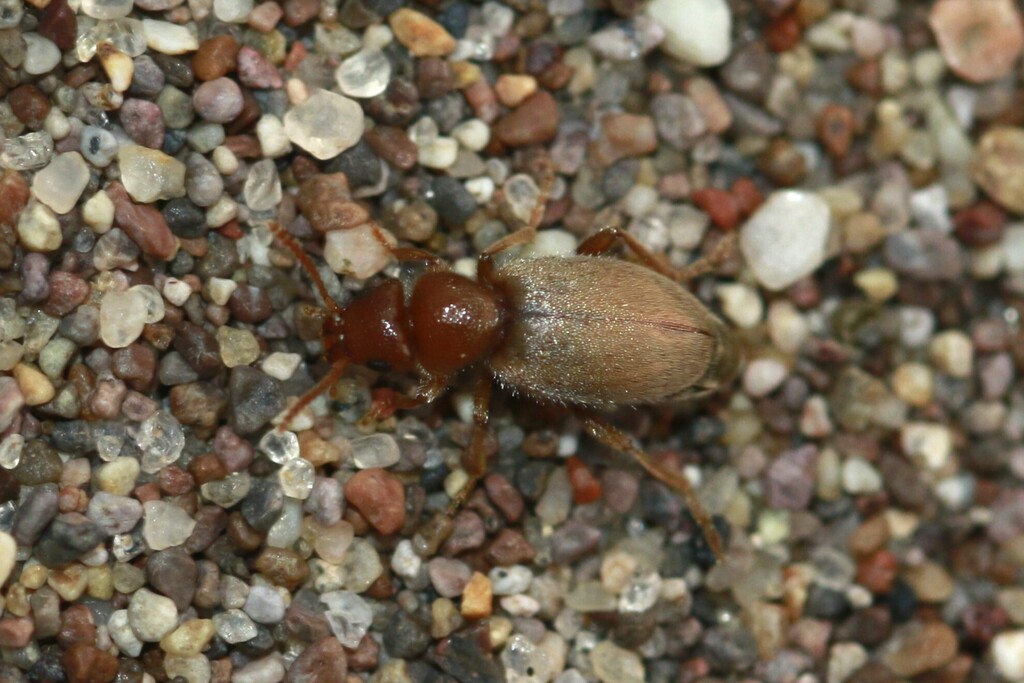
Amblyderus werneri
Amblyderus werneri is a species of ant-like flower beetle in the family Anthicidae. It is an endemic beetle of Colorado, USA, that is only known from the Great Sand Dunes National Monument and in the nearby sand dune habitats in Alamosa and Saguache Counties. Common names for A. werneri are Werner's ant-like flower beetle and the Great Sand Dunes anthicid beetle. A. werneri is a small light yellow-brown to orange flightless beetle that inhabits dune habitats and is considered critically imperiled by NatureServe and "Under Conserved" by the Colorado Natural Heritage Program from Colorado State University. They are scavengers that feed on dead insects. They forage in debris pockets among the sand dunes and often allow the wind to blow them into these debris-filled depressions.
From the article Amblyderus werneri on Wikipedia (CC BY-SA), quoted section by section
Description
Adults of the species are from 3.0 to 3.9 mm (0.12 to 0.15 in) in length. They are yellowish brown to orange and tend to be consistent in their colouration. The head is triangular, and almost twice as wide as it is long. The eyes are large and oval. The head is a light yellowish brown to orange colour, with the posterior section of the head sometimes darker. The integument is indistinctly tuberculate over entire disc, with the exception of the median smooth line. The antenna is almost double the length of the head. The prothorax is only marginally wider than the base of the head. The prothorax tapers posteriorly, with the base approximately half the width of the apex. The basal portion of the prothorax is cylindrical. The pronotum disc is tuberculated, with each tubercle having a matching puncture and decumbent seta posterior to it. The anterior section of the prothorax is finely tuberculate and is covered in white to silvery erect hairs that extends towards the heads on the dorsal surface. On the prosternum, there are longer hairs that extend laterally and ventrally. Overall, the prothorax is light yellowsish brown. The elytra is suboval, with the length of the elytra almost double the size of its width. The width of the elytra is approximately 1/3 wider than the base part of the prothorax. …
Range & habitat
A. werneri thus far has only been observed in Great Sand Dunes National Monument and in the surrounding counties, Alamosa and Saguache, in similar dune habitats in Colorado, USA.
Wikipedia: “Distribution”
In human culture
A. werneri was named after Floyd G. Werner, an entomologist that dedicated much of his efforts on the Anthicidae beetles and first discovered that this species was undescribed by science.
Wikipedia: “Etymology”
Listen
Looking for field recordings…
Where it lives
Recorded sightings
—
geo-referenced records in GBIF, from museums, herbaria and field observers.
Drag the globe to turn it. Dots are where records exist, not a range map; darker means more records.
In the stacks
Searching the stacks…
Every page naming Amblyderus werneri in the Biodiversity Heritage Library →
This page is assembled live from iNaturalist, GBIF, Wikipedia, the Source Library and the Internet Archive. It is not yet part of the hand-edited codex. iNaturalist taxon 213328.