- Animals
- ›Molluscs
- ›Bivalves
- ›Autobranchia
- ›Pteriomorphia
- ›Scallops and Allies
- ›Pectinoidea
- ›Scallops
- ›Pectininae
- ›Aequipectinini
- ›Argopecten
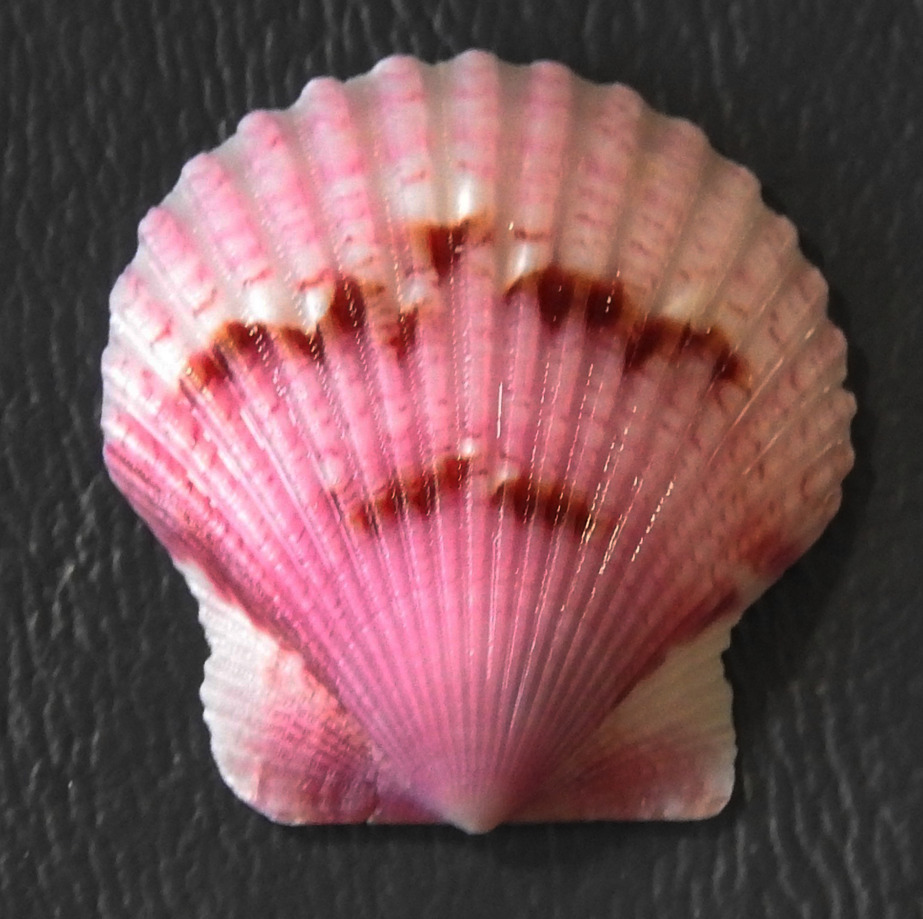
Atlantic Calico Scallop
Argopecten gibbus
Argopecten gibbus, the Atlantic calico scallop, is a species of medium-sized edible marine bivalve mollusk in the family Pectinidae, the scallops.
This species was once the basis of an important fishery, but in recent years catches have been low.
From the article Argopecten gibbus on Wikipedia (CC BY-SA), quoted section by section
Description
This species grows up to three inches in maximum width, and is similar in shape and sculpturing to the Atlantic bay scallop. Both valves of the shell are cupped. The shell near the hinge is extended into "ears", as is the case in all scallops. The shell of the Atlantic calico scallop has about 20 radial ribs, which are sometimes roughened by growth lines. The exterior coloration of the upper (left) valve of this species is most typically a mottled pattern of purple on a cream background. The lower (right) valve of this scallop is usually whitish with small reddish or purple spotting on the sides. The interior of the shell is white, often with some beige coloration on the "ears" and top edge. The eye-catching color of the shell of this species gave rise to its popular name; in the US, "calico" was for many years an inexpensive but colorful fabric printed with small flower patterns. The name is no longer in practice within the US.
Range & habitat
The Atlantic calico scallop ranges from Delaware to Brazil, and is still sometimes fished commercially. It is not found in bays; instead it lives in open water up to 100-foot depths. The shells are commonly found washed up on ocean beaches. Valve color and shell morphometry distinguish calico scallops from related species. In the Indian River Lagoon in Florida, two other scallops occur: the bay scallop, (Argopecten irradians), which generally has a uniform gray to gray-brown coloration with distinct convexity of the right (lower) valve. The other is the rough scallop, (Aequipecten muscosus), which has unequal 'ears' and has sharp scales on the lower surface of the ribs. The color of the rough scallop is yellow, orange, red or brownish.
Wikipedia: “Habitat”
Where it lives
Recorded sightings
—
geo-referenced records in GBIF, from museums, herbaria and field observers.
Drag the globe to turn it. Dots are where records exist, not a range map; darker means more records.
In the stacks
Searching the stacks…
Every page naming Argopecten gibbus in the Biodiversity Heritage Library →
This page is assembled live from iNaturalist, GBIF, Wikipedia, the Source Library and the Internet Archive. It is not yet part of the hand-edited codex. iNaturalist taxon 214128.