On eBird ↗
Austral Rail
Live sightings near you, the range map, bar charts of when it is seen, and Macaulay Library photos and recordings.
Austral Rail
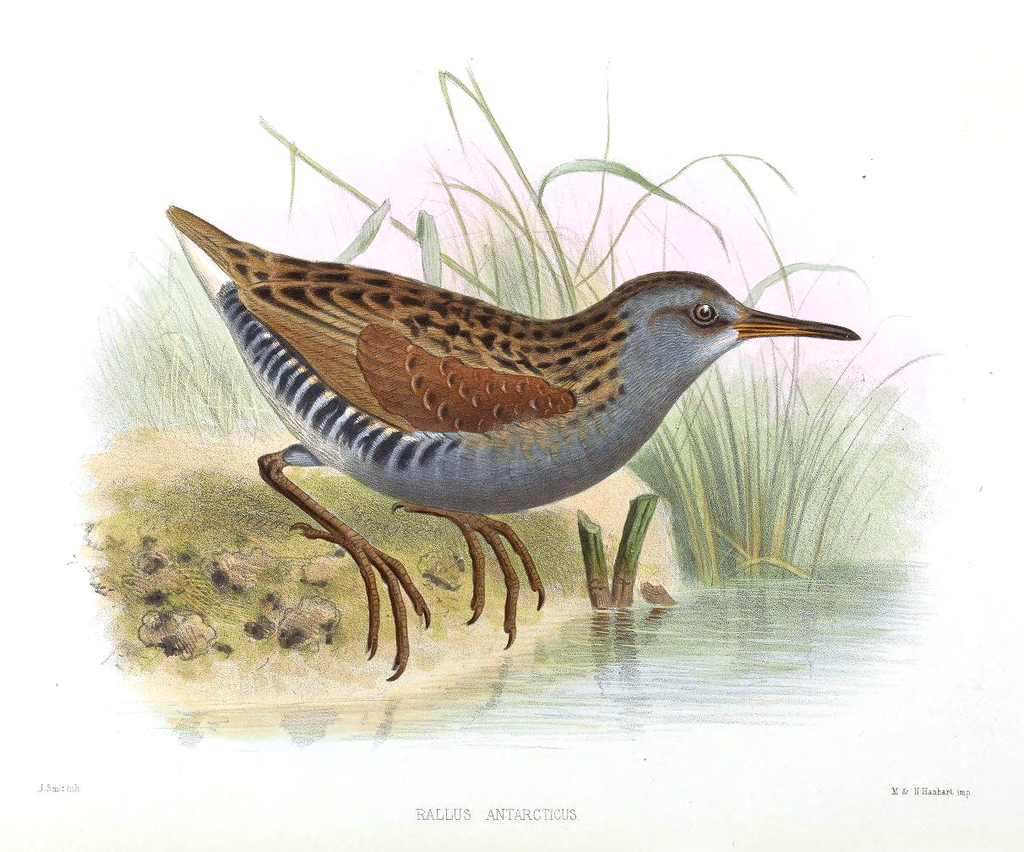
Rallus antarcticus
The austral rail (Rallus antarcticus) is a species of bird in the family Rallidae. It is found in Argentina and Chile. Its natural habitats are swamps, freshwater lakes, and freshwater marshes. It is threatened by habitat loss caused by the development of intensive agriculture.
From the article Austral rail on Wikipedia (CC BY-SA), quoted section by section
Description
The austral rail is about 20 cm (7.9 in) long. Adults have dull brown upperparts with buff-edged black centers to the back feathers. Their face and throat are gray, their breast olive brown, and their flanks barred with black and white. Juveniles are similar with the addition of sooty tips on the breast feathers and a white throat.
Range & habitat
The austral rail is patchily distributed in southern Chile's Magallanes Region and in southern Argentina between the departments of Río Negro and Santa Cruz. It formerly occurred as far north as Santiago, Chile, and Buenos Aires, Argentina. It has also been recorded as a vagrant on the Falkland Islands. It is found mostly near the coast where it inhabits wet fields and meadows, rushy lake shores, and reedbeds.
Wikipedia: “Distribution and habitat”
What it does
Little is known about the austral rail's foraging behavior and diet. Both are assumed to be similar to that of the Ecuadorian rail (R. aequatorialis), which has an eclectic diet.
Wikipedia: “Feeding”
Listen
Looking for field recordings…
Where it lives
Recorded sightings
—
geo-referenced records in GBIF, from museums, herbaria and field observers.
Drag the globe to turn it. Dots are where records exist, not a range map; darker means more records.
In the stacks
Searching the stacks…
Every page naming Rallus antarcticus in the Biodiversity Heritage Library →
This page is assembled live from iNaturalist, GBIF, Wikipedia, the Source Library and the Internet Archive. It is not yet part of the hand-edited codex. iNaturalist taxon 216.