- Fungi Including Lichens
- ›Ascomycete Fungi
- ›Sac Fungi and Lichens
- ›Common Lichens
- ›Shield Lichens, Sunburst Lichens, Rosette Lichens, and Allies
- ›shield lichens, rim lichens, and allies
- ›spindles and structured lichens
- ›Cladonia
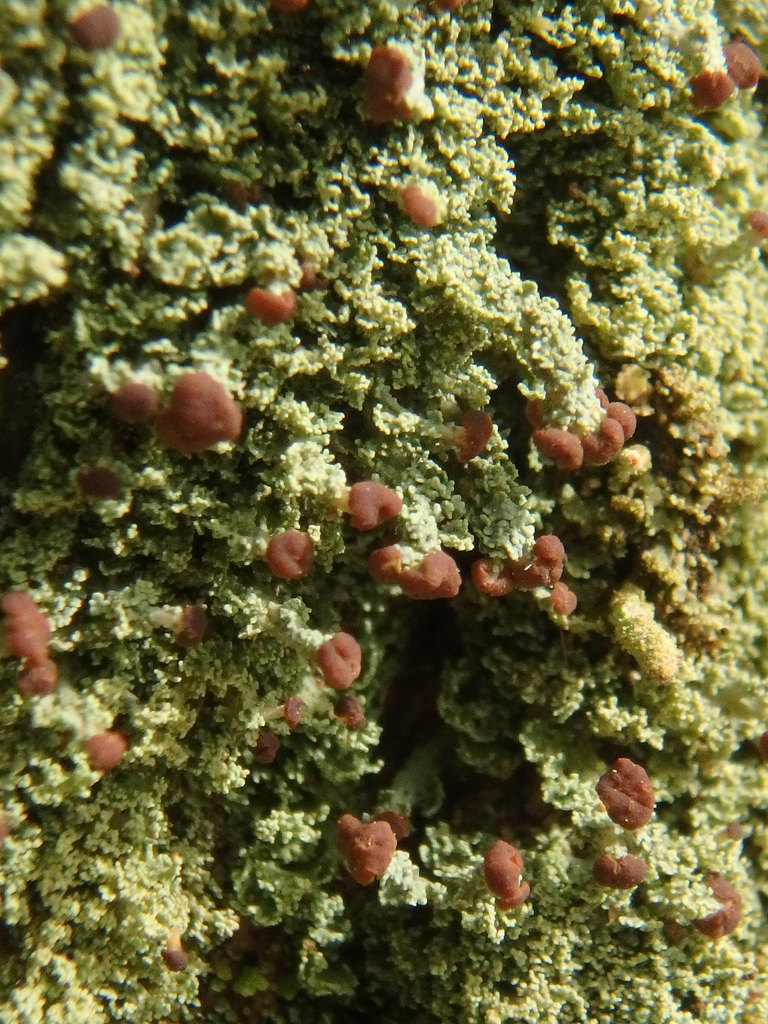
Fence-rail Cladonia
Cladonia parasitica
Cladonia parasitica, commonly known as the fence-rail cladonia, fence-rail cup lichen or parasite club lichen, is a species of fruticose, cup lichen in the family Cladoniaceae. It was first described by Hoffmann in 1784 under the name Lichen parasiticus, until he reclassified it under the genus Cladonia in 1795.
From the article Cladonia parasitica on Wikipedia (CC BY-SA), quoted section by section
Description
Cladonia parasitica mainly grows on old oak and pine wood. The thallus is brown or grey. The squamules are minutely divided and look like coral or small scales. When apothecia are present they take the form of small brown morel-like protrusions atop the branches. The species is found in North America and Eurasia in the boreal, boreal-nemoral, and nemoral regions. Cladonia parasitica is considered a red-listed species in Sweden, categorized as (Near Threatened). It is used as a signal species, indicating high-value old-growth forest. Its secondary metabolites include barbatic acid, decarboxythamnolic acid and thamnolic acid.
Where it lives
Recorded sightings
—
geo-referenced records in GBIF, from museums, herbaria and field observers.
Drag the globe to turn it. Dots are where records exist, not a range map; darker means more records.
In the stacks
Searching the stacks…
Every page naming Cladonia parasitica in the Biodiversity Heritage Library →
This page is assembled live from iNaturalist, GBIF, Wikipedia, the Source Library and the Internet Archive. It is not yet part of the hand-edited codex. iNaturalist taxon 217132.