- Animals
- ›Arthropods
- ›Hexapods
- ›Insects
- ›Winged and Once-winged Insects
- ›Beetles
- ›Water, Rove, Scarab, Long-horned, Leaf, and Snout Beetles
- ›Cucujiform Beetles
- ›Cucujoidea
- ›Pleasing Fungus Beetles
- ›Erotylinae
- ›Dacnini
- ›Dacne
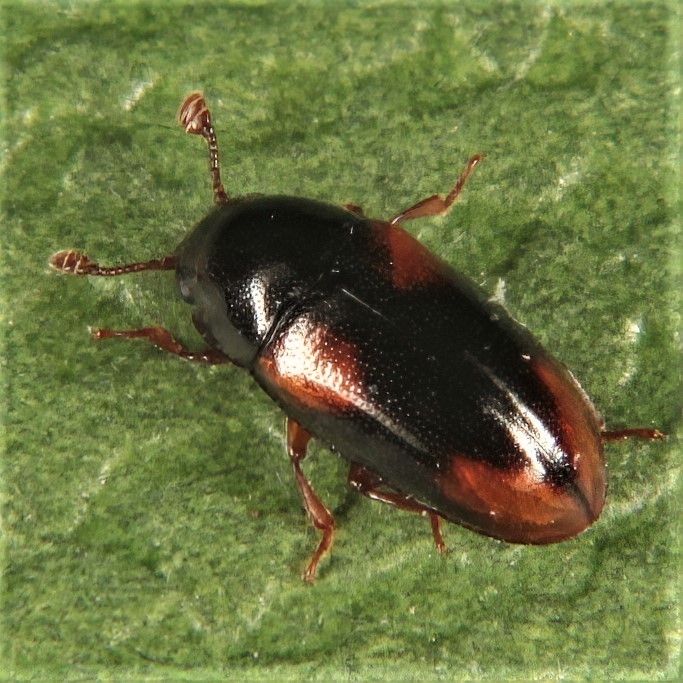
Dacne quadrimaculata
Dacne quadrimaculata is a tiny North American species of pleasing fungus beetle (family Erotylidae). It is placed in subfamily Dacninae, or – in taxonomic arrangements that prefer a more comprehensive subfamily Erotylinae – in tribe Dacnini of the Erotylinae.
This is one of the two Nearctic Dacne remaining in the genus, after most others have been split into distinct genera, the Beringian Xenodacne and the Neotropical Ameridacne. It occurs in the east and center of the continent, while the other species (D.californica) is found in the west. However, they do not seem to be sister species.
From the article Dacne quadrimaculata on Wikipedia (CC BY-SA), quoted section by section
Description
About 2.4-3.5 mm long and 1.1-1.7 mm wide as adults, this beetle is one of the smallest Erotylidae within its range. Pill-shaped and strongly shiny, the adults' coloration is brownish-black overall, with a round reddish spot near the base and another more elongated one at the tip of each elytron; these spots are the origin of its scientific name quadrimaculata, meaning "four-spotted" in Latin. The epistome, legs and antennae, and at least the tip and sides if not the entire abdomen are also reddish. After emerging from the pupa, these beetles are (as usual) lighter, and it seems that it takes rather long for this species' chitin to harden to its final dark color. Like most of its close relatives, D.quadrimaculata has elytra which bear a mass of small pits vaguely arranged in lengthwise rows, and has a prothorax base that is almost as wide as the "shoulders"; unlike in the other "true" Dacne of North America, D.californica, the forward edge of its prothorax is considerably more narrow than the base however. Unlike in the beetles now moved out of Dacne, the forward margin of the pronotum bulges to form a "hood" which covers the base of the head up to the forward half of the compound eyes. …
Range & habitat
D.quadrimaculata is essentially restricted to North America east of the 100th meridian west. It is found from Nova Scotia and Québec in Canada and Maine in the USA west to Manitoba, and in the south from North Carolina to Nebraska and Texas. For unclear reasons, it seems to be scarce or entirely absent from Gulf of Mexico coast region. In the north it ranges at least to Kentville, Nova Scotia, Casco, Maine, Potton Springs, Quebec, Ottawa, Ontario, and Winnipeg, Manitoba. Westward, it has been recorded at Itasca State Park in Minnesota, Child's Point bluff in Mount Vernon Gardens (13th Street, Omaha, Nebraska), in Topeka, Kansas, and Austin, Texas. The latter place is also one of its most southernly records, together with the settlement of Retreat at the lower West Fork Pigeon River, Haywood County, North Carolina, and Cheaha State Park in Alabama. The type specimen, like many beetles collected by Thomas Say, is probably lost; its type locality was not given more precisely than "North America". Adults are most commonly encountered in the warm months; unlike many other pleasing fungus beetles which are conspicuously more common in the summer, D.quadrimaculata is regularly encountered from mid-April, such as on an April 18 in Toronto, Ontario, near the northeastern end of its range. At its southwestern limit, in Austin, Texas, it was even collected on a March 12. …
Wikipedia: “Range and ecology”
Listen
Looking for field recordings…
Where it lives
Recorded sightings
—
geo-referenced records in GBIF, from museums, herbaria and field observers.
Drag the globe to turn it. Dots are where records exist, not a range map; darker means more records.
In the stacks
Searching the stacks…
Every page naming Dacne quadrimaculata in the Biodiversity Heritage Library →
This page is assembled live from iNaturalist, GBIF, Wikipedia, the Source Library and the Internet Archive. It is not yet part of the hand-edited codex. iNaturalist taxon 218064.