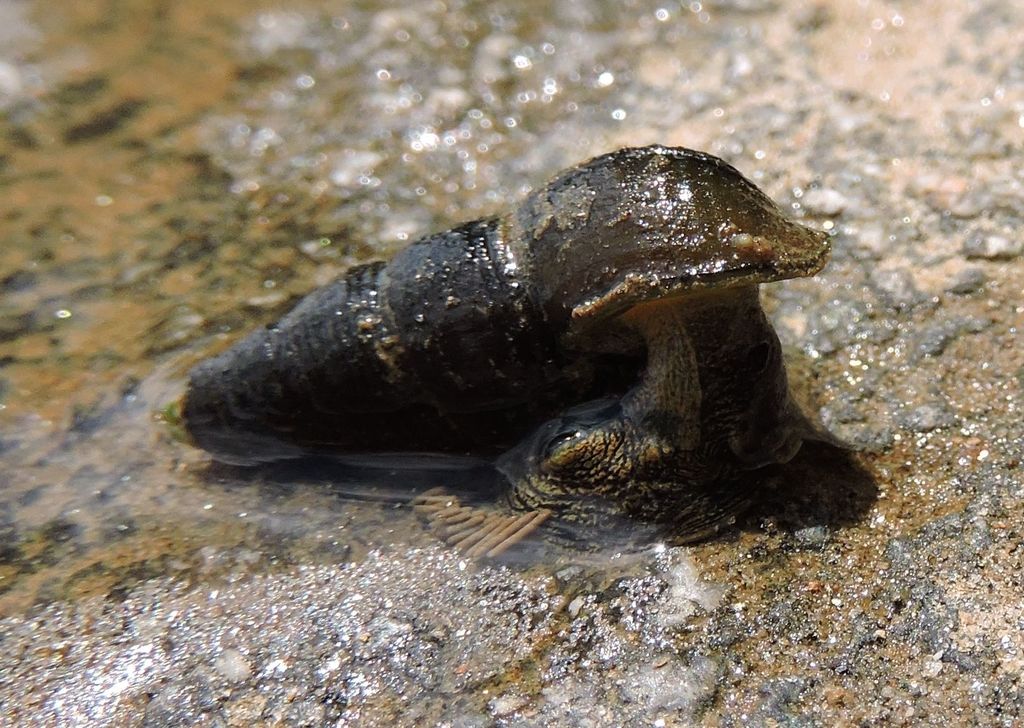
Piedmont Elimia
Elimia virginica
Elimia virginica, common names the Piedmont elimia or Virginia river snail, is a species of freshwater snail with an operculum, an aquatic gastropod mollusk in the family Pleuroceridae.
From the article Elimia virginica on Wikipedia (CC BY-SA), quoted section by section
Description
It is easy to distinguish the female of this species in whole animals, because of the presence of the external genital sinus. In 2008. four nucleotide sequences and one protein sequence of Elimia virginica were determined.
Wikipedia: “Anatomy”
Range & habitat
Elimia virginica is native to the United States east of the continental divide. The species occurs in large Atlantic coast rivers in eastern North America, from Massachusetts to Virginia. The northeastern limit of the native range of the species is the lower Connecticut River. The distribution of this species is shrinking in the native Connecticut River, and it is considered rare in Connecticut. Its conservation status in the Connecticut River Watershed is W1 ("a rare species, with 20 or fewer known occurrences in the watershed states"). The conservation status of Elimia virginica according to NatureServe, is as follows:
United States of America – secure. Massachusetts – presumed extirpated. Connecticut – critically imperiled. New York – vulnerable. New Jersey – unranked. Pennsylvania – secure. Virginia – apparently secure. North Carolina – unrankable.
Wikipedia: “Indigenous distribution”
What it does
Elimia virginica is dioecious. It lays its eggs from spring to summer, in particular in June and July. This species, unlike softer shelled physid snails, grows very slowly, and has the lowest intrinsic rate of increase (this means that populations grow very slowly), along with Leptoxis carinata, in this environment. Individuals of this species are often sexually mature within one year; and can live 5 years.
Wikipedia: “Life cycle”
Where it lives
Recorded sightings
—
geo-referenced records in GBIF, from museums, herbaria and field observers.
Drag the globe to turn it. Dots are where records exist, not a range map; darker means more records.
In the stacks
Searching the stacks…
Every page naming Elimia virginica in the Biodiversity Heritage Library →
This page is assembled live from iNaturalist, GBIF, Wikipedia, the Source Library and the Internet Archive. It is not yet part of the hand-edited codex. iNaturalist taxon 219023.