- Animals
- ›Arthropods
- ›Hexapods
- ›Insects
- ›Winged and Once-winged Insects
- ›Beetles
- ›Water, Rove, Scarab, Long-horned, Leaf, and Snout Beetles
- ›Cucujiform Beetles
- ›Snout and Bark Beetles
- ›True Weevils
- ›Bark and Ambrosia Beetles
- ›Engraver Beetles and Allies
- ›Ips
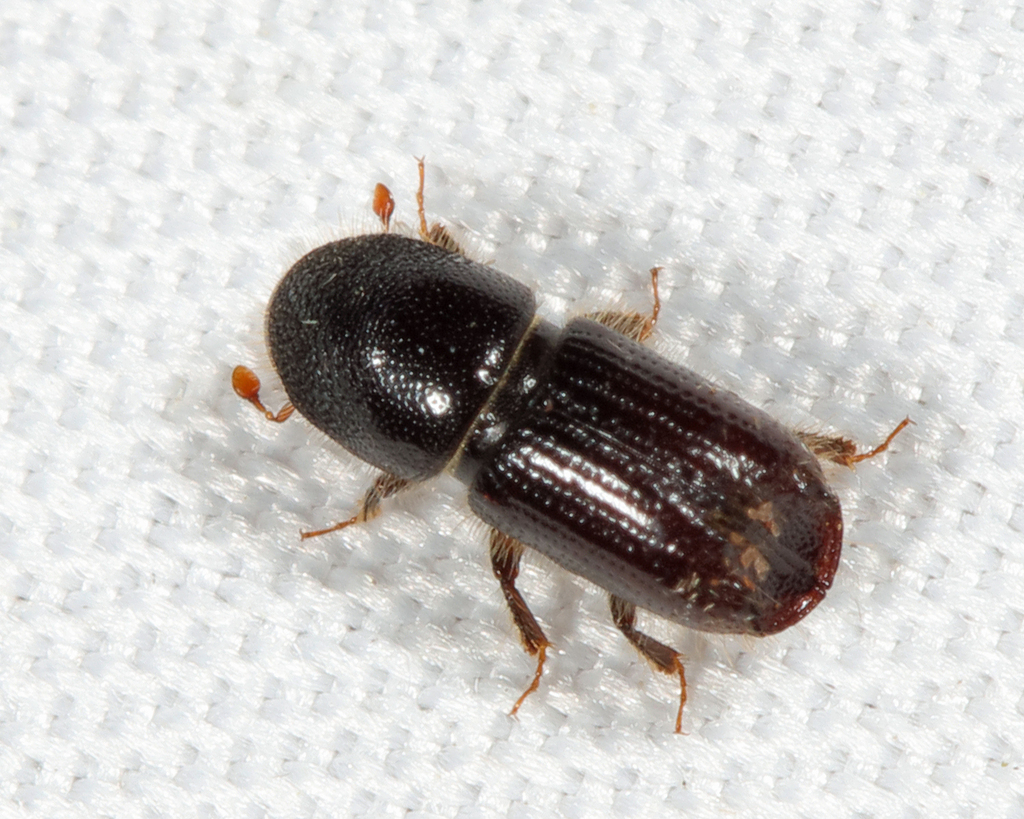
Pine Engraver
Ips pini
Ips pini, also known as the pine engraver or North American pine engraver, is a species of typical bark beetle in the family Curculionidae native to North America. Its habitat is broadly distributed throughout the North American continent, extending from Canada and Alaska to northern Mexico, where it is primarily associated with coniferous forests and trees of smaller diameters, typically ranging from 12 to 20 cm.
Ips pini populations are subcategorized by their geographic ranges and are primarily distinguished by how they produce the enantiomeric composition of ipsdienol, the major pheromone produced by males. The species is a vector for blue stain fungus, which colonizes the sapwood and disrupts the host tree's water transport system.
From the article Ips pini on Wikipedia (CC BY-SA), quoted section by section
Description
Adult Ips pini beetles range from three to five mm in length, though some individual beetles can grow up to six mm. A notable structural feature of these beetles is their elytral declivity, which is distinctively concave and equipped with spines at the terminal end. Additionally, pine engravers have a predominantly dark coloration, displaying varying shades of brown and black.
Wikipedia: “Morphology”
What it does
The eggs laid by adult female Ips pini are oblong, are approximately 1.0 mm in length and 0.5 mm in width, and have a distinctive white, pearl-like color. The larvae tend to curl up in C-shaped forms and are most clearly identified by their red-colored heads in contrast to their white bodies. As these larvae progress in their developmental stages, they grow approximately 3⁄16 inch (4.8 mm), demonstrating significant size increases across their larval stage. As the larvae mature into the pupal stage, they become a waxy-white color, which signifies a key phase in their transition towards adulthood. The pupae maintain a size that is comparatively similar to the adult beetles, indicating the nearing completion of their metamorphosis. The life cycle stages begin with an egg, progressing to the larva, transforming into the pupa, and culminating in the adult beetle, with the life span typically lasting eight weeks. Prevailing environmental and climatic conditions influence the ability of Ips pini beetles to complete multiple generations within a year. Depending on the favorability of these conditions, these beetles typically go through two cycles annually, but may achieve as many as four reproductive cycles . …
Wikipedia: “Life cycle stage identification”
Listen
Looking for field recordings…
Where it lives
Recorded sightings
—
geo-referenced records in GBIF, from museums, herbaria and field observers.
Drag the globe to turn it. Dots are where records exist, not a range map; darker means more records.
In the stacks
Searching the stacks…
Every page naming Ips pini in the Biodiversity Heritage Library →
This page is assembled live from iNaturalist, GBIF, Wikipedia, the Source Library and the Internet Archive. It is not yet part of the hand-edited codex. iNaturalist taxon 222278.