- Fungi Including Lichens
- ›Ascomycete Fungi
- ›Sac Fungi and Lichens
- ›Common Lichens
- ›Shield Lichens, Sunburst Lichens, Rosette Lichens, and Allies
- ›shield lichens, rim lichens, and allies
- ›Stereocaulaceae
- ›Lepraria
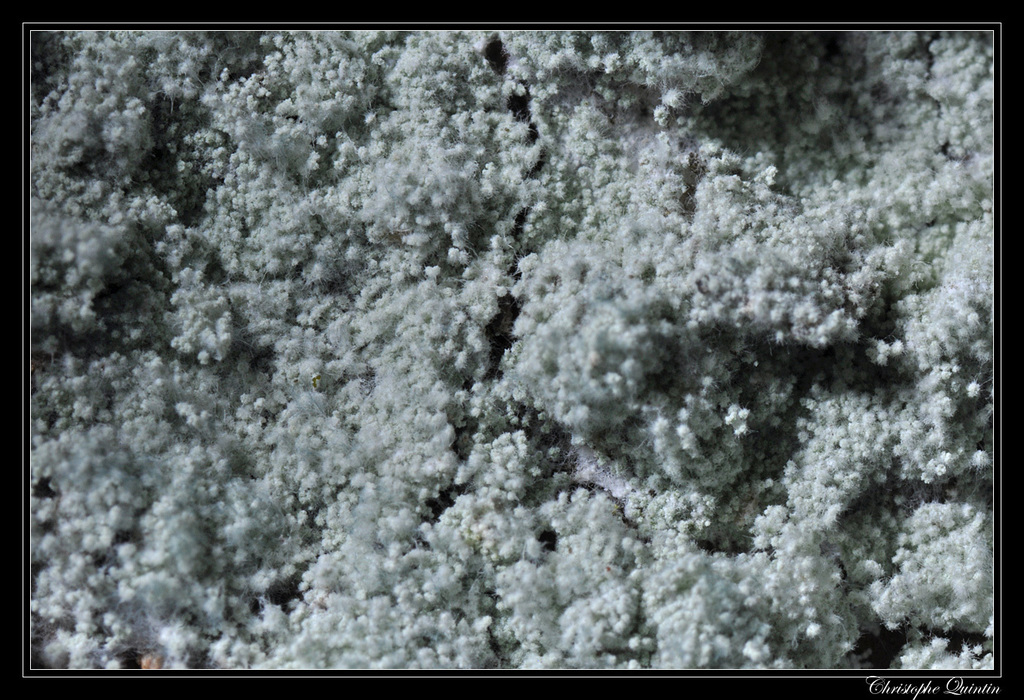
Common Dust Lichen
Lepraria incana
Lepraria incana is a species of dust lichen in the family Stereocaulaceae. First described scientifically by Johann Jacob Dillenius in 1741, and then formally by Carl Linnaeus in 1753, it is the type species of the genus Lepraria. The thallus of this species is green to greyish-green, and powdery – as if made of tiny granules. These granules are soredia, which are asexual reproductive structures. Like most members of genus Lepraria, the lichen has few distinguishing features, lacking both a medulla and sexual reproductive structures (apothecia). Chemically, the lichen is characterised by the presence of the secondary chemicals known as divaricatic acid and zeorin.
The lichen prefers to grow on bark on the base of trees in moist and partly shaded locations, but will also grow on dead wood, silica-rich rocks, or soil. It is not particularly selective in terms of its bark substrate, and has been recorded growing on a wide variety of both deciduous and coniferous trees. Lepraria incana is common and widespread in Europe and Asia. Although it was previously thought to be even more widely distributed, with records from North America and South America, research has shown that at least some of the Lepraria incana lookalikes on those continents – although morphologically indistinguishable – are genetically distinct, and they have been described as unique species. Lepraria incana is relatively tolerant to air pollution and some studies have investigated its use as a biomonitor. The lichen is known to harbour several species of lichenicolous fungi as well as a mycovirus.
From the article Lepraria incana on Wikipedia (CC BY-SA), quoted section by section
Description
The thallus of Lepraria incana is leprose (powdery), and greenish grey in colour, often with blue tinge. It has a diffuse margin with neither distinct lobes, nor a distinct cortex, forming continuous patches with diameters up to about 8 cm (3.1 in), or forming smaller colonies of poorly developed patches or areoles. The thallus consists of abundant powdery soredia (little balls of algae wrapped in fungus hyphae) up to 50 μm in diameter. A medulla is sometimes present, but if so, it is usually poorly developed. Consoredia (diaspores made of aggregated soredia) are sometimes present, and they measure up to 110 μm. Overall, the appearance of the lichen can be quite variable, as sometimes it forms more or less loose cotton-like cushions, while other times it consists only of soredia that can be sparse or dense. The photobiont partner of the lichen is a spherical (coccoid) member of the green algal phylum Chlorophyta, with a diameter of up to 18 μm. In terms of secondary chemicals, Lepraria incana contains divaricatic acid, zeorin, and nordivaricatic acid (trace amounts). Some specimens have trace amounts of atranorin, although this may be a contaminant. It also contains anthraquinones such as parietin, fallacinal, parietinic acid, and citreorosein. …
Range & habitat
Lepraria incana most commonly occurs on bark on the base of trees. It prefers old bark that is generally more than 20 years old. The lichen grows well on coniferous bark, although it prefers the bark of oak (genus Quercus). It has been judged to be well-adapted to rugose (wrinkled) bark and cork accumulation, as seen in the old stem parts of Pseudotsuga and Quercus. One study found that the probability of the lichen occurring increased with increasing bark crevice depth and decreasing tree bark pH (i.e., tending towards acidic), although another study noted its occurrence on the smooth bark of Abies. In Finland, the most common bark substrates for the lichen are from trees in the genera Picea, Tilia, and Pinus. Less frequently, it is encountered on rotten wood, soil, and rocks. In Belarus, it is the most common of nine species of Lepraria found there, accounting for nearly half of hundreds of herbarium specimens examined. There, it is most common on Picea abies and Pinus sylvestris. Similarly, it is almost always present, and sometimes dominant, in epiphytic lichen communities on common oak (Quercus rubra) in Lithuanian oak woods. In Latvia, it is most common on Quercus robur and Tilia cordata in dry deciduous forests, while in Estonia it is common in old spruce-dominated forests on account of the shade, relatively high humidity, and low pH of spruce bark. …
Wikipedia: “Habitat and distribution”
What it does
A novel four-segmented dsRNA virus was detected in Lepraria incana. This virus, named Lepraria chrysovirus 1 (LiCV1), is related to those found in the genus Alphachrysovirus, and is one of the first mycoviruses identified from a lichen. Polycoccum anatolicum is a lichenicolous fungus that has been found growing on Lepraria incana thalli in Turkey. At the time of its description as a new species (2013), it was the first Polycoccum known to occur on Lepraria. Psammina filamentosa, known from the Netherlands and the UK, is an algicolous and lichenicolous fungus that was described as a new species in 2020. It causes small and often somewhat granular black spots on Lepraria incana. Arthonia phaeophysciae and Rhymbocarpus pubescens are other lichenicolous fungi that grow on Lepraria incana. Athelia arachnoidea is a corticioid fungus that can act as a facultative parasite of lichens. Known to destroy the lichen vegetation of entire forests, only lichens that are able recolonize the trees within a few months – including Lepraria incana – can survive an infestation of this fungus.
Wikipedia: “Ecology”
Where it lives
Recorded sightings
—
geo-referenced records in GBIF, from museums, herbaria and field observers.
Drag the globe to turn it. Dots are where records exist, not a range map; darker means more records.
In the stacks
Searching the stacks…
Every page naming Lepraria incana in the Biodiversity Heritage Library →
This page is assembled live from iNaturalist, GBIF, Wikipedia, the Source Library and the Internet Archive. It is not yet part of the hand-edited codex. iNaturalist taxon 223257.