- Animals
- ›Arthropods
- ›Hexapods
- ›Insects
- ›Winged and Once-winged Insects
- ›True Bugs, Hoppers, Aphids, and allies
- ›True Hoppers
- ›Spittlebugs, Cicadas, Leafhoppers and Treehoppers
- ›Spittlebugs and Froghoppers
- ›True Spittlebugs
- ›Aphrophorinae
- ›Cloviini
- ›Lepyronia
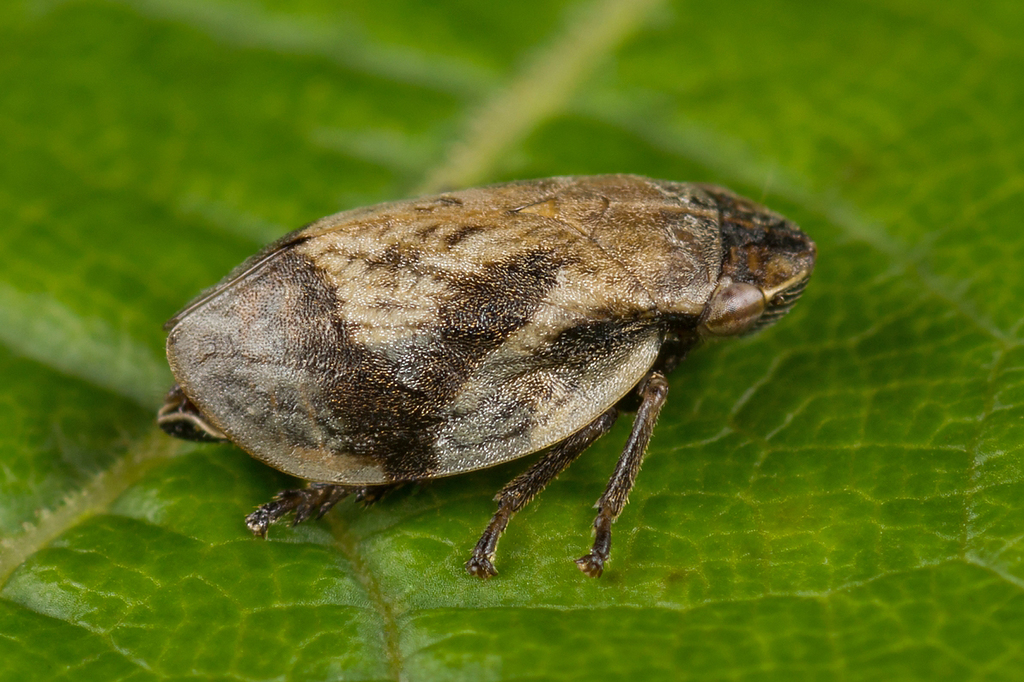
Lepyronia coleoptrata
Lepyronia coleoptrata is a species of spittlebug in the Aphrophoridae family. Native to Europe and Asia, this species has been introduced to northeast North America.
From the article Lepyronia coleoptrata on Wikipedia (CC BY-SA), quoted section by section
Description
Imago measuring 5.1-7.8 mm, pale brown with dark membranes on the front wings. Egg 1.6-0.4 mm, oblong, somewhat curved, flattened from dorsal and convex on ventral sides. The larva is 5.7-6.7 mm, at the older age there are distinct dark spots on the body. Hibernate eggs under the bark of perennial shoots. Larvae revive late April - first half of May. Populate annual (55-96%) and perennial (40-45%) lavender shoots, concentrated mainly at a height of up to 20 cm from the soil surface. They feed by forming a foam around themselves, which is a secretory fluid. In places of damage, the shoot tissue dries up and cracks, which prevents water and nutrients from accessing the plant parts above. Strongly damaged shoots lag behind in growth and development, thin out, acquire a light coloration, the part wavily bends and does not dissolve. The mass of the inflorescences decreases by 12-67%.
Wikipedia: “Description and ecology”
What it does
The wingworms spread in the second half of June. After the flight, they are found not only on lavender, but also on crops of other crops, in forest belts, along the edges of fields, in wastelands with various grass vegetation. They feed on leaves, which causes the formation of spots, yellowish spots. Full sexual maturity is reached in August - September. Females lay eggs that remain for the winter. One generation per year develops.
== References ==
Wikipedia: “Reproduction”
Listen
Looking for field recordings…
Where it lives
Recorded sightings
—
geo-referenced records in GBIF, from museums, herbaria and field observers.
Drag the globe to turn it. Dots are where records exist, not a range map; darker means more records.
In the stacks
Searching the stacks…
Every page naming Lepyronia coleoptrata in the Biodiversity Heritage Library →
This page is assembled live from iNaturalist, GBIF, Wikipedia, the Source Library and the Internet Archive. It is not yet part of the hand-edited codex. iNaturalist taxon 223524.