- Animals
- ›Molluscs
- ›Gastropods
- ›Caenogastropods
- ›Littorinimorpha
- ›Looping Snails and Allies
- ›Hydrobiid Mud Snails
- ›Nymphophilinae
- ›Marstonia
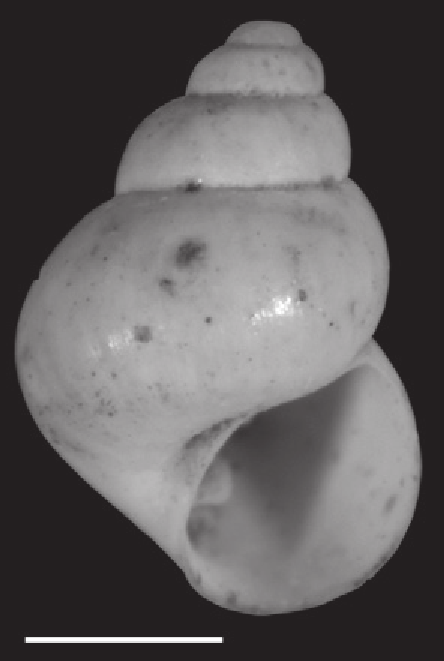
Comal Siltsnail
Marstonia comalensis
Marstonia comalensis is a species of minute freshwater snail with a gill and an operculum, an aquatic gastropod mollusk or micromollusk in the family Hydrobiidae. It is found in south central Texas, United States.
Marstonia comalensis is large for this genus. It has an ovate-conic, openly umbilicate shell. The penis has a short filament and oblique, squarish lobe bearing a narrow gland along its distal edge. It is well differentiated morphologically from other congeners that have similar shells and penes, and is also genetically divergent relative to those congeners that have been sequenced (mtCOI divergence 3.0–8.5%).
From the article Marstonia comalensis on Wikipedia (CC BY-SA), quoted section by section
Description
The cephalic tentacles are pale, except for black eyespots. Snout is brown, distal lips are pale and foot is pale. Pallial roof has black pigment bands along edges of ctenidium and dorsal edge of genital duct; visceral coil pale except for black pigment on testis. Ctenidium is positioned a little in front of pericardium. There are 24-25 ctenidial filaments, that are broadly triangular with lateral surfaces ridged. Osphradium is narrow, positioned slightly posterior to middle of ctenidium. Radula has about 36 well-formed rows of teeth. Central teeth are about 38 μm wide with convex cutting edge. There are 3-8 lateral cusps. Central cusp are pointed or hoe-shaped, parallel-sided proximally or tapering throughout. There are 1-3 small basal cusps. Basal tongue is U- or V-shaped, about as long as lateral margins. Lateral tooth face is rectangular. Central cusp is pointed or hoe-shaped. There are 2-5 lateral cusps (inner) and 3-7 (outer). Outer wing is broad, flexed, with about 140% length of cutting edge. Basal tongue weakly is developed. Inner and outer marginal teeth both have 14-21 cusps and basally positioned rectangular wing.
Hypobranchial gland is large, overlapping rectum and part of genital duct, thickened alongside kidney. …
Wikipedia: “Anatomy”
Range & habitat
The type locality is Comal Creek, near New Braunfels, Comal County, Texas. The original collections of Marstonia comalensis are worn shells having the appearance of drift material. It is possible that Marstonia comalensis became extinct at Comal Springs when this water body temporarily dried in 1964; it is also possible that the shells of this species which have been found at this site were washed downflow from extant populations in the headwaters of the Guadalupe River. Records published by Hershler & Liu (2011) considerably expanded the geographic range of Marstinia comalensis, which lives in springs and fluvial habitats spread among four river basins in south-central Texas. Almost all of these localities are on the Edwards Plateau. Records indicate that Marstonia comalensis was historically distributed in the upper portions of the Brazos River, Colorado River (Texas), Guadalupe River (Texas) and Nueces River basins, south-central Texas. …
Wikipedia: “Distribution”
Where it lives
Recorded sightings
—
geo-referenced records in GBIF, from museums, herbaria and field observers.
Drag the globe to turn it. Dots are where records exist, not a range map; darker means more records.
In the stacks
Searching the stacks…
Every page naming Marstonia comalensis in the Biodiversity Heritage Library →
This page is assembled live from iNaturalist, GBIF, Wikipedia, the Source Library and the Internet Archive. It is not yet part of the hand-edited codex. iNaturalist taxon 224457.