- Animals
- ›Arthropods
- ›Hexapods
- ›Insects
- ›Winged and Once-winged Insects
- ›Beetles
- ›Water, Rove, Scarab, Long-horned, Leaf, and Snout Beetles
- ›Scarabaeiform Beetles
- ›Scarabs, Stag Beetles, and Allies
- ›Scarabs
- ›Dung Beetles
- ›Onthophagini
- ›Onthophagus
- ›Onthophagus
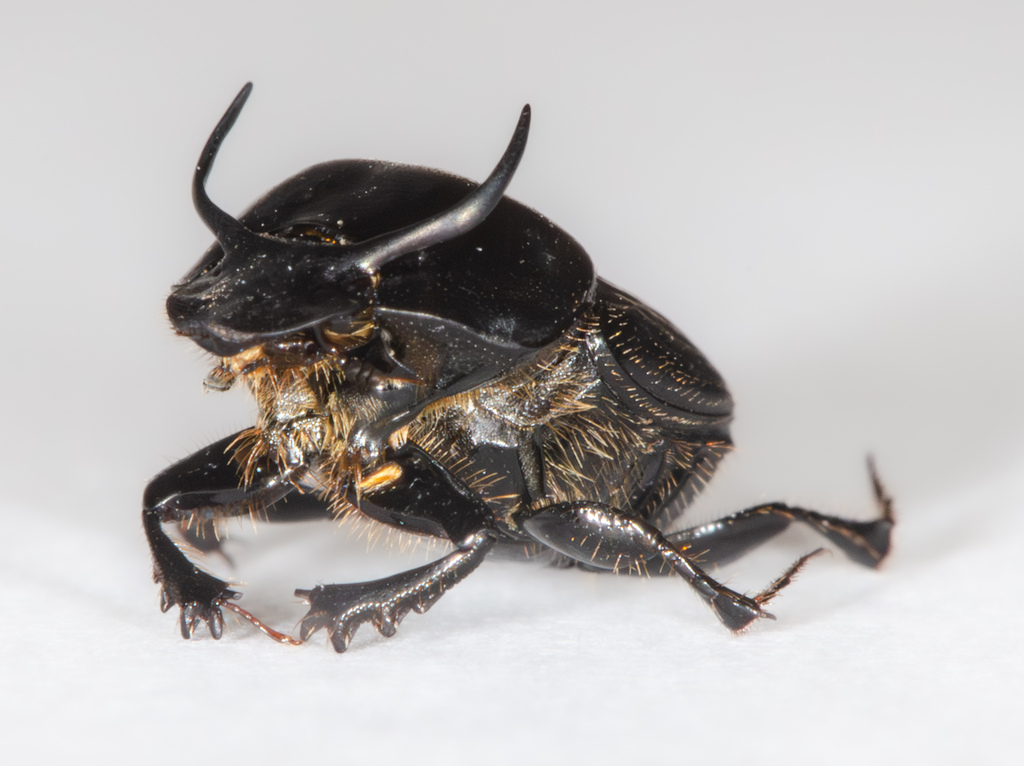
Bull-headed Dung Beetle
Onthophagus taurus
Onthophagus taurus, the taurus scarab, is a species of dung beetle in the genus Onthophagus and the family Scarabaeidae. Also known as the bull-headed dung beetle, it is a species that specializes in cattle dung and is widely utilized to maintain clean pastures, making it agriculturally valuable. These beetles are typically 8–10 millimetres (0.31–0.39 in) in size. The males of this species exhibit distinct characteristics: large "major" males possess long, sweeping, curved horns resembling those of a longhorn bull, while small "minor" males have tiny horns that project upward from the back of their heads. Females, on the other hand, lack horns. These small beetles are oval shaped, the color is usually black or reddish brown. Sometimes the pronotum has a weak metallic sheen.
From the article Onthophagus taurus on Wikipedia (CC BY-SA), quoted section by section
Range & habitat
Onthophagus taurus originally inhabiting areas characterized by a Mediterranean climate, is native to central and southern Europe as well as Asia Minor, spanning from Spain to Morocco, Turkey, and Iran. It was introduced to the United States and Australia in the late 1960s to early 1970s to help manage cow dung. This introduction aimed to displace dung from cattle pastures underground, thereby, promoting soil health and pest control. They are most abundant in grassland habitats where cows reside. This species is now present in Australia, Europe, Morocco, Algeria, Tunisia, Syria, Iraq, Transcaucasia, Asia Minor, Iran, Afghanistan, Central Asia, and the United States of America. Onthophagus taurus was accidentally introduced in the eastern United States. It was initially sighted in Florida in 1971, and later in the northeast United States. Based on the population size and spread pattern, it is suggested that O. taurus likely entered the United States from the coastal area of Florida. Subsequently, the US Department of Agriculture deliberately released O. taurus in various locations, including California, Texas, and New Jersey, resulting in a substantial increase in range from where it was first introduced. O. taurus develops most optimally between 16 °C and 23 °C. As a result, its reproductive success is limited in extremely cold regions, restricting its distribution there. …
Wikipedia: “Habitat”
What it does
Onthophagus taurus females fly to fresh dung pads and use their mandibles to excavate tunnels into the soil below. These beetles spend days sorting through manure and arranging it throughout the tunnel. The female then carefully constructs the brood chamber using her saliva. Subsequently, they move dung down to the ends of the tunnel where they pack dung into oval brood balls, and they roll them into the dug-out brood chamber. This nesting area houses several brood balls approximately 10 – 15 cm below the surface. One egg is laid inside each brood ball where larvae would complete their development within these buried balls of manure. By storing the dung underground, it stays fresh and protects the developing grubs from predators and parasites. Adult males enter the dung pad to feed and mate. Both males and females assist in offspring provisioning. A male's primary role is to transport dung from the surface and deliver it to the female in the brood chamber, while the female's primary role is to incorporate this dung into the brood balls.
Wikipedia: “Brood ball behavior”
How it is grown
Dung beetles can contribute more nitrogen levels in the soil by burrowing manure into the ground to form their tunnels. Onthophagus taurus are known as tunnelers. They create tunnels beneath dung pats, where they deposit dung balls. This creates channels for water and air to move through. In doing so, they also improve the soil and help it absorb and retain more water, thus supporting healthier crop growth. Additionally, the mixing of soil and dung by tunneling beetles improves soil tilth, which refers to the soil's physical condition for plant growth. As they dig tunnels, these beetles also push soil up onto the dung pile, further aiding in the incorporation of organic matter into the soil, while increasing the recycling of nutrients back into the soil. Lastly digging these burrows increases soil permeability and lowers the risk of soil erosion and surface runoff. As a result, less nitrogen pollution would flood the farm fields due to the soil's increased capacity for water retention. This subsequently prevents the formation of dead zones caused by excess nitrogen runoff. Furthermore, dung beetles can play a critical role in disrupting the life cycle of dung-breeding flies. By collecting and disbursing feces underground, they eliminate the surface breeding habitat for these pests, preventing egg-laying and reproduction. …
Wikipedia: “Agricultural importance”
Listen
Looking for field recordings…
Where it lives
Recorded sightings
—
geo-referenced records in GBIF, from museums, herbaria and field observers.
Drag the globe to turn it. Dots are where records exist, not a range map; darker means more records.
In the stacks
Searching the stacks…
Every page naming Onthophagus taurus in the Biodiversity Heritage Library →
This page is assembled live from iNaturalist, GBIF, Wikipedia, the Source Library and the Internet Archive. It is not yet part of the hand-edited codex. iNaturalist taxon 226435.