- Fungi Including Lichens
- ›Basidiomycete Fungi
- ›Higher Basidiomycetes
- ›Mushrooms, Bracket Fungi, Puffballs, and Allies
- ›Agaricomycetidae
- ›Common Gilled Mushrooms and Allies
- ›Agaricineae
- ›Hymenogastraceae
- ›Phaeocollybia
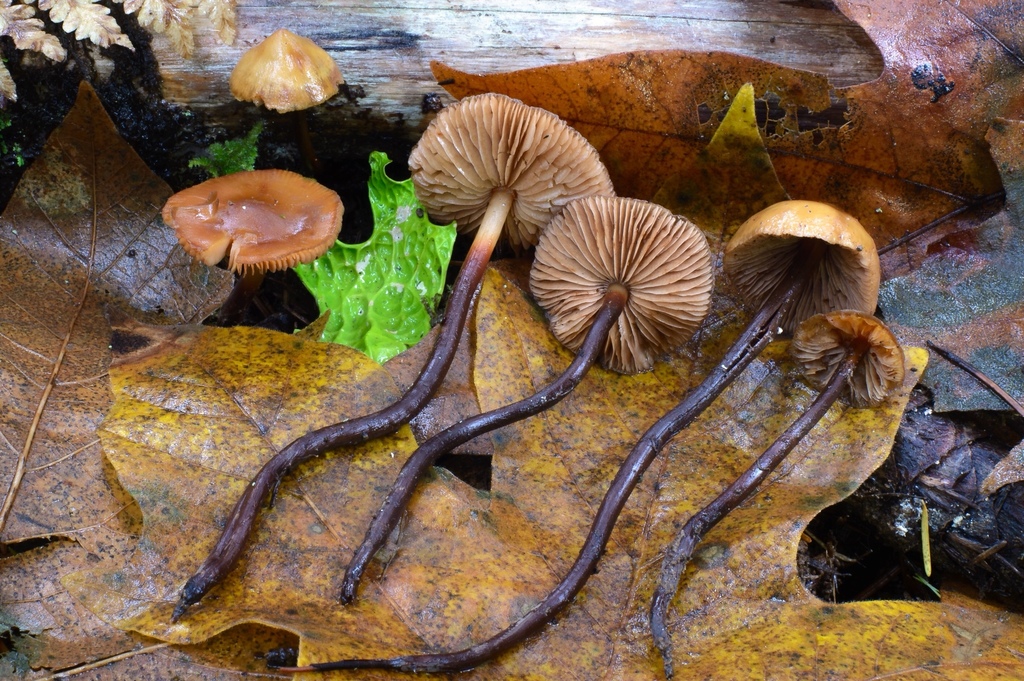
Phaeocollybia attenuata
Phaeocollybia attenuata, commonly known as the little phaeo, is a species of mushroom in the genus Phaeocollybia. It is found in mixed conifer forests and is endemic to the Pacific Northwest.
From the article Phaeocollybia attenuata on Wikipedia (CC BY-SA), quoted section by section
Description
The cap of Phaeocollybia attenuata is brownish in color, and is between 1 and 5 centimeters in diameter. It starts out conical, and becomes convex or campanulate as the mushroom gets older. The stipe is more than 20 centimeters long, but only about 2-6 centimeters of it are visible aboveground. It is about 2-5 millimeters wide. It is brownish, and darkens from the bottom up in age. The gills start out buff, and become brownish with age. The spore print is reddish brown. There are several other species in the same genus that are small and similarly colored, such as P. pleurocystidiata, P. radicata, P. phaeogaleroides, and P. californica.
Range & habitat
Phaeocollybia attenuata is found in mixed and coniferous forests. It is mycorrhizal, and is most commonly reported from forests near the Oregon coast. It is often found with spruce.
== References ==
Wikipedia: “Habitat and ecology”
Where it lives
Recorded sightings
—
geo-referenced records in GBIF, from museums, herbaria and field observers.
Drag the globe to turn it. Dots are where records exist, not a range map; darker means more records.
In the stacks
Searching the stacks…
Every page naming Phaeocollybia attenuata in the Biodiversity Heritage Library →
This page is assembled live from iNaturalist, GBIF, Wikipedia, the Source Library and the Internet Archive. It is not yet part of the hand-edited codex. iNaturalist taxon 227622.