- Animals
- ›Molluscs
- ›Bivalves
- ›Autobranchia
- ›Heteroconchia
- ›Euheterodonta
- ›Imparidentia
- ›Pea Clams, Fingernail Clams and Allies
- ›Sphaerioidea
- ›Pea Clams
- ›Sphaeriinae
- ›Pisidium
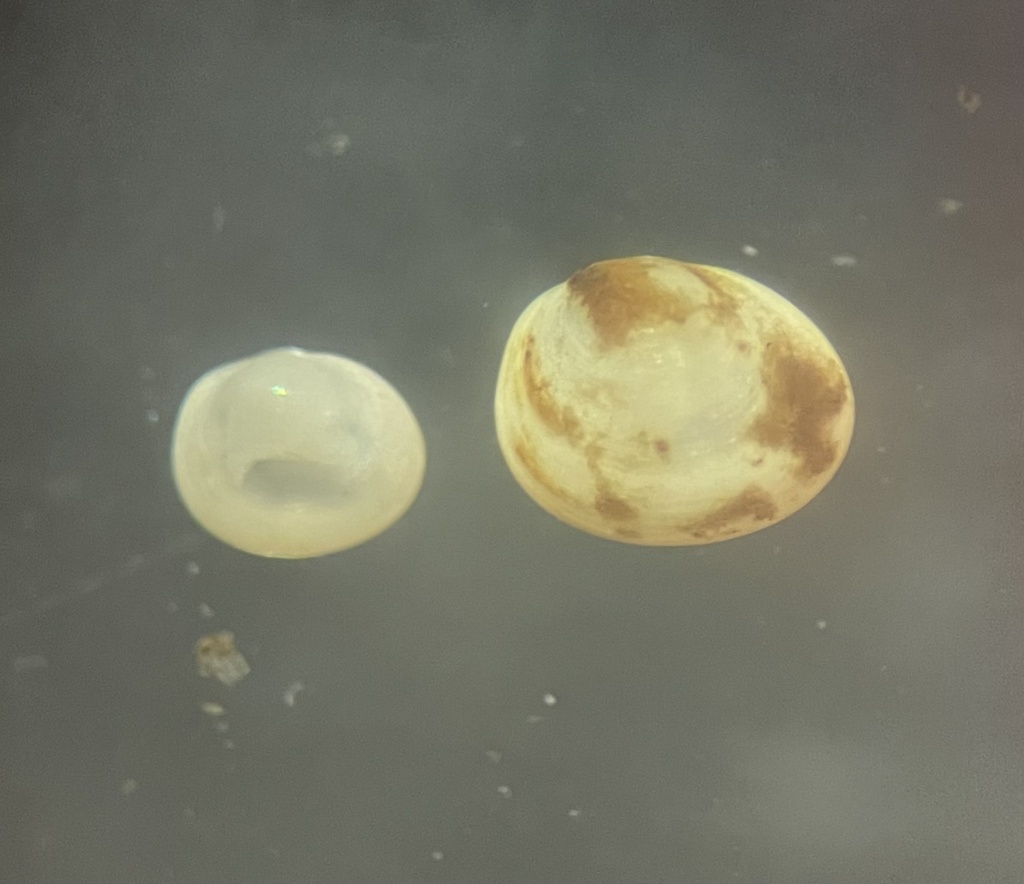
Punctured Peaclam
Pisidium punctiferum
Pisidium punctiferum, common name Striate Peaclam, is a freshwater bivalve of the family Sphaeriidae.
From the article Pisidium punctiferum on Wikipedia (CC BY-SA), quoted section by section
Description
The shell is somewhat subquadrately oval, thin, diaphanous, close, finely striate concentrically, whitish horny, or slightly tinted with fuscous patches near the umbones, and covered with numerous granular points, which are finer and more crowded on the umbones, where the concentric striation is less evident. The shell is anteriorly rather short and subangulate, posteriorly a little truncate. The hinge is with well-developed lateral teeth in both valves, 1-1/1-1. The cardinal teeth is small 2/2. This curious little shell varies somewhat, and specimens are sometimes more oval and compressed than the one figured. Occasionally they are higher and shorter, with a steeper posterior slope. The granular points are more easily seen in dead shells, which are opaque. In living examples they seem, under a strong lens, to bear short hairs. The length of a large example is 4 mm, the height is 3.5 mm, the thickness is 2.5 mm. Of an average example the length is 3 mm, the height is 2.5 mm, the thickness is 2 mm. Among species of the genus Pisidium the shell appear to resemble most Cyclas argentina D'Orb. (=? Pisidium argentina), and Cyclas calyculata Drap. (=? Pisidium calyculata). It is usually more equilateral than either of those species. The epidermis is thin and colourless, so that the striate gills may be seen through the shell. …
Range & habitat
The type locality is a pond at Saint Ann's River, near Port of Spain, Trinidad. They were collected by the government botanist Mr. H. Prestoe and by Robert John Lechmere Guppy in 1867.
USA: Kentucky Virginia Illinois northeast Florida Dominica Brazil
Wikipedia: “Distribution”
Where it lives
Recorded sightings
—
geo-referenced records in GBIF, from museums, herbaria and field observers.
Drag the globe to turn it. Dots are where records exist, not a range map; darker means more records.
In the stacks
Searching the stacks…
Every page naming Pisidium punctiferum in the Biodiversity Heritage Library →
This page is assembled live from iNaturalist, GBIF, Wikipedia, the Source Library and the Internet Archive. It is not yet part of the hand-edited codex. iNaturalist taxon 228170.