- Animals
- ›Chordates
- ›Vertebrates
- ›Ray-finned Fishes
- ›Spiny-rayed fishes
- ›Cods and Hakes
- ›Gadoidei
- ›Cods and Haddocks
- ›Pollachius
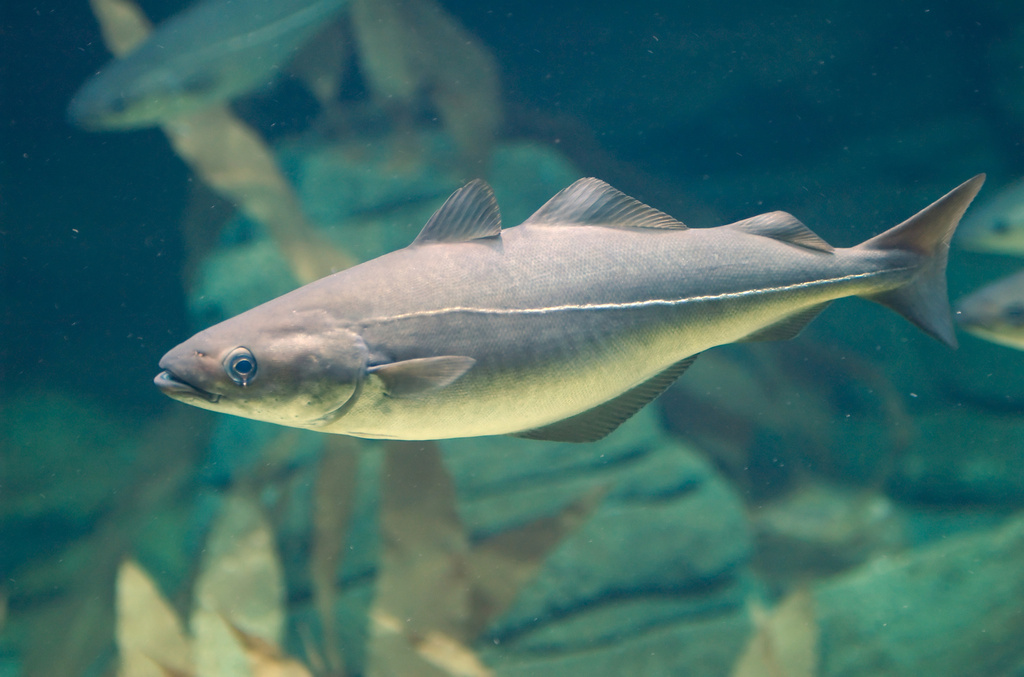
Pollock
Pollachius virens
Pollachius virens is a species of marine fish in the genus Pollachius. Together with P. pollachius, it is generally referred to in the United States as pollock. It is commonly known in Britain as the coalfish, coley, or saithe ( or ), and the young fish may also be called podleys or cuddies in Scotland and northern England.
From the article Pollachius virens on Wikipedia (CC BY-SA), quoted section by section
Description
This species can be separated from P. pollachius by looking at the relative lengths of the upper and lower jaws. P. pollachius has a longer underslung lower jaw while P. virens has approximately equal upper and lower jaw lengths. This gives a very different profile to the head. In general, P. pollachius is a brown or golden colour with a dark back while P. virens is bright silver with a very dark green back. P. virens generally appears to have relatively smaller eyes. The lateral line of P. pollachius has a noticeable kink over the pectoral fins while that of P. virens is straighter. Adults can typically live up to 16–20 years and grow to 100–120 centimetres (40–45 in) but individuals up to 130 cm (50 in) and weight up to 32 kg (71 lb) have been caught. The current IGFA All-Tackle World Record is 22.7 kilograms (50 lb 1 oz) which was caught at Saltstraumen in Norway.
Range & habitat
It is common in the northern parts of the Northern Atlantic, including the Bay of Biscay. Juveniles tend to be found close to shore, particularly in rocky areas, and tend to move out into deeper waters as they grow.
Wikipedia: “Distribution and habitat”
What it does
Saithe reach sexual maturity at 4–9 years old and are iteroparous, batch spawners with determinate fecundity. Females produce, depending on their size, between 500 thousand and 9 million eggs which are 1.0 to 1.3 millimetres (5⁄128 to 7⁄128 in) in diameter.
Wikipedia: “Reproduction”
At the table
Coalfish is edible and has commercial value, although it is considerably less valuable than premium whitefish such as cod and haddock. To achieve a salmon-like orange color, it can be salted and smoked. In Germany, the fish is commonly sold as Seelachs (literally 'sea salmon'), although it is not closely related to any salmon. While a great deal of saithe consumed in Europe are caught in British waters, it is not a popular fish with consumers there. Most of the British saithe catch is thus exported to France, where it is widely eaten. The flesh of coalfish (P. virens) is darkly coloured (hence the common name) while that of P. pollachius is similar to other members of the cod family. This dark colour in the fresh uncooked flesh may have led to the undeserved reputation of this fish as poor for eating. Saithe often congregate around fish farms and feed on uneaten salmon feeds which have passed through the net walls of the cages. It is the opinion of fishermen that the fish caught close to fish farms is of poor quality. Quality testing shows that there is relatively minor difference in fillet quality between fish which were caught close to fish farms and those that were not; however, catches taken close to fish farms have a higher proportion of fish of poor quality. …
Wikipedia: “As food”
Where it lives
Recorded sightings
—
geo-referenced records in GBIF, from museums, herbaria and field observers.
Drag the globe to turn it. Dots are where records exist, not a range map; darker means more records.
In the stacks
Searching the stacks…
Every page naming Pollachius virens in the Biodiversity Heritage Library →
This page is assembled live from iNaturalist, GBIF, Wikipedia, the Source Library and the Internet Archive. It is not yet part of the hand-edited codex. iNaturalist taxon 228496.