- Fungi Including Lichens
- ›Ascomycete Fungi
- ›Sac Fungi and Lichens
- ›Common Lichens
- ›Shield Lichens, Sunburst Lichens, Rosette Lichens, and Allies
- ›shield lichens, rim lichens, and allies
- ›bushy lichens, sea-fog lichens, and allies
- ›Ramalina
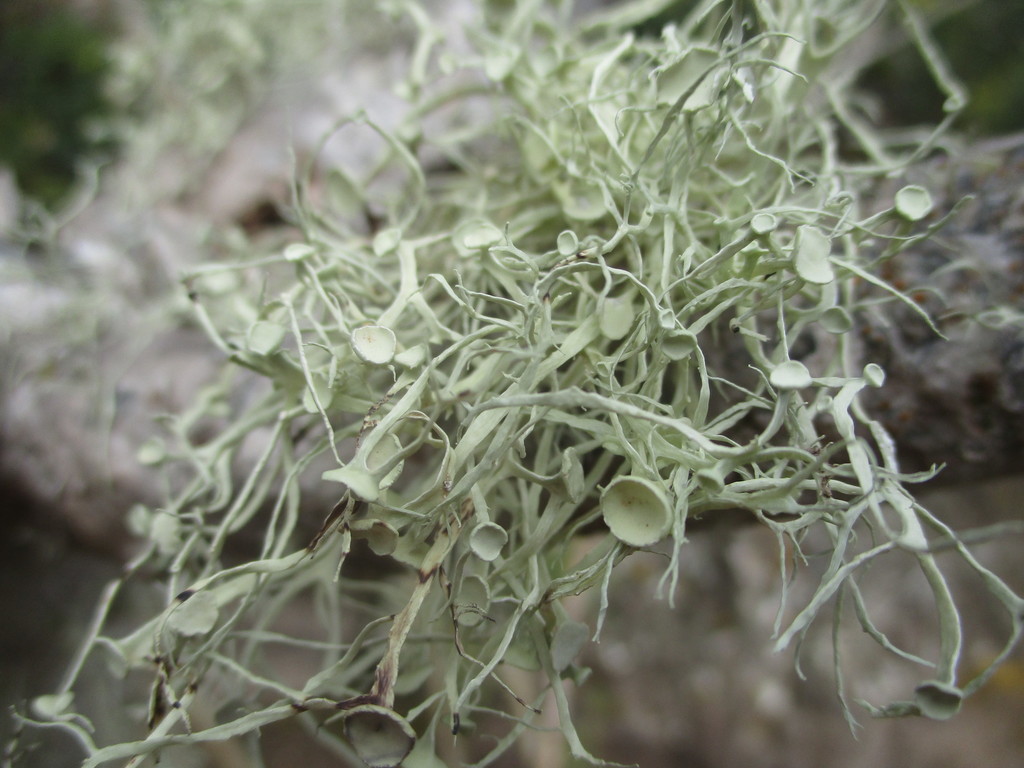
Ramalina calicaris
Ramalina calicaris is a species of fruticose, bark-dwelling lichen-forming fungus in the family Ramalinaceae. The lichen forms tufted to hanging, greenish-grey shrubby growth anchored by a holdfast at the base, with branches that are often distinctly channelled and strap-shaped, typically 2–3 mm wide and reaching 15–20 cm in length. Its reproductive structures are frequently produced, appearing as pale pink-ochre discs borne at the tips or margins of the branches, often on bends of angled branches with short spur-like projections. The species grows primarily on the branches and twigs of trees and shrubs with nutrient-rich bark, particularly in coastal settings and humid forests. Chemically, the cortex contains usnic acid, while the medulla may contain compounds of the sekikaic acid complex or lack additional substances.
The species occurs across Europe (where it is most frequent in western districts), North Africa, Macaronesia, and parts of Asia including China, India, and Thailand. The taxonomy of R. calicaris has been complicated by historical confusion over which specimens should be considered the original type material, leading to ongoing nomenclatural debates about the proper application of the name. Linnaeus's original Lichen calicaris encompassed both rock-dwelling and bark-dwelling material, but subsequent lectotypification fixed the name to a rock-dwelling specimen corresponding to Ramalina siliquosa, conflicting with long-established usage for the bark-dwelling species. Several taxa historically described as infraspecific forms of R.
From the article Ramalina calicaris on Wikipedia (CC BY-SA), quoted section by section
Description
Ramalina calicaris is a fruticose (shrubby) lichen with a greenish grey thallus, anchored to the substrate by a basal holdfast. Thalli are often tufted when young, but may become longer and more pendent with age, reaching about 15–20 cm in length in some accounts. The branches (laciniae) are typically strap-shaped and relatively sparingly branched. They are often distinctly channelled (canaliculate) and commonly about 2–3 mm wide, though broader forms have been reported. The surface is described as smooth to weakly wrinkled, and thalli may appear stiff and spiky when dry. Small pores (pseudocyphellae) penetrate the surface; these range from dot-like to spindle-shaped and may be few or numerous depending on the specimen.
Apothecia (spore-producing structures) are usually frequent and lecanorine in form, typically positioned at or near the tips of the branches, though they can also occur along the margins. They may develop on bends of angled branches and can sometimes show a short spur-like projection. The disc has been described as pale pink-ochre with a thin thalline margin. The spore-bearing structures (asci) each contain eight spores and have an apical tip whose iodine-staining pattern matches the Bacidia type. Ascospores are hyaline and 1-septate, with reported sizes around 10–16 × 5–7 μm. The photosynthetic partner (photobiont) is a chlorococcoid green alga. …
Range & habitat
Ramalina calicaris is primarily corticolous (bark-dwelling), typically growing on branches and twigs rather than on trunks. It is most often associated with trees and shrubs with relatively nutrient-rich bark, and is reported as occurring frequently in coastal settings in parts of its European range. Aptroot and de Bruyn (2011) described it as occurring mostly in coastal regions in Europe but emphasized that, unlike several other Ramalina species, it is not a maritime lichen; they also suggested that its frequent occurrence on small twigs, possibly in the canopy, may contribute to under-recording. In Italy it is recorded mainly from deciduous trees (more rarely conifers), with occurrences reported especially on branches in humid beech forests, though some older records have been flagged as needing confirmation. In Britain and Ireland, the species is mapped and assessed as Least Concern within that framework, and it is described as most frequent in western districts, with more easterly records considered local. Italian records span multiple regions, but distribution reporting has been complicated by historical misidentifications, with at least one earlier regional report explicitly attributed to confusion with other taxa. The species has also been documented from Bosnia and Herzegovina and Greece. …
Wikipedia: “Habitat and distribution”
What it does
Ramalina calicaris is a symbiotic lichen with a chlorococcoid (green) algal photobiont. Thalli are commonly fertile, with apothecia reported as frequent in multiple regional accounts, suggesting that sexual reproduction is an important means of persistence and dispersal in this species where it occurs. Experimental work on Ramalina calicaris var. japonica (a variety from East Asia) indicates sensitivity to increased nitrogen pollution. In that study, higher nitrogen deposition was associated with reduced growth of the lichen body and lower survival of reproductive fragments, and the researchers proposed that this variety begins to suffer harm at nitrogen deposition levels above about 6 kg per hectare per year under the experimental conditions used. Because the work focused on this particular variety, it remains unclear whether other populations of R. calicaris share the same sensitivity threshold. A separate short-term study conducted in the Shennongjia Mountains of China examined how the lichen responds to increased nitrogen deposition. The researchers simulated nitrogen pollution at various levels and found that as nitrogen increased, the lichen absorbed more nitrogen while phosphorus levels increased more slowly, creating an imbalance between these two essential nutrients. …
Wikipedia: “Ecology”
Where it lives
Recorded sightings
—
geo-referenced records in GBIF, from museums, herbaria and field observers.
Drag the globe to turn it. Dots are where records exist, not a range map; darker means more records.
In the stacks
Searching the stacks…
Every page naming Ramalina calicaris in the Biodiversity Heritage Library →
This page is assembled live from iNaturalist, GBIF, Wikipedia, the Source Library and the Internet Archive. It is not yet part of the hand-edited codex. iNaturalist taxon 229758.