- Fungi Including Lichens
- ›Ascomycete Fungi
- ›Sac Fungi and Lichens
- ›Common Lichens
- ›Shield Lichens, Sunburst Lichens, Rosette Lichens, and Allies
- ›shield lichens, rim lichens, and allies
- ›bushy lichens, sea-fog lichens, and allies
- ›Ramalina
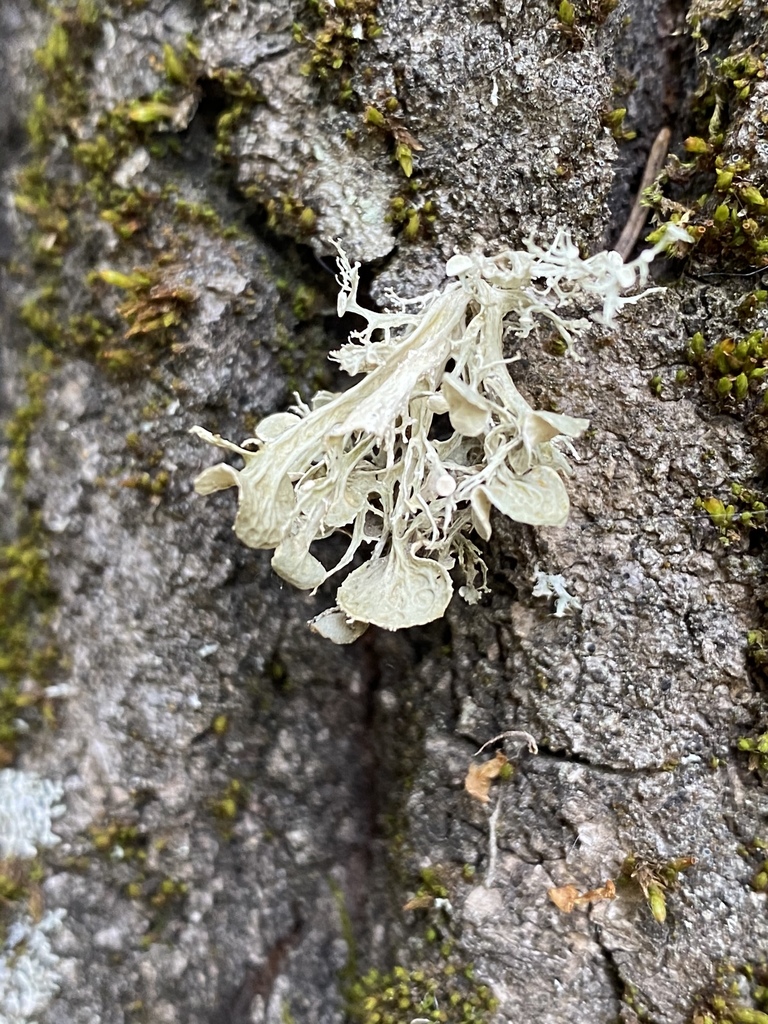
Fan Ramalina
Ramalina sinensis
Ramalina sinensis is a species of fruticose lichen in the family Ramalinaceae. It is an erect, bushy lichen with broad, flattened branches that are greener above and paler beneath. The species is widespread across the Northern Hemisphere, occurring in North America, China, and Russia, where it grows on the bark of various trees. In Yunnan, it has a history of use as an edible lichen, prepared as a cold dish or cooked with pork.
From the article Ramalina sinensis on Wikipedia (CC BY-SA), quoted section by section
Description
Ramalina sinensis is an erect fruticose lichen attached by a narrow holdfast. Its lobes are broad, flattened, and often palmately divided, with a greener upper surface and a paler whitish underside, giving the thallus a distinctly two-sided appearance. The branches are solid rather than hollow, the lower surface bears sunken net-like pseudocyphellae, and apothecia are often produced near the tips. Its ascospores are small (5 μm long and 2.5 μm wide), spindle-shaped, and slightly curved.
Range & habitat
Ramalina sinensis is widespread across the Northern Hemisphere, but it often occurs as small, scattered local populations. In the Canadian prairies it has been reported as uncommon, especially in dry sandy habitats. In southern Manitoba, material studied in 2012 was collected in Sandilands Provincial Forest, Spruce Woods Provincial Park, and Whiteshell Provincial Park, where the lichen grew on ash, poplar, oak, spruce, and pincherry shrubs. In southwestern China, R. sinensis has been recorded from Sichuan, Tibet, and Yunnan, where it grows on bark in montane habitats at elevations of about 1,800–4,300 m. It is also widespread in the mountainous forests of North China. In Russia's Altai Territory, R. sinensis is regarded as a quite rare species on the Salair Ridge. There it occurs mostly in valley willow forests, Picea obovata forests, and communities dominated by Abies sibirica and Tilia sibirica, growing on the bark of Populus tremula, Salix, Tilia sibirica, Abies sibirica, and Picea obovata, usually 1–5 m above the ground.
Wikipedia: “Habitat and distribution”
What it does
Because Ramalina sinensis forms apothecia but lacks vegetative propagules, it is thought to disperse chiefly by sexual spores, which must later re-associate with a compatible alga. This may help explain the species' broad overall range and the weak geographic pattern in its populations, while the absence of vegetative propagules may also contribute to its local rarity in places such as Manitoba. In the Qinling Mountains of Shaanxi, Ramalina sinensis has been recorded as a seasonal food of the golden snub-nosed monkey (Rhinopithecus roxellana). Together with Parmelia species, it formed an important part of the monkeys' winter diet; during that season the monkeys ate lichens much more heavily than in summer.
Wikipedia: “Ecology”
At the table
In Yunnan, Ramalina sinensis has been used as an edible lichen by Yi, Dai, Han, and other local communities. Together with Ramalina conduplicans, it is cooked to prepare a traditional cold dish, and in some parts of southern Yunnan this dish is served at marriage banquets. The lichen is typically boiled, soaked in fresh water, and then eaten with seasonings; in some places it is also cooked with pork. Dried lichen material was sold in public markets in Yunnan, where it could be bought for culinary use. In market samples, Ramalina sinensis was often mixed with R. conduplicans, and local sellers did not usually distinguish between the two species.
Wikipedia: “Human uses”
Where it lives
Recorded sightings
—
geo-referenced records in GBIF, from museums, herbaria and field observers.
Drag the globe to turn it. Dots are where records exist, not a range map; darker means more records.
In the stacks
Searching the stacks…
Every page naming Ramalina sinensis in the Biodiversity Heritage Library →
This page is assembled live from iNaturalist, GBIF, Wikipedia, the Source Library and the Internet Archive. It is not yet part of the hand-edited codex. iNaturalist taxon 229777.