- Animals
- ›Arthropods
- ›Hexapods
- ›Insects
- ›Winged and Once-winged Insects
- ›Beetles
- ›Water, Rove, Scarab, Long-horned, Leaf, and Snout Beetles
- ›Cucujiform Beetles
- ›Longhorn Beetles and Allies
- ›Longhorn Beetles
- ›Flower Longhorn Beetles
- ›Rhagiini
- ›Rhagium
- ›Rhagium
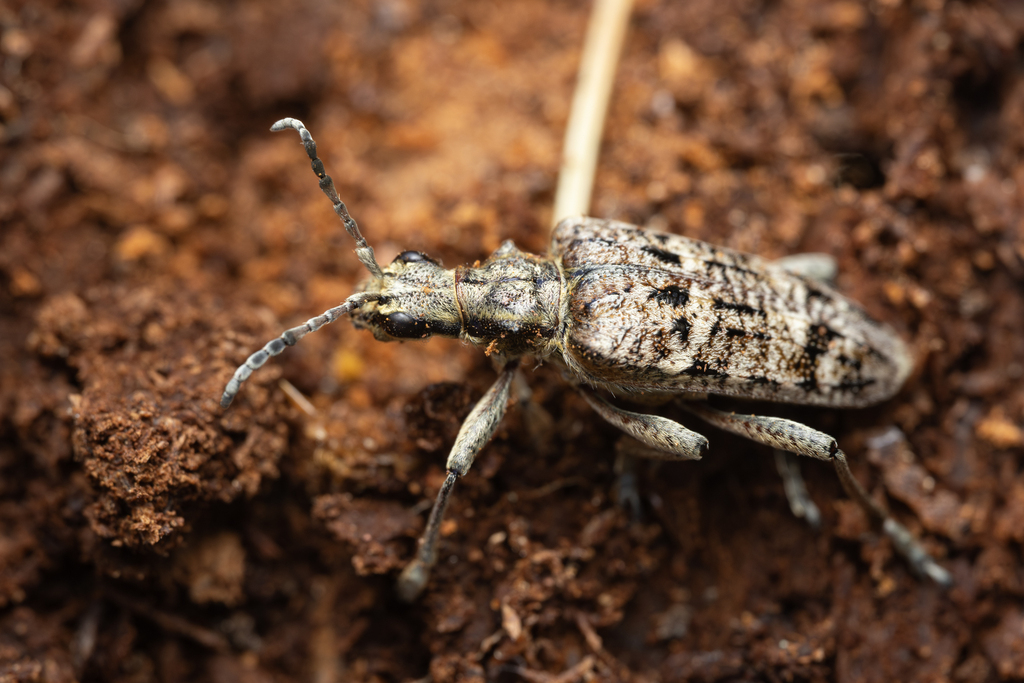
Ribbed Pine Borer
Rhagium inquisitor
Rhagium inquisitor, the “ribbed pine borer”, is a species of longhorn beetle in the family Cerambycidae. It was described by Carl Linnaeus in the 1758 10th edition of Systema Naturae as ‘‘Cerambyx inquisitor’’.The species is widely distributed in the Holarctic and is associated mainly with dead or recently felled coniferous wood.
From the article Rhagium inquisitor on Wikipedia (CC BY-SA), quoted section by section
Description
Adults are medium-sized longhorn beetles, usually about 9–22 mm long. The body is dark brown to blackish and is covered with mottled grey, yellowish, or brown pubescence that provides camouflage on bark and dead wood. The elytra are strongly sculptured and have prominent longitudinal ribs, a feature reflected in the common name “ribbed pine borer”. Unlike many longhorn beetles, the antennae are relatively short, usually much shorter than the body. The pronotum is broad and bears lateral projections or spines. The larvae are pale, soft-bodied wood-borers adapted to feeding beneath bark.
Range & habitat
‘‘Rhagium inquisitor’’ is widely distributed across the Holarctic region. In Europe it occurs in coniferous and mixed forests over much of the continent, and it is also recorded from parts of North Africa, the Caucasus, Turkey, Russia, and northern Asia. In North America it is known from Canada and the United States, especially in boreal, montane, and other coniferous forest habitats.
Wikipedia: “Distribution”
What it does
The life cycle usually lasts about two years. Females lay eggs in bark crevices on dead, dying, or recently cut trees. The larvae feed beneath the bark, mainly in the inner bark and cambial region, producing irregular galleries packed with frass. Mature larvae pupate beneath the bark in oval cells or chambers, often surrounded by coarse wood shavings or frass. Adults may overwinter in their pupal chambers and emerge in spring. In Europe, adults are generally recorded from April to July, although local flight periods vary with climate and altitude.
Wikipedia: “Life cycle and behavior”
Listen
Looking for field recordings…
Where it lives
Recorded sightings
—
geo-referenced records in GBIF, from museums, herbaria and field observers.
Drag the globe to turn it. Dots are where records exist, not a range map; darker means more records.
In the stacks
Searching the stacks…
Every page naming Rhagium inquisitor in the Biodiversity Heritage Library →
This page is assembled live from iNaturalist, GBIF, Wikipedia, the Source Library and the Internet Archive. It is not yet part of the hand-edited codex. iNaturalist taxon 229871.