- Animals
- ›Arthropods
- ›Hexapods
- ›Insects
- ›Winged and Once-winged Insects
- ›Beetles
- ›Water, Rove, Scarab, Long-horned, Leaf, and Snout Beetles
- ›Cucujiform Beetles
- ›Cucujoidea
- ›Pleasing Fungus Beetles
- ›Erotylinae
- ›Tritomini
- ›Triplax
- ›Triplax thoracica
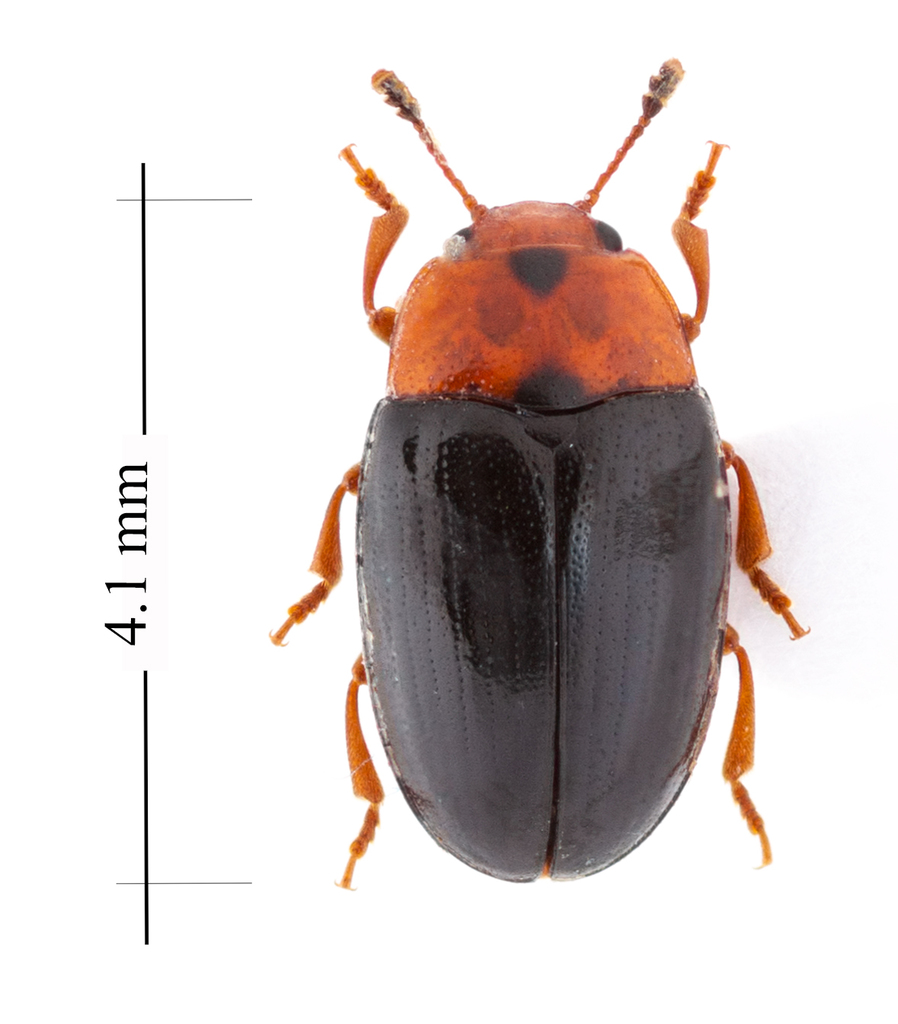
Triplax dissimulator
Triplax dissimulator is a North American species of small pleasing fungus beetle (family Erotylidae). It is placed in subfamily Tritominae (formerly Triplacinae), or – in taxonomic arrangements that prefer a more comprehensive subfamily Erotylinae – in tribe Tritomini of the Erotylinae.
From the article Triplax dissimulator on Wikipedia (CC BY-SA), quoted section by section
Description
Adults of this beetle are about 3-4.8 mm long and 1.6-2.6 mm wide; their elongated elliptical body is very broad for a Triplax, less than twice as long as it is wide. It resembles the closely related genus Tritoma in proportions, but its pronotum and basal half of the wing sides are almost parallel, not distinctly curving as is usual for Tritoma. The surface of the carapace is mostly bare or almost so, with conspicuous hair only on the abdomen. Like in many of their relatives, head and pronotum are reddish-orange, while the elytra are black and slightly shiny. Unusual for a Triplax, the centerline of the pronotum has two black spots, one at the front and one at the back side of the pronotum; these spots may be vestigial, usually they are immediately obvious. Most commonly the spots are slightly pointed towards the center of the pronotum; in some individuals they are larger and connect to form a broad lengthwise stripe, which has an hourglass shape except in the most large-spotted specimens. As usual for the members of the "breast-plated" species complex, T.flavicollis has orange antenna bases and legs; its hindleg coxae are black, however, and the coxae of its middle legs are brown. The "stem" of the antennae is orange like the base, while the "clubbed" antenna tip is brown to black. …
Range & habitat
The type locality of Triplax dissimulator is no more precise than "Illinois". It is one of the most northernly members of its genus in North America, occurring in the northeastern USA and south-central Canada with a similar distribution as T.frosti, in an arc running southeast to west along the huge prehistoric Lake Agassiz-Ojibway. From Quebec and Maine, it ranges south to New Jersey, and westwards across the Great Lakes region at least to Alberta in the north and Minnesota in the south.
Its northern extent is at least to St. Patrick's, Prince Edward Island, Morar, Nova Scotia, Hovey Hill in Richmond Parish, New Brunswick, Duparquet, Quebec, Malachi, Ontario, the Criddle/Vane Homestead Provincial Park ("Aweme") in Manitoba, and Edwand and Fort McMurray in Alberta. To what extent records from Alaska are genuine or due to misattributed or human-introduced specimens is unclear; the region is generally considered outside the natural range of Triplax. The southern limit of its range is even less well known. It occurs south at least to Newark, New Jersey and Harrisburg, Pennsylvania, but its distribution westwards to Illinois and Wisconsin is largely conjectural. In Minnesota, where it is perhaps most comprehensively attested, it occurs west at least to Itasca State Park. …
Wikipedia: “Distribution and ecology”
Listen
Looking for field recordings…
Where it lives
Recorded sightings
—
geo-referenced records in GBIF, from museums, herbaria and field observers.
Drag the globe to turn it. Dots are where records exist, not a range map; darker means more records.
In the stacks
Searching the stacks…
Every page naming Triplax dissimulator in the Biodiversity Heritage Library →
This page is assembled live from iNaturalist, GBIF, Wikipedia, the Source Library and the Internet Archive. It is not yet part of the hand-edited codex. iNaturalist taxon 233012.