- Animals
- ›Arthropods
- ›Hexapods
- ›Insects
- ›Winged and Once-winged Insects
- ›Beetles
- ›Water, Rove, Scarab, Long-horned, Leaf, and Snout Beetles
- ›Cucujiform Beetles
- ›Cucujoidea
- ›Pleasing Fungus Beetles
- ›Erotylinae
- ›Tritomini
- ›Triplax
- ›Triplax thoracica
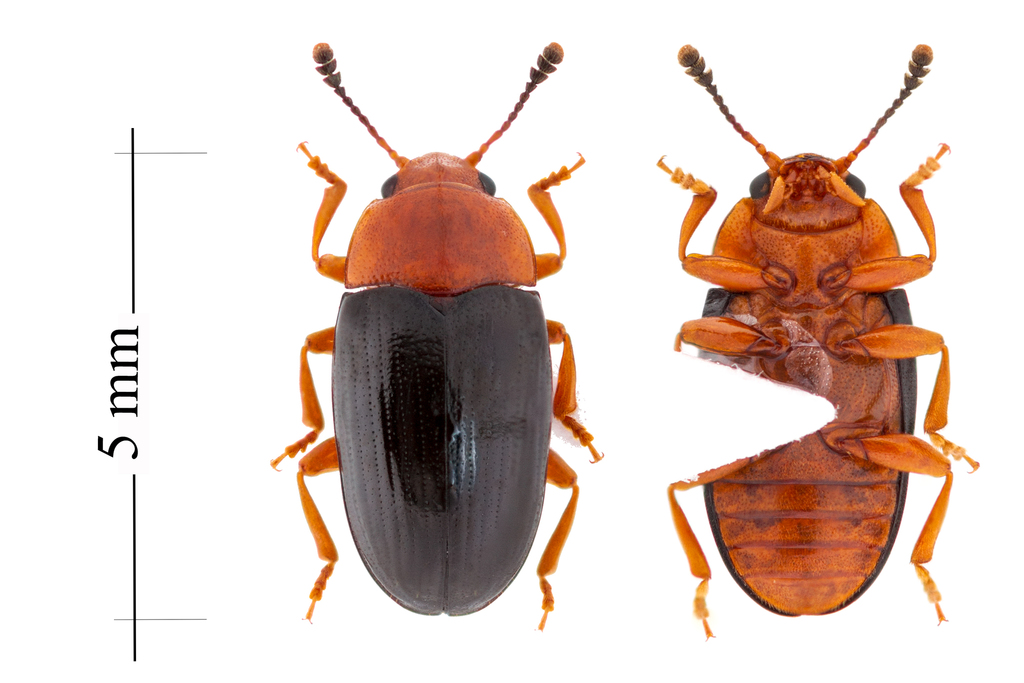
Breastplated Pleasing Fungus Beetle
Triplax thoracica
Triplax thoracica, the breast-plated triplax or breast-plated pleasing fungus beetle, is a North American species of small pleasing fungus beetle (family Erotylidae). It is placed in subfamily Tritominae (formerly Triplacinae), or – in taxonomic arrangements that prefer a more comprehensive subfamily Erotylinae – in tribe Tritomini of the Erotylinae.
It is suspected to form a large cryptic species complex with its relatives T.californica, T.cuneata, T.dissimulator, T.errans, T.flavicollis, T.frosti, T.lacensis, T.mesosternalis, T.microgaster, T.puncticeps and T.wehrlei (but see below).
From the article Triplax thoracica on Wikipedia (CC BY-SA), quoted section by section
Description
Adults of this beetle are about 3-5.7 mm long and 1.5-2.9 mm wide. Their elongated body has smoothly curving sides; it is somewhat shiny and mostly bare, with conspicuous hair only on the abdomen. Like in many of their relatives, head and pronotum are reddish-orange, while the elytra are black. The scutellum is dark brown, appearing black like the elytra except from up close. As usual for the members of the "breast-plated" species complex, T.thoracica has orange legs and antenna bases and lacks a conspicuous margin to the forehead sides, which also form a well-rounded obtuse angle towards the mouth; the "stems" of its antennae become gradually darker towards the black antenna "clubs".
It can be distinguished from most other Triplax – even very close relatives – by having an all-orange underside, no distinct margin at the base of the elytra, and strongly expanded maxillary palps; T.frosti is identical in these regards, but T.thoracica differs from that species by having the spaces between the lengthwise lines of large punctures on the elytra strewn with smaller punctures throughout (instead of smooth at the elytra base as in T.frosti), and a scutellum that is a similar blackish color as the elytra, not orange-yellow as the pronotum as it is in T.frosti. The male genitalia are also clearly different. …
Range & habitat
The type specimen, like many beetles collected by Thomas Say, is probably lost; its type locality was not given more precisely than "United States", referring to the U.S. territory around 1820. T.thoracica is widespread in North America east of the Rocky Mountains, from Prince Edward Island, New Brunswick and Nova Scotia to Alberta in the north, and south to the Gulf of Mexico coast and New Mexico. Its western limit runs through North Dakota, South Dakota, Nebraska and Colorado. Isolated records elsewhere – e.g. British Columbia or Central America – are probably due to misidentifications or individuals introduced by humans. Its northern limit is north of the Great Lakes region; it occurs northeastwards at least to St. Patrick's, Prince Edward Island, Cumberland, Pictou and Guysborough counties in Nova Scotia, Bathurst, New Brunswick and Potton Springs, Quebec, and further west at least to Duparquet, Quebec, Nipigon, Ontario, the Criddle/Vane Homestead Provincial Park ("Aweme") in Manitoba, and Beaverlodge and Fort McMurray in Alberta where it even ranges into subarctic climates. Supposed records further north, such as from Lake Athabasca and north of the Peace River, or northwest such as near Kelowna, British Columbia, require confirmation. …
Wikipedia: “Distribution”
What it does
This beetle inhabits deciduous forests, avoiding dry and sparsely vegetated regions in the Great Plains; at the northern limit of its range it might also utilize conifer-dominated taiga forests. Adults are active whenever the ground is not frozen, typically between mid-March and late October, but in the south of the range they may be encountered almost year-round. Even as far north as southeastern Pennsylvania, it has been collected on March 30 (Unionville, Chester County) and November 25 (Collingdale). In Victoria, Texas, specimens were taken on March 12 and December 28, in Gainesville, Florida, on February 9, and in Columbia, Missouri, near the center of its range, on December 9. It is better-adapted to cold than many other Triplax, as demonstrated by its almost year-round occurrence, its wide Canadian range, and a record from 4,000 feet (1,200 m) AMSL on Mount Mansfield, Vermont. However, as usual for Triplax, they are most commonly encountered between June and August, when they can sometimes be caught on the wing e.g. with a window trap. As typical for its species complex, they have a strong preference for oyster mushrooms (Pleurotus; Agaricales: Pleurotaceae) as larvae and adults; usually, these beetles are recorded on the common oyster mushroom (Pleurotus ostreatus). The larvae in particular may not be able to eat any other food. …
Wikipedia: “Ecology”
Listen
Looking for field recordings…
Where it lives
Recorded sightings
—
geo-referenced records in GBIF, from museums, herbaria and field observers.
Drag the globe to turn it. Dots are where records exist, not a range map; darker means more records.
In the stacks
Searching the stacks…
Every page naming Triplax thoracica in the Biodiversity Heritage Library →
This page is assembled live from iNaturalist, GBIF, Wikipedia, the Source Library and the Internet Archive. It is not yet part of the hand-edited codex. iNaturalist taxon 233017.