- Animals
- ›Arthropods
- ›Hexapods
- ›Insects
- ›Winged and Once-winged Insects
- ›Beetles
- ›Water, Rove, Scarab, Long-horned, Leaf, and Snout Beetles
- ›Cucujiform Beetles
- ›Cucujoidea
- ›Pleasing Fungus Beetles
- ›Erotylinae
- ›Tritomini
- ›Tritoma
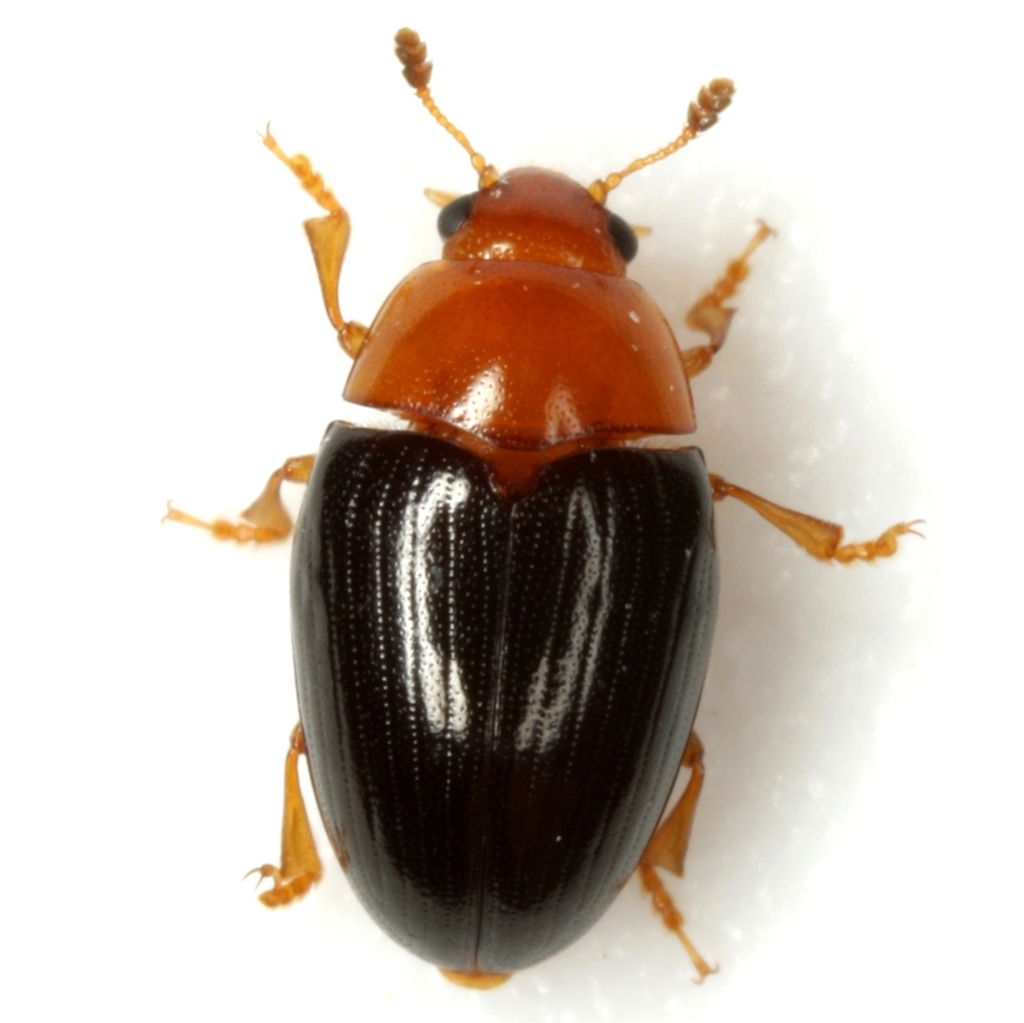
Tritoma angulata
Tritoma angulata is a species of small pleasing fungus beetle (family Erotylidae) endemic to the United States. It belongs to subfamily Tritominae, or – in taxonomic arrangements that prefer a more comprehensive subfamily Erotylinae – in tribe Tritomini of the Erotylinae.
From the article Tritoma angulata on Wikipedia (CC BY-SA), quoted section by section
Description
This is a tiny beetle, about 2.6-4.35 mm long and 1.8-2.6 mm wide as adults. It is widely oval in shape, with the wingtips almost as blunt as the head; unlike most Tritoma, they lack contrasting red coloration on the elytra and/or pronotum. The adults are moderately shiny and almost entirely blackish, with a browner underside and head, and yellow-orange legs whose tibiae are conspicuously widened; the "stalks" of the antennae are also yellow-orange, while the "clubs" at the end are black. However, there is a rare color morph in which the head, prothorax, and scutellum are yellow-orange like the legs. Such individuals can be mistaken for T.erythrocephala, but their conspicuously widened tibia tips are distinctive. However, even noted Erotylidae expert George Crotch got fooled by the close similarity – the T. erythrocephala in his collection actually was a T.angulata, while one of his two supposed T.angulata was a Pseudischyrus nigrans. …
Range & habitat
T.angulata is found in the eastern to central US, from the New England states to Michigan, Iowa and Nebraska in the north, and from Florida to central Missouri, Arkansas and central Texas in the south. Westwards its range extends at least to Washington County, Arkansas, and across the Missouri River at Kenosha in Cass County, Nebraska. There is also a single specimen whose collection locality is given as "Pasadena, Cal.", but this is probably erroneous. Records from the western limit of its range, e.g. Iowa and Nebraska, are scarce, but this beetle is usually under-recorded, being less prone to getting into Malaise traps than other Tritoma species. The type specimen, like many beetles collected by Thomas Say, is probably lost; its type locality was not given more precisely than "United States", referring to the U.S. territory around 1820. Jean Lacordaire in his 1842 major review of pleasing fungus beetles described a "variety A" of T.unicolor; this beetle is almost certainly T.angulata. …
Wikipedia: “Distribution and taxonomy”
What it does
To thrive, this species seems to require higher temperatures than many of its relatives: while they can be found on the wing at least from early March to mid-October, sizeable numbers of adults are noted only between June and early September. As noted above, they seem to have the same diurnal or crepuscular habits as other Tritoma, but are less likely to be caught in Malaise traps than usual for this genus.
Like its closest relatives, T.angulata eats gilled fungi as larva and adults. Its main food source seems to be fungi of the "brittlegill" family Russulaceae in order Russulales. Among these, the blancaccio (Lactifluus piperatus) has been found most often in association with T.angulata and is also suitable as larval food, as is the related Lactifluus subvellereus which seems to be somewhat less popular with this beetle. But many records of T.angulata larvae exist from unidentified Russulaceae; probably, many members of the family are suitable as food for this beetle's adults, and several might even feed its more demanding larvae. For adult T.angulata, the green brittlegill (Russula aeruginea) as well as R.mariae and R.subalbida also seem to be quite attractive, but somewhat less so than the two Lactiflua. …
Wikipedia: “Ecology”
Listen
Looking for field recordings…
Where it lives
Recorded sightings
—
geo-referenced records in GBIF, from museums, herbaria and field observers.
Drag the globe to turn it. Dots are where records exist, not a range map; darker means more records.
In the stacks
Searching the stacks…
Every page naming Tritoma angulata in the Biodiversity Heritage Library →
This page is assembled live from iNaturalist, GBIF, Wikipedia, the Source Library and the Internet Archive. It is not yet part of the hand-edited codex. iNaturalist taxon 233026.