- Animals
- ›Arthropods
- ›Hexapods
- ›Insects
- ›Winged and Once-winged Insects
- ›Beetles
- ›Water, Rove, Scarab, Long-horned, Leaf, and Snout Beetles
- ›Cucujiform Beetles
- ›Cucujoidea
- ›Pleasing Fungus Beetles
- ›Erotylinae
- ›Tritomini
- ›Tritoma
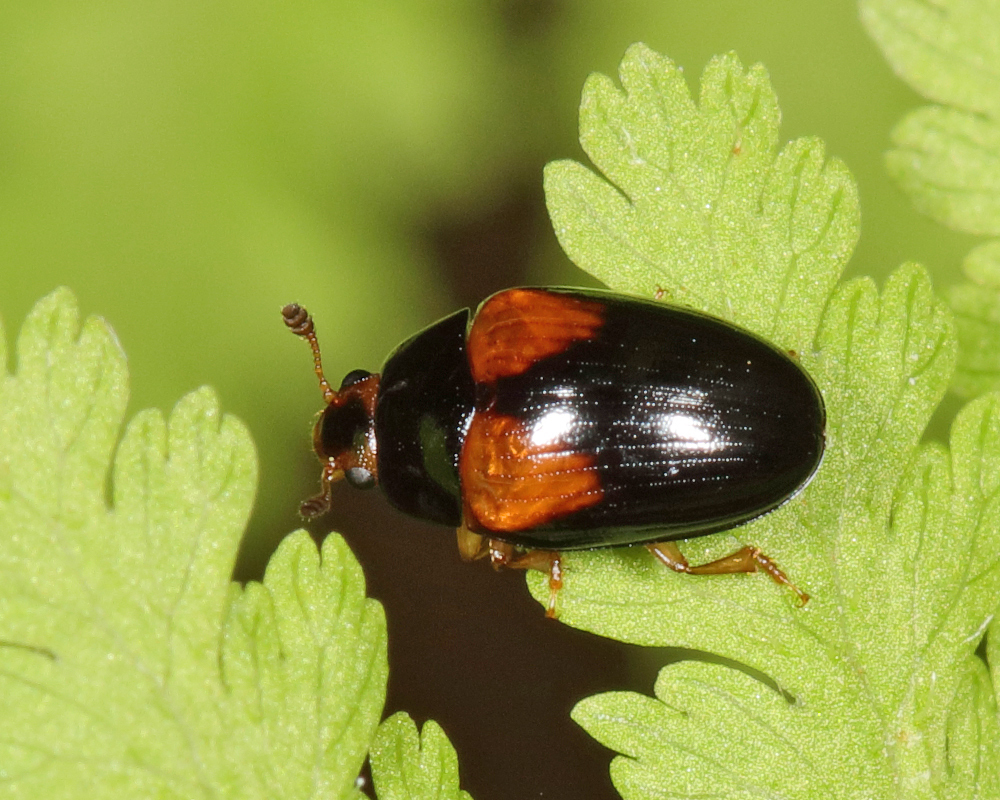
Two-spotted Pleasing Fungus Beetle
Tritoma biguttata
Tritoma biguttata, the two-spotted pleasing fungus beetle or two-spotted tritoma, is a North American species of small pleasing fungus beetle (family Erotylidae). It belongs to subfamily Tritominae, or – in taxonomic arrangements that prefer a more comprehensive subfamily Erotylinae – in tribe Tritomini of the Erotylinae.
From the article Tritoma biguttata on Wikipedia (CC BY-SA), quoted section by section
Description
This is a tiny beetle, about 2.7-4.4 mm long and 1.5-2.6 mm wide as adults, widely oval in shape with somewhat pointed wingtips, and a shiny surface of the exoskeleton. As typical for Tritoma sensu stricto, T.biguttata has a triangular mentum, as well as an epistome whose tip is sharply cut off, causing the line running parallel to the epistome margin to angle towards the antennae insertions. Their coloration differs according to subspecies: Typical adults of the nominate T.b.biguttata are black on the top of the head, the upperside of the pronotum and the underside of the pronotal epipleura, the scutellum, and most of the elytra. The "clubs" of the antennae are dark reddish-brown. The rest of head and underside, the legs, and the "stalk" of the antennae are orange. On each elytron, there is a large and somewhat triangular orange-red spot, extending at the front from next to the scutellum to the "shoulder"; to the rear, the spot stretches for 25-50% of the elytral length, narrowing towards the end. …
Range & habitat
T.humeralis is found in eastern to central North America, from Quebec to Wisconsin in the north, and from Florida to Texas in the south. Its western limit is not well known; it ranges at least to Jefferson County, Nebraska and Goliad, Texas. In the northeastern USA, it occurs at least up to Durham, New Hampshire, Hamburg and Six Mile Creek in upstate New York, and to Middlesex County and Saugus, Massachusetts. Two subspecies are accepted today. Highly distinct in coloration (see above), they represent a southeast-northwest divide:
Tritoma biguttata affinis Lacordaire, 1842 – South Carolina to southwestern Illinois, southern Missouri, Nebraska and Iowa; in the south from Florida to Texas Tritoma biguttata biguttata (Say, 1825) – Quebec to Wisconsin, and northern Virginia to Michigan, northwestern Illinois, northern Tennessee, northern Missouri and South Dakota. The type specimen of biguttata, like many beetles collected by Thomas Say, is probably lost. Its origin was given simply as "United States. Jean Lacordaire's type specimen of affinis has an even more nondescript origin: "North America". There are also some questionable specimens with the color pattern of typical biguttata: one, at the AMNH, was supposedly collected by Charles Palm at St. …
Wikipedia: “Range and subspecies”
What it does
Adults of T.b.affinis at the southern limit of its range are active at least from April to November; further north, this warmth-loving species starts to hibernate in October. A record from woodland debris ("woods trash") on February 8, 1939, at [[Florence, South Carolina]], probably refers to hibernating individuals, but at Creeds, Virginia, on October 13, 1944, adults were still active on fungi. Wherever it occurs, T.biguttata is most often encountered in the hot summer months, when the adults can be attracted to UV light at night. The "carolinae" intergrades do not form a truly self-sustaining population; their offspring backcross with affinis and biguttata, while the F1 hybrids are constantly replenished. Thus, "carolinae" records are almost invariably in summer and early fall (June to September), when the new F1 offspring are on the wing and easily identified by their unequivocally intermediate color pattern. Not infrequently, this species is found associated with T.humeralis – which looks almost like T.b.biguttata from above, but is easily recognized by its blackish underside – and somewhat less often with T.mimetica. These close relatives have somewhat more indiscriminate feeding habits, which probably prevents too intense competition. Records not associated with fungi or woodland detritus such as tree bark are comparatively rare for Erotylidae in general. …
Wikipedia: “Ecology”
Listen
Looking for field recordings…
Where it lives
Recorded sightings
—
geo-referenced records in GBIF, from museums, herbaria and field observers.
Drag the globe to turn it. Dots are where records exist, not a range map; darker means more records.
In the stacks
Searching the stacks…
Every page naming Tritoma biguttata in the Biodiversity Heritage Library →
This page is assembled live from iNaturalist, GBIF, Wikipedia, the Source Library and the Internet Archive. It is not yet part of the hand-edited codex. iNaturalist taxon 233027.