- Fungi Including Lichens
- ›Ascomycete Fungi
- ›Sac Fungi and Lichens
- ›Common Lichens
- ›rocktripes, bloodspot lichens, and allies
- ›rocktripes, bloodspot lichens, and allies
- ›Rocktripes, Toadskin Lichens, and allies
- ›Umbilicaria
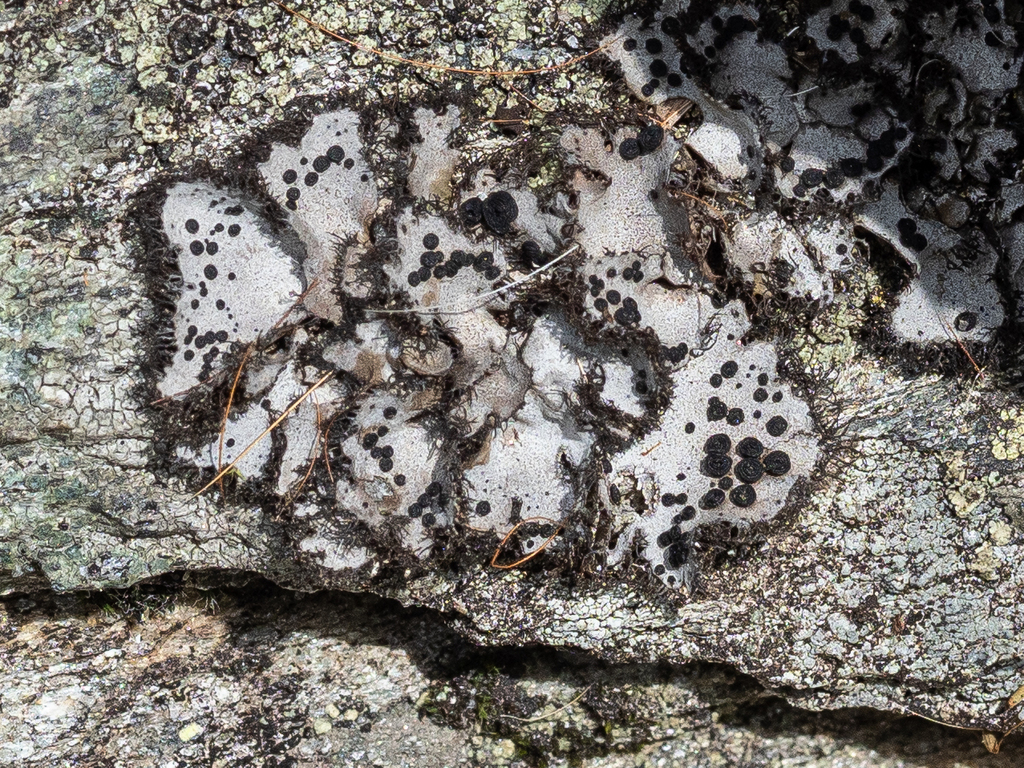
Fringed Rocktripe Lichen
Umbilicaria cylindrica
Umbilicaria cylindrica, commonly known as the fringed rock tripe, is a leafy lichen found in cold, high-altitude and polar regions across the globe. It forms roughly circular thalli measuring between 2–10 centimetres and is easily recognised with a dark upper surface bordered by a fringe of fine, hair-like projections. As one of the first colonisers of bare rock, it paves the way for more complex communities in areas exposed to intense ultraviolet light. The species is particularly abundant in Arctic–alpine environments, where it can form extensive patches on exposed boulders and rock outcrops.
First described scientifically by Carl Linnaeus in 1753, the species has undergone several reclassifications as researchers have explored its varied appearances and chemical traits. While many names have been historically assigned to its various forms, current studies show that these differences are simply variations within one highly variable species. Essential for identification are its maze-like reproductive discs (apothecia) and its distinctive three-layered internal structure. The species exhibits considerable morphological plasticity, with variations in thallus size, colour, and surface texture documented across its range.
From the article Umbilicaria cylindrica on Wikipedia (CC BY-SA), quoted section by section
Description
Umbilicaria cylindrica has a leaf-like thallus that reaches 2–10 cm in diameter, though most specimens are smaller than 4 cm across. One specimen, originally documented as the variety delisei, was recorded at a diameter of 26 cm. The thallus consists of multiple lobes that may be either smoothly rounded or irregularly jagged, and sometimes contain small holes. The upper surface ranges in colour from dark brown to dark grey or black, and may be covered in places with a grey, powdery coating. Its texture can be smooth or slightly rough with tiny, map-like cracks. Inside, the thallus has a distinctive three-layered medulla: a loosely arranged, web-like (arachnoidal) outer layer, a dense plectenchymatic central core, and another web-like layer beneath. The internal structure of the thallus contains a distinctive three-layered medulla (inner tissue): an upper web-like layer beneath the algal zone, a dense central layer where fungal threads are tightly packed in parallel, and a lower web-like layer connecting to the bottom surface. This "decussata-type" medullary structure is characteristic of the species. …
Range & habitat
Umbilicaria cylindrica is an Arctic–alpine lichen found on exposed rocky surfaces in cold, mountainous regions. It prefers siliceous (acidic) rocks such as granite and basalt, and typically grows in the alpine vegetation zone above treeline. Thalli are usually located on windswept boulders and outcrops with only a brief seasonal snow cover, often near mountaintops. In the Alps, it occurs from subalpine elevations around 1000 m up to the nival zone, with records from as high as 4270 m on the Finsteraarhorn. This lichen tolerates extreme climatic conditions of high UV exposure, frequent freeze-thaw cycles, and desiccation typical of alpine and polar environments. In Greenland, the species shows an unusual altitudinal distribution pattern: while typically found at high elevations elsewhere, it is scarce in continental highlands and lower coastal areas due to the desiccating effects of frequent Foehn winds. However, it persists at higher coastal altitudes up to 1600 m where these warm, dry winds have less impact. Rather than acting as a pioneer species in these locations, it functions more as a specialist coloniser of protected ecological niches. Umbilicaria cylindrica has a circumpolar distribution across the Northern Hemisphere and is widespread in arctic and boreal-alpine regions. …
Wikipedia: “Habitat and distribution”
What it does
In its alpine habitats, U. cylindrica often grows as part of lichen-dominated communities on bare rock. It is a pioneer species on newly exposed substrates (such as glacier forefields), helping initiate soil formation and ecosystem succession on barren rock. Its tolerance for harsh conditions allows it to colonize surfaces that few other organisms can, and mature thalli can persist for decades, slowly expanding and often dominating the microhabitat. On sun-exposed, wind-blasted ridges and plateaus, U. cylindrica frequently co-occurs with other hardy lichens (e.g. species of Cetraria, Stereocaulon, Rhizocarpon) and bryophytes, although total vegetation cover remains sparse. In Arctic sites, it can be among the most abundant foliose lichens on relatively flat rock surfaces (reaching about 5–8% cover in some lichen communities). Umbilicaria cylindrica is known to host specialised parasitic or commensal fungi (lichenicolous fungi) that grow on or within its thallus. Several species have been documented on U. cylindrica. For example, the fungus Stigmidium gyrophorarum infects the thallus of U. cylindrica, forming tiny black perithecia on its surface. The species is also host to Lichenostigma epiumbilicariae, a lichenicolous fungus that forms distinctive dark superficial hyphal cords on the upper surface of the thallus. While this fungus specifically targets U. …
Wikipedia: “Ecology”
Where it lives
Recorded sightings
—
geo-referenced records in GBIF, from museums, herbaria and field observers.
Drag the globe to turn it. Dots are where records exist, not a range map; darker means more records.
In the stacks
Searching the stacks…
Every page naming Umbilicaria cylindrica in the Biodiversity Heritage Library →
This page is assembled live from iNaturalist, GBIF, Wikipedia, the Source Library and the Internet Archive. It is not yet part of the hand-edited codex. iNaturalist taxon 233242.