- Fungi Including Lichens
- ›Ascomycete Fungi
- ›Sac Fungi and Lichens
- ›Common Lichens
- ›rocktripes, bloodspot lichens, and allies
- ›rocktripes, bloodspot lichens, and allies
- ›Rocktripes, Toadskin Lichens, and allies
- ›Umbilicaria
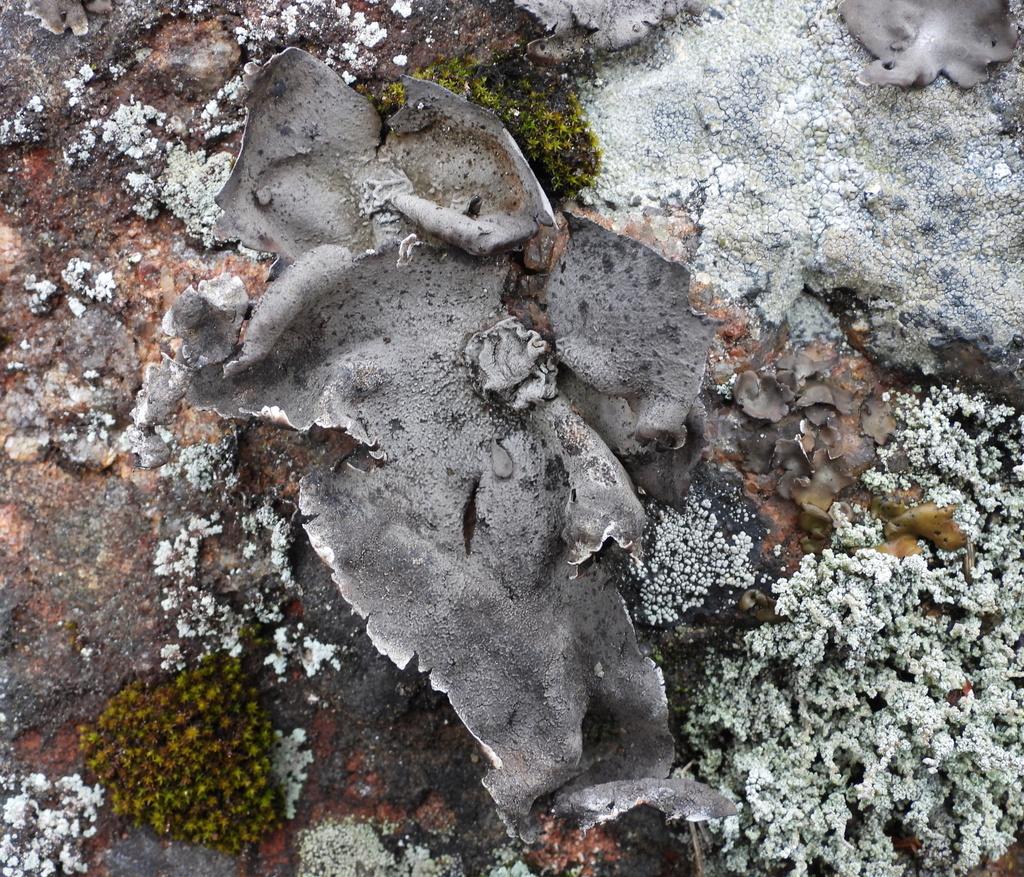
Umbilicaria nylanderiana
Umbilicaria nylanderiana is a species of foliose lichen in the family Umbilicariaceae. It typically appears as a single, rigid disc attached to rock surfaces. First described in 1927, it can grow up to 6 cm (2.4 in) across and is characterised by its dark brown to grey upper surface with dense, rounded ridges, and a black lower surface. The species is found worldwide on boulders and cliffs in alpine regions, including Europe, North and South America, and parts of maritime Antarctica. It can be distinguished from similar-looking species by its production of specialised reproductive structures called thalloconidia, which appear as dark oval cells covering most of its lower surface.
From the article Umbilicaria nylanderiana on Wikipedia (CC BY-SA), quoted section by section
Description
The thallus of Umbilicaria nylanderiana is typically monophyllous (having single lobe), rigid, and brittle, often with lacerated margins, although it can sometimes be polyphyllous (multi-lobed), particularly in wind-exposed habitats. It usually measures up to 6 cm (2.4 in) across, but Antarctic specimens are considerably smaller, growing to about 2 cm in diameter. The upper thallus surface is dark brown to grey, characterised by densely packed, high, rounded ridges, while the lower surface is black and smooth. Reproductive features of the lichen include black, adnate, and gyrose apothecia (fruiting bodies), which are more common in Neotropic specimens and rarer in European samples. Asci (spore-bearing cells) are club shaped (clavate). Ascospores typically number eight per ascus, ranging from unicellular to multicellular, and are hyaline or brown, measuring 7–16 by 5–9 μm. The thalloconidia are unicellular, dark brown to black, and oval or ellipsoid, typically covering the entire lower surface except at the peripheral areas.
Range & habitat
Umbilicaria nylanderiana is primarily found on the vertical to horizontal faces of large boulders or cliffs in the alpine zone, frequently above the snow line in winter. Its distribution is global, occurring throughout Europe, North America, and South America. This species is the only common brown Umbilicaria in Ecuador and occupies ecological niches similar to those of several brown species in North America, Europe, and Asia, such as U. hyperborea, U. deusta, and U. arctica. In Antarctica, its distribution is restricted to the maritime Antarctic region, ranging from the South Orkney Islands in the north to as far south as 68°S along the west coast of the Antarctic Peninsula and its offshore islands. In this region, it is found only in coastal sites at elevations between 5 and 200 m (16 and 656 ft) above sea level, often on north-facing volcanic rocks. While generally rare in Antarctica, it can be locally abundant in some environments.
== References ==
Wikipedia: “Habitat and distribution”
Where it lives
Recorded sightings
—
geo-referenced records in GBIF, from museums, herbaria and field observers.
Drag the globe to turn it. Dots are where records exist, not a range map; darker means more records.
In the stacks
Searching the stacks…
Every page naming Umbilicaria nylanderiana in the Biodiversity Heritage Library →
This page is assembled live from iNaturalist, GBIF, Wikipedia, the Source Library and the Internet Archive. It is not yet part of the hand-edited codex. iNaturalist taxon 233250.