- Animals
- ›Arthropods
- ›Hexapods
- ›Insects
- ›Winged and Once-winged Insects
- ›Flies
- ›Brachyceran Flies
- ›Cyclorrhaphan Flies
- ›Schizophoran Flies
- ›Acalyptrate Flies
- ›Opomyzoidea
- ›Leaf-miner Flies
- ›Phytomyzinae
- ›Liriomyza
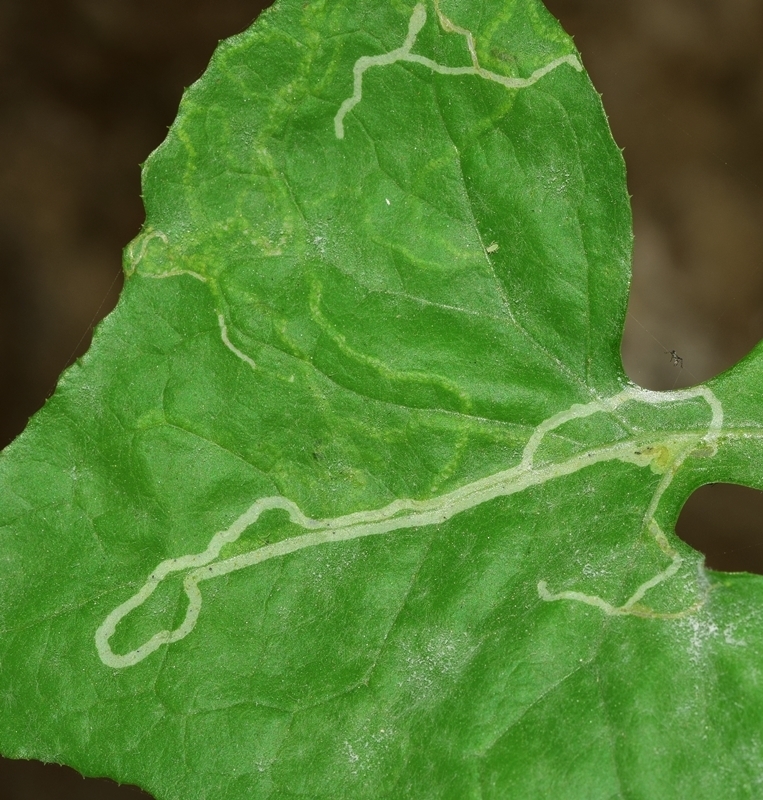
American Serpentine Leaf Miner
Liriomyza trifolii
Liriomyza trifolii, known generally as the American serpentine leafminer or celery leafminer, is a species of leaf miner fly in the family Agromyzidae.
L. trifolii is a damaging pest, as it consumes and destroys produce and other plant products. It commonly infests greenhouses and is one of the three most-damaging leaf miners in existence today. It is found in several countries around the globe as an invasive species, but is native to the Caribbean and the Southeastern United States.
From the article Liriomyza trifolii on Wikipedia (CC BY-SA), quoted section by section
Description
L. trifolii are relatively small flies for their family. The adults typically measure less than 2 mm in length. They are mostly yellow in color, although parts of the abdomen and thorax are dark brown or grey. They typically have yellow legs. A key distinction between L. trifolii and their very similar relatives, L. sativae, are L. trifolii's dark, matte mesonotum.
L. trifolii typically have a wingspan of 1.25 to 1.90 mm. Their wings are transparent and have veins in a similar pattern to that of flies in the Phytomyzinae subfamily.
Range & habitat
Originally, L. trifolii was solely found in Caribbean countries and the southeastern United States (specifically concentrated in southern Florida). However, export of produce and other vegetative goods from these areas has led to the dispersion of L. trifolii to several countries in Asia along the Pacific Ocean, as well as Europe, California, and certain parts of Canada. This human-facilitated dispersion occurred mostly after L. trifolii became resistant to certain insecticides and therefore were not killed off by the exports' treatment with insecticides before and after transport.
Wikipedia: “Distribution”
What it does
L. trifolii is a highly destructive pest of both produce and ornamental plants. They often infest greenhouses and inhabit shipping containers, making them an invasive species in several countries around the globe. Because of this, they are a quarantine species in several countries, meaning their host plants are isolated for testing when L. trifolii are found on them. L. trifolii are most destructive to floricultural crops, which are severely impacted by any insect damage. Leaf miner abundance is assessed using a variety of sampling methods, including counting mines, counting live larvae, collecting pupae, and capturing adults. L. trifolii can be destructive to crops in many ways, including spreading diseases, destroying seedlings, and altering leaf production, which damages the fruits. All of these impacts on the crops decrease their value, which can be catastrophic to the industry.
Insecticide Resistance. The spread of this pest is widely due to the fly's developed resistance to certain insecticides. This has been a major issue combatted by attempts from the Florida Fruit and Vegetable Association (FFVA) to mitigate the infestation and spread of these pests. However, due to previous spreading of L. trifolii through exported goods, L. trifolii are already a major pest of ornamentals in California. …
Wikipedia: “Interactions With Humans”
At the table
Both larval and adult female L. trifolii feed primarily on the leaves of their host plants. Larvae feed mostly on the layer of the leaf just below the epidermis, while female adults feed on liquids expelled by the leaves after the adult has punctured them. L. trifolii feed on a large variety of host plants, including both vegetables and ornamental plants. Studies on the flies' preferred hosts show that some of L. trifolii's most preferable hosts are chrysanthemums, Gerber daisies, and celery. When the females are placed on preferable hosts, they produce more holes and show an increased rate of oviposition.
Wikipedia: “Food Resources”
In human culture
Compared to other flies, L. trifolii have a relatively brief life cycle, ranging from 21 to 28 days in habitats they are native to. Because of this, there can be multiple generations of L. trifolii within one year in warm climates. Additionally, the rate of development for L. trifolii has been shown to be temperature-dependent. Maximum pupal survival rates and oviposition rates were shown to occur at 30˚C.
Eggs. The eggs are typically about 1 mm long, 0.2 mm wide, and oval in shape. Initially after oviposition, the eggs are clear, but they become creamy white in color as time goes on. Eggs are laid just below the surface of the leaf; when the larvae hatch, they mine their way out of the leaf as they feed, hence the name "leaf miner". The eggs frequently fall victim to parasitoid wasps.
Larval Instars. The larvae of L. trifolii are unique from those of many other flies in their shape, as the body of L. trifolii larva does not taper at the head end. The larvae are uniform in thickness at both their anterior and posterior ends but additionally have a pair of spiracles at the posterior end. They do not have legs and are initially clear in color, but gradually become yellow as they mature. The larval instars are differentiable by the lengths of the body and mouthparts. The first instar is recognizable by a mean body length of 0.39 mm and a mouthpart length of 0.10 mm. …
Wikipedia: “Life History”
Listen
Looking for field recordings…
Where it lives
Recorded sightings
—
geo-referenced records in GBIF, from museums, herbaria and field observers.
Drag the globe to turn it. Dots are where records exist, not a range map; darker means more records.
In the stacks
Searching the stacks…
Every page naming Liriomyza trifolii in the Biodiversity Heritage Library →
This page is assembled live from iNaturalist, GBIF, Wikipedia, the Source Library and the Internet Archive. It is not yet part of the hand-edited codex. iNaturalist taxon 243751.