- Animals
- ›Arthropods
- ›Hexapods
- ›Insects
- ›Winged and Once-winged Insects
- ›True Bugs, Hoppers, Aphids, and allies
- ›True Hoppers
- ›Spittlebugs, Cicadas, Leafhoppers and Treehoppers
- ›Cicadas
- ›Typical Cicadas
- ›Cicadinae
- ›Moss Cicadas and Allies
- ›Guyalnina
- ›Quesada
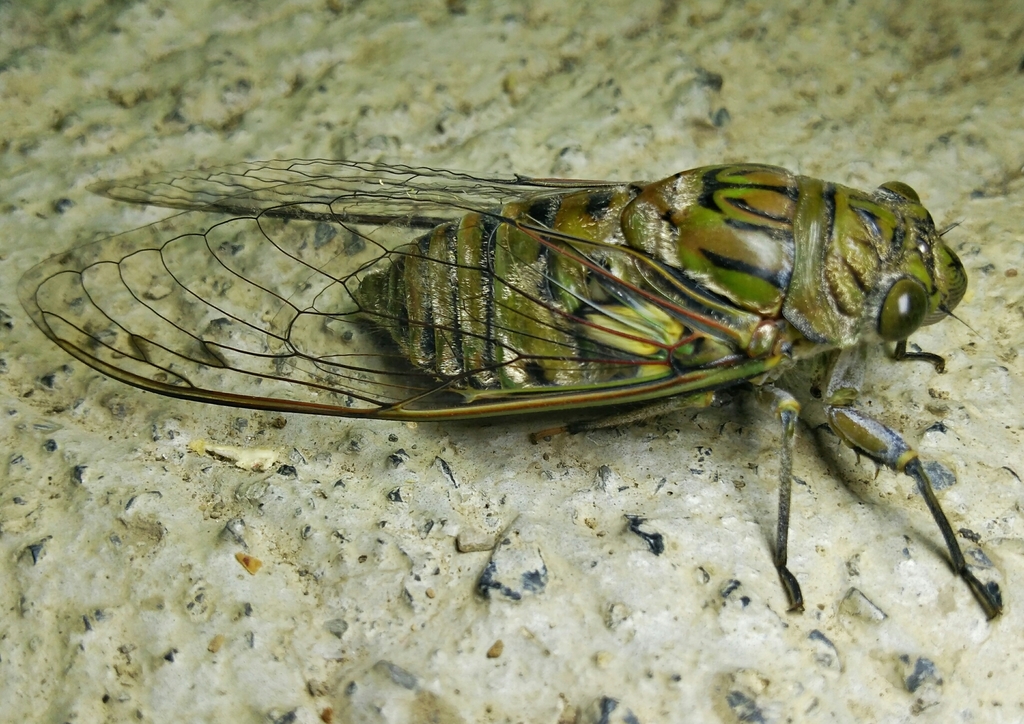
Giant Cicada
Quesada gigas
The Giant cicada (Quesada gigas), also known as the chichara grande, coyoyo, or coyuyo, is a species of large cicada native to North, Central, and South America. One of two species in the genus Quesada, it is the widest ranging cicada in the Western Hemisphere.
From the article Giant cicada on Wikipedia (CC BY-SA), quoted section by section
Description
The giant cicada is one of the largest cicada species in North America. Like other Texan species, the giant cicada has an appearance that helps it camouflage into the environment. These true bugs are usually a combination of black, green and brown patterns, with brown to olive eyes and a brownish-green pronotal collar color. Texan cicadas distinguish themselves by sound, rather than appearance.
Range & habitat
The giant cicada is the only species of the genus Quesada found in North America. The species feeds off of a wide variety of plant families. As an endothermic species, it has the ability to live in a wide range of environments. In the United States, the giant cicada primarily resides in the South Texas brushland, in an area spanning approximately from Laughlin Air Force Base (near Del Rio, Texas) in the west through Uvalde, San Antonio and Austin in the east, ranging nearly to the western limits of Houston. There have been sightings near cities such as Bellville, Brenham, Chappell Hill and Hempstead, Texas. Further south, its range includes most of the southern half of Texas before entering into Mexico, where it is primarily found from Coahuila, along the Mexican Gulf coast states, through to the Yucatán Peninsula. The species' range typically does not extend inland or far to the west until San Luis Potosí. In the west of Mexico, its range begins just north of Mazatlán and continues southward, along the coast, and inland through Guadalajara, Mexico City and all regions further south. South of Mexico, the giant cicada is found across much of Belize, El Salvador, Guatemala, Honduras, Nicaragua, Costa Rica, Panama, Brazil, Colombia, Ecuador, Venezuela, the Guianas, Trinidad and Tobago, Bolivia, Peru, Paraguay and Uruguay. …
Wikipedia: “Distribution and habitat”
What it does
Immature giant cicadas spend at least four years underground before emerging as adults. The cicadas feed on tree roots, typically Huisache or other members of the legume family. They usually emerge between April and October in south Texas, and from June to July in central Texas.
Wikipedia: “Life cycle”
In human culture
The giant cicada was discovered by Guillaume-Antoine Olivier in 1790. British naturalist Henry Walter Bates described the shrill songs of the cicadas during his exploration in the Amazon in the late 1840s. There are historical records of the cicada in Bexar County, Texas starting in 1934, but this population died out - possibly due to the extended drought of the 1950s. Since 2005, the cicada population has grown and become widespread in central Texas. It currently ranges from central Texas to as far south as Mina Clavero, Argentina.
Wikipedia: “History”
Listen
Looking for field recordings…
Where it lives
Recorded sightings
—
geo-referenced records in GBIF, from museums, herbaria and field observers.
Drag the globe to turn it. Dots are where records exist, not a range map; darker means more records.
In the stacks
Searching the stacks…
Every page naming Quesada gigas in the Biodiversity Heritage Library →
This page is assembled live from iNaturalist, GBIF, Wikipedia, the Source Library and the Internet Archive. It is not yet part of the hand-edited codex. iNaturalist taxon 244024.