- Plants
- ›Vascular Plants
- ›flowering plants
- ›Dicots
- ›Mints, Plantains, Olives, and Allies
- ›broomrape family
- ›Orobancheae
- ›Orobanche
- ›Glandulosae
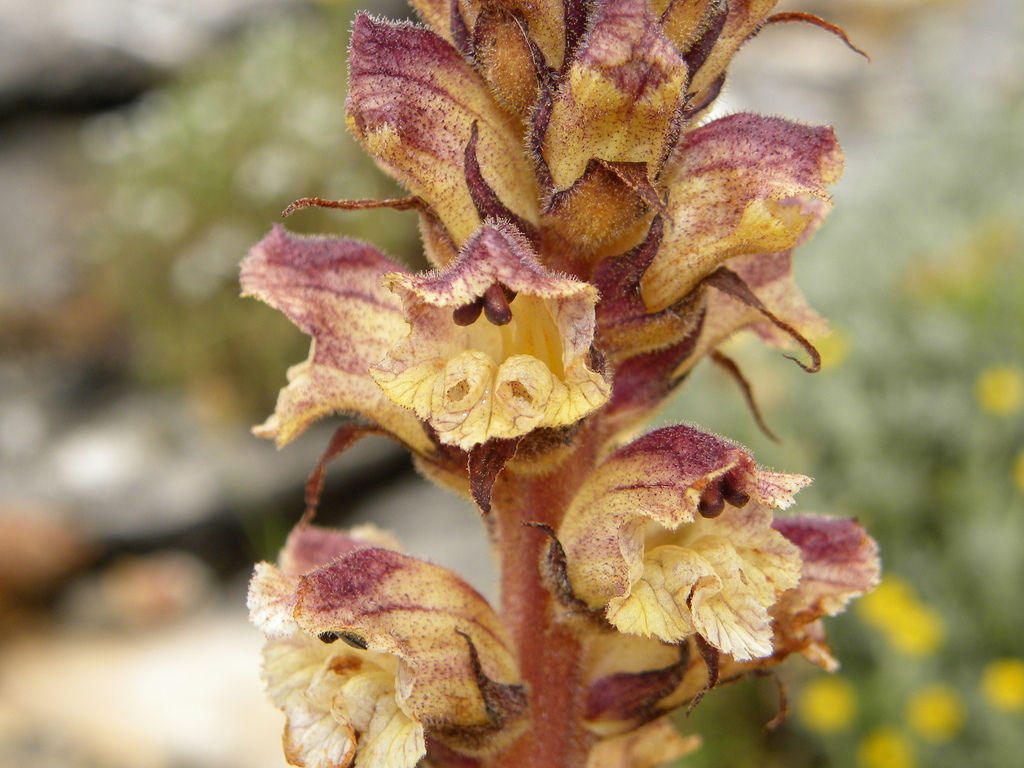
Thistle Broomrape
Orobanche reticulata
Orobanche reticulata is a species of broomrape known by the common name thistle broomrape. It is a parasitic plant whose host is normally the creeping thistle. It is native to the lowlands of Western Europe and Central Asia, but in the United Kingdom it is a rare and protected plant, growing only in Yorkshire, on grassland sites such as Quarry Moor.
From the article Orobanche reticulata on Wikipedia (CC BY-SA), quoted section by section
Description
Orobanche reticulata was described by taxonomist Karl Friedrich Wilhelm Wallroth (Wallr.) in 1825. Its usual host plant is creeping thistle. It is a herbaceous and self-supporting plant with simple broad, scale-like leaves, normally growing up to 70 centimetres (28 in), and it flowers between May and July. It is a tuberous perennial, a hermaphrodite plant which possibly germinates in the spring. It has a yellow-purple stem. The two-lipped flowers, measuring 15–25 mm (0.6–1 inch), have dark spots and purple stigmas. However, for full identification, the host must be noted.
Range & habitat
In general it is a lowland plant which grows on the edges of rivers and roads, and on floodplains, preferring grassland. In the United Kingdom it prefers dry, calcareous soil without shade, and an altitude of 100–150 metres (328–492 feet). It is possibly water-dispersed in some cases. It is a plant of temperate climates, native to the lowlands of Western Europe and Central Asia. In Belgium and northern France its range is 10–30%; in Germany, Denmark and the Netherlands 30–60%.
Orobanche reticulata in the United Kingdom. Orobanche reticulata is native and stable in the UK, where it is also known as Yorkshire broomrape. It is however a rare plant there, having been notified as a protected plant under Schedule 8. It grows only in Yorkshire, where it appears mainly in the Magnesian Limestone zone, but also at Wharram Quarry. At Wharram it has a "good population" of up to 224 flower spikes (2017), parasitising woolly thistle, and can grow quite tall there (up to 81 centimetres (32 in)) although it may have been introduced artificially. At Hetchell Wood 117 flower spikes were recorded in 2015, and at Ripon Loop 77 spikes were recorded in 2014. In 2004 it was found at North Grimston. It was notified in 1989 on Hook Moor SSSI, where Natural England suggests that rabbit activity is beneficial to the survival of this plant. …
Wikipedia: “Distribution and range”
Where it lives
Recorded sightings
—
geo-referenced records in GBIF, from museums, herbaria and field observers.
Drag the globe to turn it. Dots are where records exist, not a range map; darker means more records.
In the stacks
Searching the stacks…
Every page naming Orobanche reticulata in the Biodiversity Heritage Library →
This page is assembled live from iNaturalist, GBIF, Wikipedia, the Source Library and the Internet Archive. It is not yet part of the hand-edited codex. iNaturalist taxon 245686.