- Animals
- ›Arthropods
- ›Hexapods
- ›Insects
- ›Winged and Once-winged Insects
- ›Beetles
- ›Water, Rove, Scarab, Long-horned, Leaf, and Snout Beetles
- ›Cucujiform Beetles
- ›Longhorn Beetles and Allies
- ›Longhorn Beetles
- ›Round-necked Longhorn Beetles
- ›Clytini
- ›Placosternus
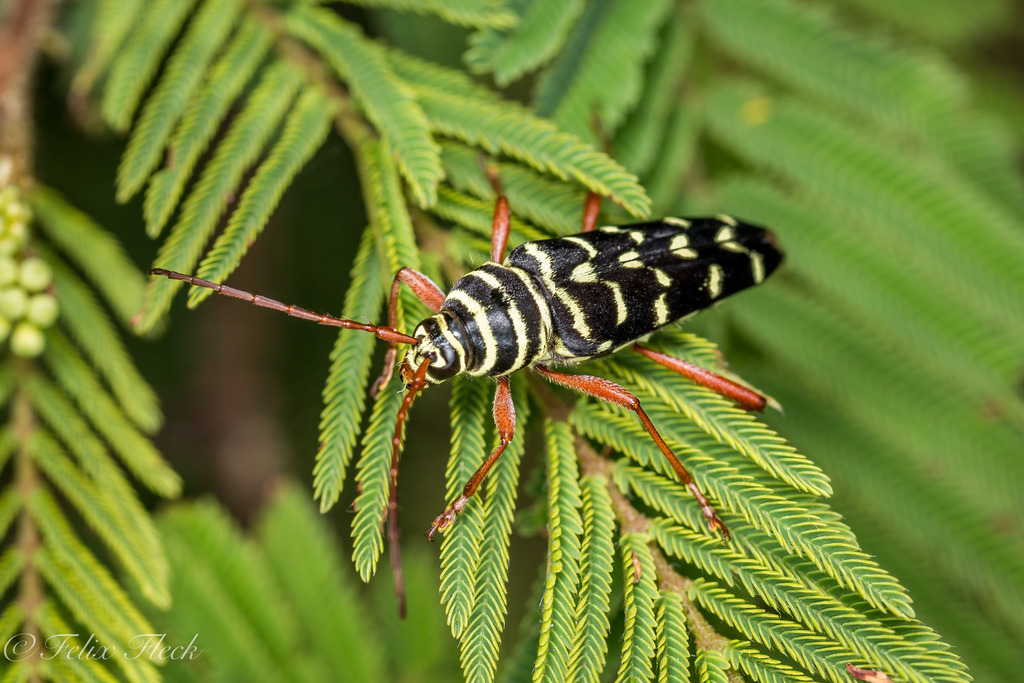
Placosternus erythropus
Placosternus erythropus is a species of beetle in the family Cerambycidae. It was described by Chevrolat in 1835.
From the article Placosternus erythropus on Wikipedia (CC BY-SA), quoted section by section
Description
Placosternus erythropus is a moderately slender beetle with exceptionally long antennae. In the US it's called "longhorned beetle," though that name is shared by many species in the family. Its body reaches up to 20mm long (25/32 inch). The iNaturalist page showing images of the four species comprising the genus Placosternus shows that the species are quite similar to one another; all are black with white or yellowish stripes and spots, and bear red or reddish appendages. Making identification even harder, the closely related genus Megacyllene embraces species which in shape, pattern and color are similar, as seen on the iNaturalist page comparing 35 Megacyllene species. The main physical distinction between the two genera is that there's a spine on the "basal antennomere" of Megacyllene species, while that spine is lacking on Placosternus species. An antennomere is any segment in an antenna, so a basal antennomore is the antennomere at the antenna's base.
Range & habitat
Placosternus erythropus occurs in western and southern Texas in the US, south through Mexico and Central America into Costa Rica.
Wikipedia: “Range”
What it does
Females deposit eggs in a woody plant's inner bark, the phloem. When the eggs hatch, each larva chews out its own chamber, first feeding on the phloem connecting with the cambium, later burrowing into the wood, the xylem. When larvae are ready to pupate, they widen their tunnel and line it with wood shavings or fibers, where they pupate. The newly emerged adults make an oval tunnel leading to the outside world, and fly away.
Wikipedia: “Life cycle”
In human culture
In the genus name Placosternus, the placo- is Greek for "flat". The suffix -sternus is a form of the Greek word sternon, meaning "chest." Thus "flat-chested." The species name erythropus is a word used in Latin but derived from the Greek term erythros, meaning "red", and pous, for "foot": "red-footed."
== References ==
Wikipedia: “Etymology”
Listen
Looking for field recordings…
Where it lives
Recorded sightings
—
geo-referenced records in GBIF, from museums, herbaria and field observers.
Drag the globe to turn it. Dots are where records exist, not a range map; darker means more records.
In the stacks
Searching the stacks…
Every page naming Placosternus erythropus in the Biodiversity Heritage Library →
This page is assembled live from iNaturalist, GBIF, Wikipedia, the Source Library and the Internet Archive. It is not yet part of the hand-edited codex. iNaturalist taxon 245841.