- Animals
- ›Arthropods
- ›Hexapods
- ›Insects
- ›Winged and Once-winged Insects
- ›Ants, Bees, Wasps, and Sawflies
- ›Narrow-waisted Wasps, Ants, and Bees
- ›Ants, Bees, and Stinging Wasps
- ›Bees and Apoid Wasps
- ›Bees
- ›Honey Bees, Bumble Bees, and Allies
- ›Apine Bees
- ›Honey Bees
- ›Apis
- ›Micrapis
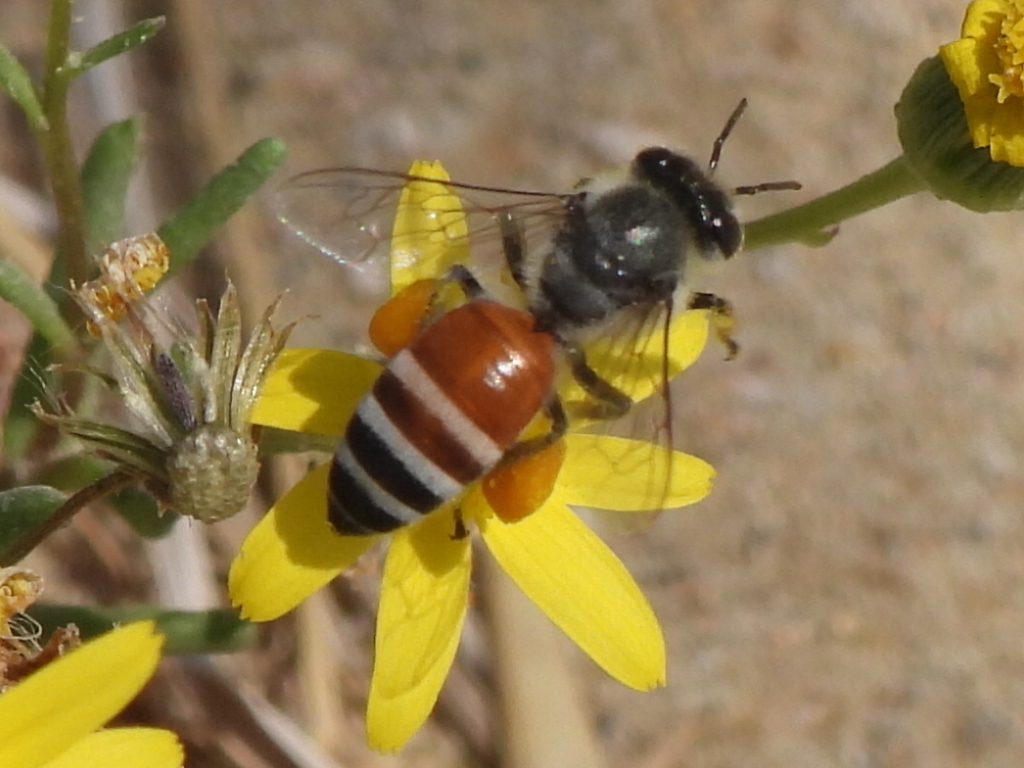
Red Dwarf Honey Bee
Apis florea
The dwarf honey bee (or red dwarf honey bee), Apis florea, is one of two species of small, wild honey bees of southern and southeastern Asia. It has a much wider distribution than its sister species, Apis andreniformis. First identified in the late 18th century, Apis florea is unique for its morphology, foraging behavior and defensive mechanisms like making a piping noise. Apis florea have open nests and small colonies, which makes them more susceptible to predation than cavity nesters with large numbers of defensive workers. The species is an important pollinator in many parts of its range and its nests are occasionally exploited as a source of wild honey.
From the article Apis florea on Wikipedia (CC BY-SA), quoted section by section
Description
A. florea is called the dwarf honey bee due to its small size compared to other honeybees. A worker is typically 7–10 mm in body length and its overall coloration is red-brown. A colony builds a single, exposed comb usually on tree branches or shrubs. A. florea produce honey that is harvested and eaten in parts of its range. They are excellent pollinators, which gives them an important ecological role in the places they inhabit. Drones carry a thumb-like bifurcation called the basitarsus, which is located two-thirds along the length of the tibia. The fimbriate lobe of A. florea has three protrusions and they sting using two stylet barbs. Apis florea and its sister species together comprise the subgenus Micrapis, and are the most primitive of the living species of Apis, reflected in their small colony size, and simple nest construction. The exposed single combs are built on branches of shrubs and small trees. The forager bees do not perform a gravity-oriented waggle dance on the vertical face of the comb to recruit nestmates as in the domesticated Apis mellifera and other species. Instead, they perform the dance on the horizontal upper surface where the comb wraps around the supporting branch. The dance is a straight run pointing directly to the source of pollen or nectar the forager has been visiting. The distinctiveness of the two species A. florea and A. …
Wikipedia: “Description and identification”
Range & habitat
A. florea spans the continents of Asia and Africa and is most commonly seen in Southeastern Asia (Thailand), the Northeastern part of India, China, and forested regions of the Middle East. A. florea reach a decision about a new nesting site via dancing. They decide on a site when the largest number of individuals dance in the direction of the new site. The workers use an auditory signal of piping to indicate a decision about a new site has been reached, with the top of the swarm lifting off into the air first, followed by the bottom of the swarm and then the middle reaching the air last, but all within one minute of the swarm’s initial lift off. Since dancing is a common mechanism of communicating about a new nesting site in both A. florea and A. mellifera, it is suggested that this form of nest site selection evolved in the common ancestor of Apis. However, A. florea do not re-evaluate a site before several individuals move to the new site like A. mellifera does. Instead, swarms travel to the new site as a group and leave to a new site if it is later discovered to be unsuitable. This makes searching for new sites a much faster process for A. florea, but not necessarily more accurate.
Apis florea are found in southeastern Asian countries, especially in Thailand, Iran, Oman, United Arab Emirates, India, Myanmar, and some parts of China, Cambodia, and Vietnam. …
Wikipedia: “Distribution and habitat”
What it does
A. florea adults eat primarily honey and nectar but also feed the brood on pollen. Future queens are fed royal jelly and are reared in larger cells so they become larger.
Wikipedia: “Diet”
Listen
Looking for field recordings…
Where it lives
Recorded sightings
—
geo-referenced records in GBIF, from museums, herbaria and field observers.
Drag the globe to turn it. Dots are where records exist, not a range map; darker means more records.
In the stacks
Searching the stacks…
Every page naming Apis florea in the Biodiversity Heritage Library →
This page is assembled live from iNaturalist, GBIF, Wikipedia, the Source Library and the Internet Archive. It is not yet part of the hand-edited codex. iNaturalist taxon 245956.