- Animals
- ›Molluscs
- ›Bivalves
- ›Autobranchia
- ›Pteriomorphia
- ›Scallops and Allies
- ›Pectinoidea
- ›Scallops
- ›Pectininae
- ›Amusiini
- ›Euvola
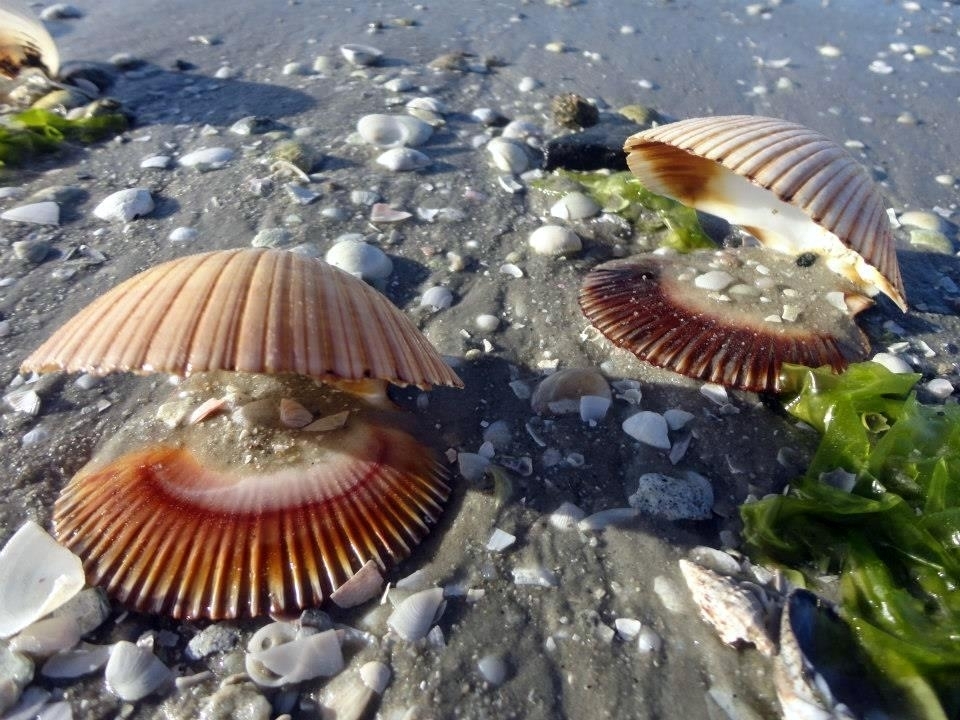
Zigzag Scallop
Euvola ziczac
Euvola ziczac, or the zigzag scallop, is a species of bivalve mollusc in the family Pectinidae. It can be found along the Atlantic coast of North America, ranging from North Carolina to the West Indies and Bermuda.
From the article Euvola ziczac on Wikipedia (CC BY-SA), quoted section by section
Range & habitat
Zigzag scallops have been found historically in several areas around Bermuda, including Harrington Sound, where they were once a popular catch among recreational fishers. Overfishing through the 1970s decimated the population to the point that a series of 1987 SCUBA surveys around the island discovered only two scallops at two different sites. Besides Bermuda, zigzag scallops can be found off Cape Hatteras in North Carolina, throughout the Gulf of Mexico and the Caribbean, and as far south as Santa Catarina, Brazil. Zigzag scallops inhabit shallow waters between two and seven meters deep near the shore and form beds in sandy areas. Scallops as a group are specially adapted to the temperature and salinity fluctuations that are part of life in the intertidal zone. Individuals bury themselves with sediment except for their tentacles, which project above the sediment and are usually the only part of the animal visible to observers. Their concave upper valves hold a thin layer of sediment that is thought to prevent fouling organisms from colonizing. Given the chance, a variety of fouling organisms will colonize scallop shells, including algae, barnacles, polychaete tube worms, sponges, hydrozoans, bryozoans, and even other molluscs.
Wikipedia: “Habitat and conservation”
What it does
Like other bivalve molluscs, Bermuda scallops feed by passively filtering plankton and organic matter from the surrounding water. They are primarily herbivorous and subsist on phytoplankton, although they have been known to inadvertently consume small planktonic animals, as well. Scallops have even been known to orient themselves in relation to surrounding water currents, but the advantages of such behavior are still being investigated. Because of their submerged, sand-dwelling lifestyle, zigzag scallops in particular extend their tentacles out of the sediment so they can continue to filter-feed even when the rest of their bodies are buried in the sand.
Wikipedia: “Diet”
Where it lives
Recorded sightings
—
geo-referenced records in GBIF, from museums, herbaria and field observers.
Drag the globe to turn it. Dots are where records exist, not a range map; darker means more records.
In the stacks
Searching the stacks…
Every page naming Euvola ziczac in the Biodiversity Heritage Library →
This page is assembled live from iNaturalist, GBIF, Wikipedia, the Source Library and the Internet Archive. It is not yet part of the hand-edited codex. iNaturalist taxon 253409.