- Animals
- ›Molluscs
- ›Gastropods
- ›Heterobranchs
- ›Euthyneura
- ›Tectipleura
- ›Sea Hares and Akera Snails
- ›Aplysioidea
- ›Seahares
- ›Aplysia
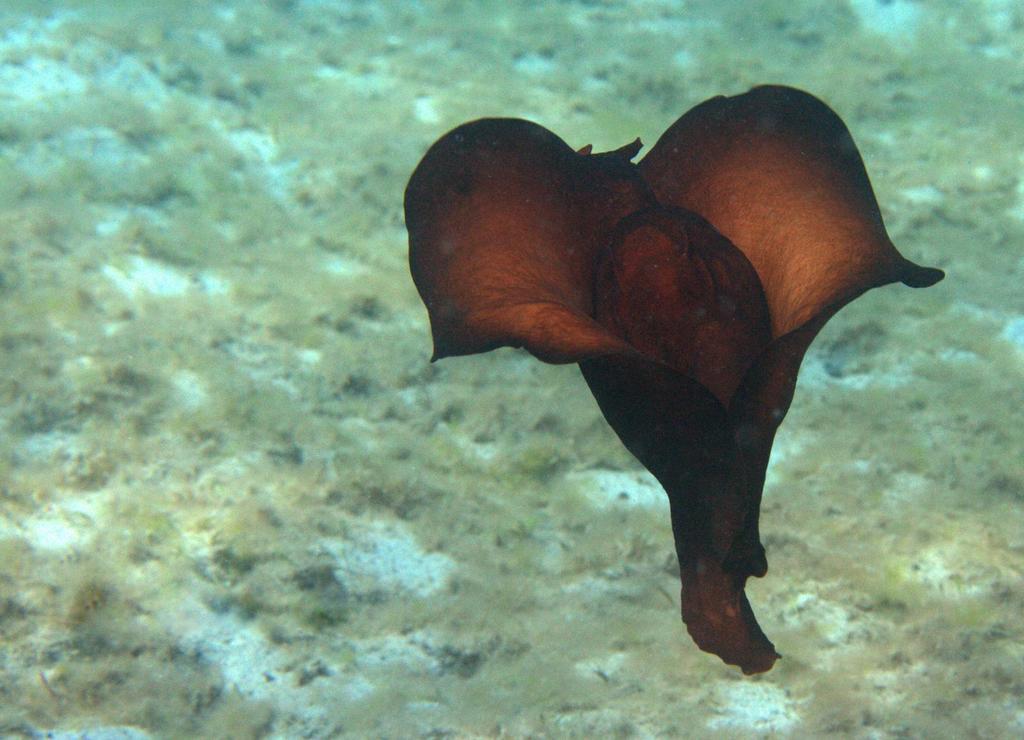
Atlantic Black Seahare
Aplysia morio
Aplysia morio, the Atlantic black sea hare or sooty sea hare, is a species of sea slug, a marine gastropod mollusk in the family Aplysiidae, the sea hares.
It lives in warm waters in the Caribbean Sea and off the south and southeastern coast of the United States, where it feeds on seaweed.
From the article Aplysia morio on Wikipedia (CC BY-SA), quoted section by section
Description
(Original description) A very large species, exceeding a foot in length; dark umber-brown or nearly black in color, without definite spots, but bearing black stripes on the head and possessing very large, broadly overlapping lateral flaps. The body is thick and stout, swollen, and very obtuse posteriorly. The head and neck are also thick and robust (though perhaps not seen fully extended). The lateral natatorial flaps are very wide, overlapping by about half their breadth, entirely free posteriorly, and extending to the end of the short foot. The rhinophores are rather small and short, conical in shape. The tentacles are large, very broad, and foliaceous, with thin, expanded margins. The body and outer surfaces of the flaps are very dark umber-brown or brownish-black, with a few obscure dusky blotches on the sides of the foot and a purplish tinge along the flap edges. The head, both above and on the sides, is marked with several narrow, purplish-black longitudinal stripes. Length in life (not fully extended): 400 mm; height: 145 mm. The shell is very thin, transparent, and pale yellow, oblong-ovate in form, obtusely rounded anteriorly, with a long posterior sinus that is only slightly incurved. The beak is rather prominent and scarcely incurved, with a reflexed membranous edge that also extends along both posterior margins. …
Range & habitat
This species is found in the semi-tropical western Atlantic Ocean. Its range includes the eastern coast of the United States, Bermuda, the West Indies, Florida, the Caribbean Sea, the Gulf of Mexico and Venezuela. It typically lives in shallow water, down to depths of about 40 m (130 ft) in areas where there is little wave action. It is usually found on rocky surfaces among the algae that it feeds on, but is also found on sandy seabeds.
Wikipedia: “Distribution and habitat”
What it does
Aplysia morio feeds on algae. In Bermuda juveniles seem to feed almost exclusively on species of the red alga Laurencia, even though there is a wide range of algae to choose from. Adults widen their diet slightly to include Palmaria palmata. The animal either crawls over the seaweed or rears up to grasp the fronds with its radula and the odontophore (cartilage) that supports it. It may also swim, in a manner reminiscent of a manta ray, when looking for food. An adult is a hermaphrodite that can act as a male and a female at the same time. As the penis of one individual is inserted into the genital opening of another, chains or clusters of mating sea hares can form. The initially spawning individual releases chemical signals that can trigger spawning in others, which may culminate in a mass spawning event. Fertilized eggs hatch and develop into veliger larvae, which drift with the plankton for at least a month and settle onto Laurencia seaweed.
Wikipedia: “Ecology”
Where it lives
Recorded sightings
—
geo-referenced records in GBIF, from museums, herbaria and field observers.
Drag the globe to turn it. Dots are where records exist, not a range map; darker means more records.
In the stacks
Searching the stacks…
Every page naming Aplysia morio in the Biodiversity Heritage Library →
This page is assembled live from iNaturalist, GBIF, Wikipedia, the Source Library and the Internet Archive. It is not yet part of the hand-edited codex. iNaturalist taxon 253929.