- Animals
- ›Arthropods
- ›Hexapods
- ›Insects
- ›Winged and Once-winged Insects
- ›Flies
- ›Brachyceran Flies
- ›Orthorrhaphan Flies
- ›Snipe Flies and Allies
- ›Horse and Deer Flies
- ›Horse Flies
- ›Diachlorini
- ›Diachlorus
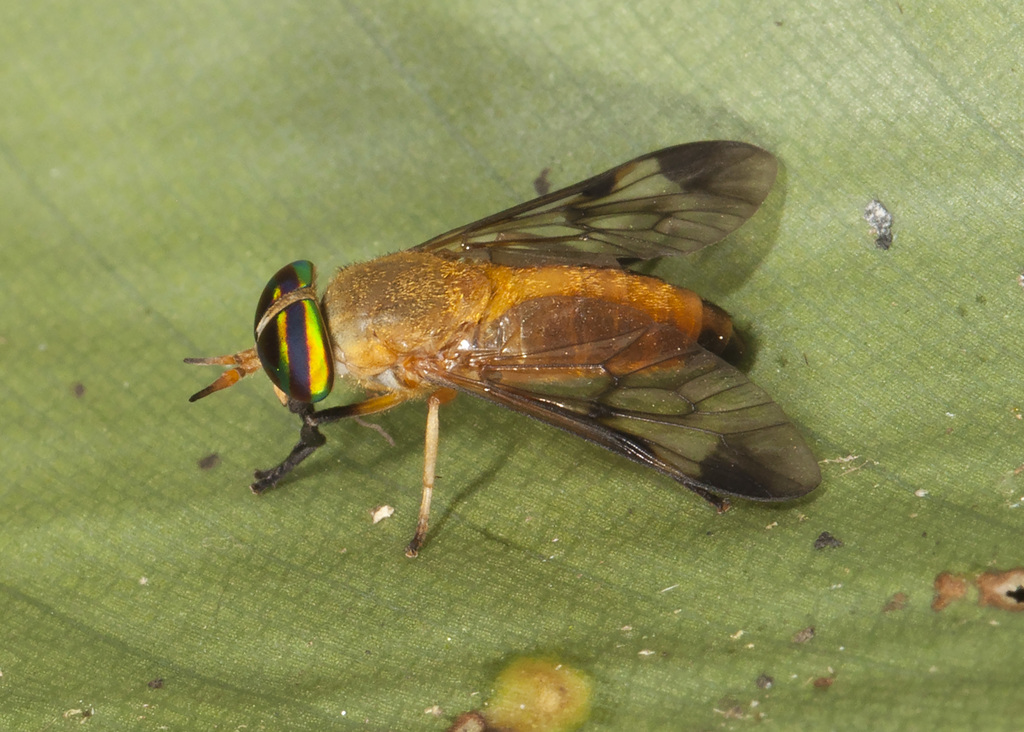
Yellow Fly of the Dismal Swamp
Diachlorus ferrugatus
Diachlorus ferrugatus, commonly known as the yellow fly or yellow fly of the dismal swamp in the United States or doctor fly in Belize, is a species of highly aggressive biting horse-fly of the family Tabanidae native to North and Central America to Costa Rica.
From the article Diachlorus ferrugatus on Wikipedia (CC BY-SA), quoted section by section
Description
Adult yellow flies are around 1 centimetre (0.39 in) long with yellow bodies, mid-legs, and hind-legs, and black fore-legs. The eyes are blue-green with purple bands. They fly with little sound, and the first sign of their presence noticed by humans is usually their bite. The larvae are thin white grubs with fine yellow fur, each segment having three pairs of pseudopodia.
Range & habitat
The yellow fly ranges from the southeastern United States, where it is found from New Jersey to Texas, to Costa Rica. It is most common near bodies of water, along with trees nearby to hide in. Spanish moss (Tillandsia usneoides) is a popular hiding spot.
Wikipedia: “Distribution and habitat”
Listen
Looking for field recordings…
Where it lives
Recorded sightings
—
geo-referenced records in GBIF, from museums, herbaria and field observers.
Drag the globe to turn it. Dots are where records exist, not a range map; darker means more records.
In the stacks
Searching the stacks…
Every page naming Diachlorus ferrugatus in the Biodiversity Heritage Library →
This page is assembled live from iNaturalist, GBIF, Wikipedia, the Source Library and the Internet Archive. It is not yet part of the hand-edited codex. iNaturalist taxon 258381.