- Animals
- ›Arthropods
- ›Hexapods
- ›Insects
- ›Winged and Once-winged Insects
- ›Flies
- ›Brachyceran Flies
- ›Orthorrhaphan Flies
- ›Asiloidea
- ›Robber Flies
- ›Asilinae
- ›Apocleini
- ›Mallophora
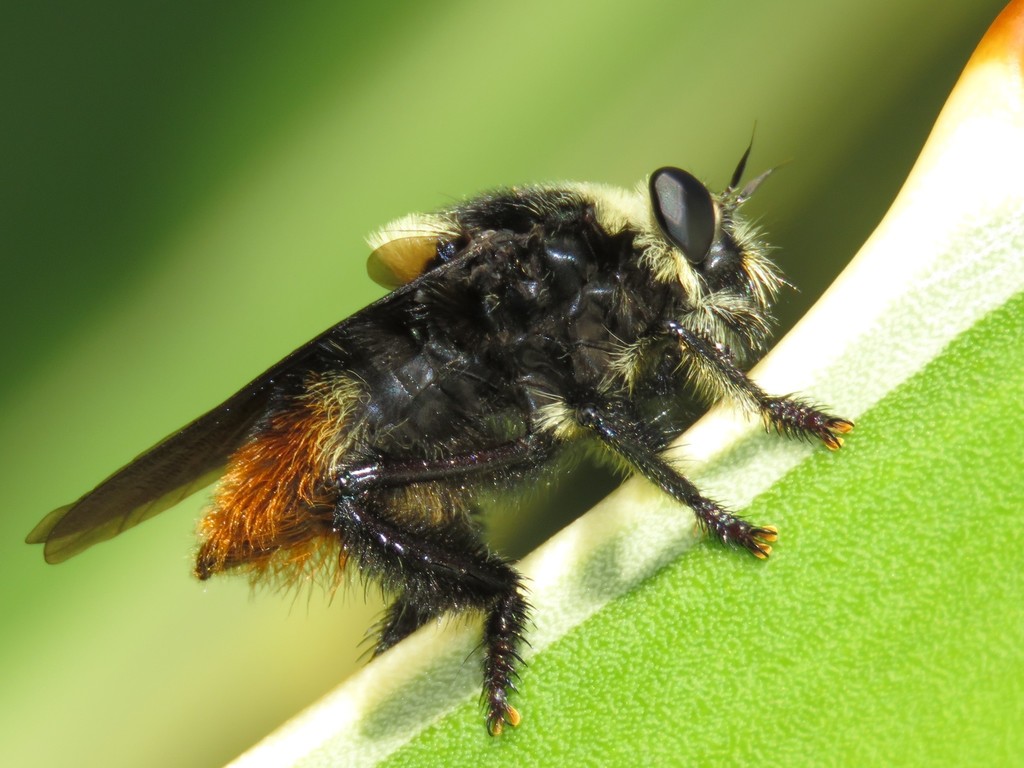
Mallophora ruficauda
Mallophora ruficauda is a species of parasitic robber fly in the family Asilidae, endemic to South and Central America. Like other robber flies, M. ruficauda is known for its aggressive behavior and predation upon other insects, especially bees. M. ruficauda (like other members of the genus Mallophora) mimics a bumblebee to fool predators into thinking it has a painful sting and is not worth eating.
M. ruficauda larvae parasitize scarab beetles and likely serve as an important biocontrol for the beetles, a pest species that eats the roots and tubers of plants while in the larval stage. On the other hand, adult M. ruficauda are apicultural pests because they feed on worker honeybees.
From the article Mallophora ruficauda on Wikipedia (CC BY-SA), quoted section by section
Description
M. ruficauda is a bumblebee mimic, meaning it appears very similar to a bumblebee despite actually being a fly. It is large and covered in dense black hair (setae) with a patch of yellow on the thorax, and has a pointed black abdomen with a spot of reddish hair at the tip. The wings are smoky brown and generate a buzzing sound during flight, similar to the wings of bees. The head is black and the face is covered in white hairs, which are also found on the ventral side of the femora, tibia, and tarsale of the third pair of legs in males. The third pair of legs is stronger and lengthened compared to the other two smaller pairs. Larvae are minute, measuring only 1.35 mm in length and 0.32 mm in width on average. Their small size allows them to easily disperse by wind after hatching. M. ruficauda is endemic to South and Central America, and is primarily present in the open grasslands and meadows where it lays its eggs. The flies are most active during the day, especially during sunny and hot days in the summer (December-May in the Southern Hemisphere).
Sensory physiology. Researchers have shown that M. ruficauda antennae are involved in resource-searching behavior, in addition to detecting outside chemical cues that the flies are able to pick up on. Their antennae are composed of four different segments: the scape, pedicel, postpedicel, and style. …
At the table
Larvae exclusively feed on their white grub hosts until they pupate and emerge as full-grown adults. The adults are predatory, feeding on insects (primarily Hymenoptera but also other insects, including other members of Diptera) endemic to the meadows that they inhabit.
Wikipedia: “Food resources”
Listen
Looking for field recordings…
Where it lives
Recorded sightings
—
geo-referenced records in GBIF, from museums, herbaria and field observers.
Drag the globe to turn it. Dots are where records exist, not a range map; darker means more records.
In the stacks
Searching the stacks…
Every page naming Mallophora ruficauda in the Biodiversity Heritage Library →
This page is assembled live from iNaturalist, GBIF, Wikipedia, the Source Library and the Internet Archive. It is not yet part of the hand-edited codex. iNaturalist taxon 260132.