 NL·0391
Herbarium of the Nature Library
- Name
- Crocodylus porosus
- Family
- Crocodylidae
- Native to
- Eastern India and Sri Lanka through Southeast Asia to northern Australia, New Guinea and the Solomon Islands
- Habitat
- Mangrove, Estuaries, Rivers and streams, Coastal waters
Saltwater crocodile
Crocodylus porosus
Also calledBuaya muara (Malay/Indonesian) · Pukpuk (Tok Pisin) · Wān'è 湾鳄 (Chinese) · Kimbula (Sinhala) · Ginga (Kunwinjku)
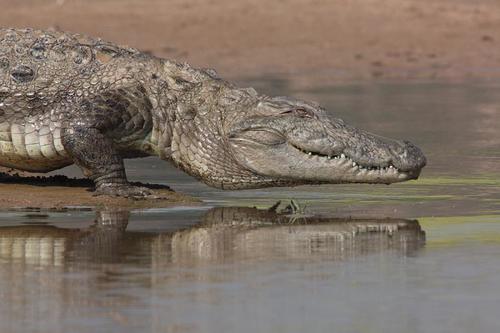
The largest living reptile, with old males exceeding 6 m and a tonne. It thrives in fresh and salt water and has crossed open sea to colonise islands from India to the Pacific.
The saltwater crocodile is a crocodilian native to saltwater habitats, brackish wetlands and freshwater rivers from India's east coast across Southeast Asia and the Sundaland to northern Australia and Micronesia. It has been listed as Least Concern on the IUCN Red List since 1996. It was hunted for its skin throughout its range up to the 1970s, and is threatened by illegal killing and habitat loss. It is regarded as dangerous to humans. Wikipedia
What it can do
- iHas the strongest bite measured in any living animal, about 16,000 newtons
- iiRides ocean currents to travel hundreds of kilometres between coasts
- iiiGets rid of excess salt through glands on its tongue
- ivCan stay submerged for an hour or more while resting
- vDetects tiny ripples with pressure-sensing pits along its jaws and body
In the field
Field marks
- aLargest reptile, heavy-bodied and grey-brown
- bBroad snout with ridges running from the eyes
- cFew or no large scales behind the head
- dOften basks on mudbanks
- Not to be confused with
- Freshwater crocodile (Australia) is smaller with a narrow snout. Mugger has a broad snout and large neck scales. Any crocodile here may be a saltie. Never approach on foot; keep well back from the water's edge and obey warning signs.
- Where to see it
- Yellow Water cruises (Kakadu) and the Adelaide River (Northern Territory); Bhitarkanika (Odisha)
- When
- Resident; dry season best for viewing
Life & habits
- Diet
- Carnivore: fish, crabs, turtles, birds, pigs, buffalo; anything it can overpower
- Habitat
- Tidal rivers, mangrove swamps, estuaries and coasts
- Size
- Males usually 4–5 m, exceptionally 6 m+ and 1,000 kg; females ~3 m
- Lifespan
- 70 years or more
Mothers guard their nest mounds, dig out the chirping hatchlings and carry them to water in their mouths. Nest temperature sets the hatchlings' sex.
Where it lives
Recorded sightings
—
geo-referenced records in GBIF, from museums, herbaria and field observers.
Native range
Eastern India and Sri Lanka through Southeast Asia to northern Australia, New Guinea and the Solomon Islands
Drag the globe to turn it. Dots are where records exist, not a range map; darker means more records.
In the old herbals & bestiaries
No plate in the Source Library names this exact species, so these show its closest relatives as the old naturalists drew them: same genus, or the same kind of animal. Click a plate to read the page it came from, with translation.

Ortus sanitatis
Relative · 1491 · p.688

History of Animals, Book II: On Oviparous Quadrupeds
Relative · Conrad Gessner · 1586 · p.724

Museum of the Royal Society
Relative · Nehemiah Grew · 1681 · p.468

Recherche curieuse d'antiquités, venuës d'Italie, de la Grece, d'Egypte, & trouvées à Nimegue, a Sant...
Relative · Chevalier, Nicolas · 1714 · p.56

Unterhaltungen aus der Naturgeschichte / 3 Die Amphibien
Relative · Wilhelm, Gottlieb Tobias · 1794 · p.407

Unterhaltungen aus der Naturgeschichte / [Tafelband.]
Relative · Borkhausen, Moritz Balthasar (1760-1806) · n.d. · p.53

Ortus sanitatis
Relative · 1491 · p.540

Garden of Health
Relative · Jacob Meydenbach · 1491 · p.686

Garden of Health
Relative · Jacob Meydenbach · 1491 · p.538

Garden of Health (Hortus Sanitatis)
Relative · Jacob Meydenbach · 1491 · p.496
In the stacks
Searching the stacks…
Every page naming Crocodylus porosus in the Biodiversity Heritage Library →
Marginalia
A Timorese legend tells that Timor island is the body of a crocodile who befriended a boy. In Arnhem Land the crocodile is an ancestral being of the Dreaming, painted on bark and rock.
Curiosity
Lolong, captured in the Philippines in 2011, measured 6.17 m, the largest crocodile ever measured in captivity.
Kinship





Photographs: iNaturalist contributors under the licences shown. Records: GBIF.org. Historical plates: Source Library (CC BY-SA 4.0; originals public domain). Summary text: Nature Library editors and Wikipedia (CC BY-SA). Medicinal and edibility notes are historical and educational, not advice. iNaturalist taxon 26068.