- Animals
- ›Arthropods
- ›Crustaceans
- ›Typical Crustaceans
- ›Malacostracans
- ›Decapods, Isopods, and allies
- ›Amphipods, Isopods, and Allies
- ›Amphipods
- ›Senticaudata
- ›Corophiida
- ›Caprellidira
- ›Skeleton Shrimp, Whale Lice, and Allies
- ›Skeleton Shrimp
- ›Caprellinae
- ›Caprella
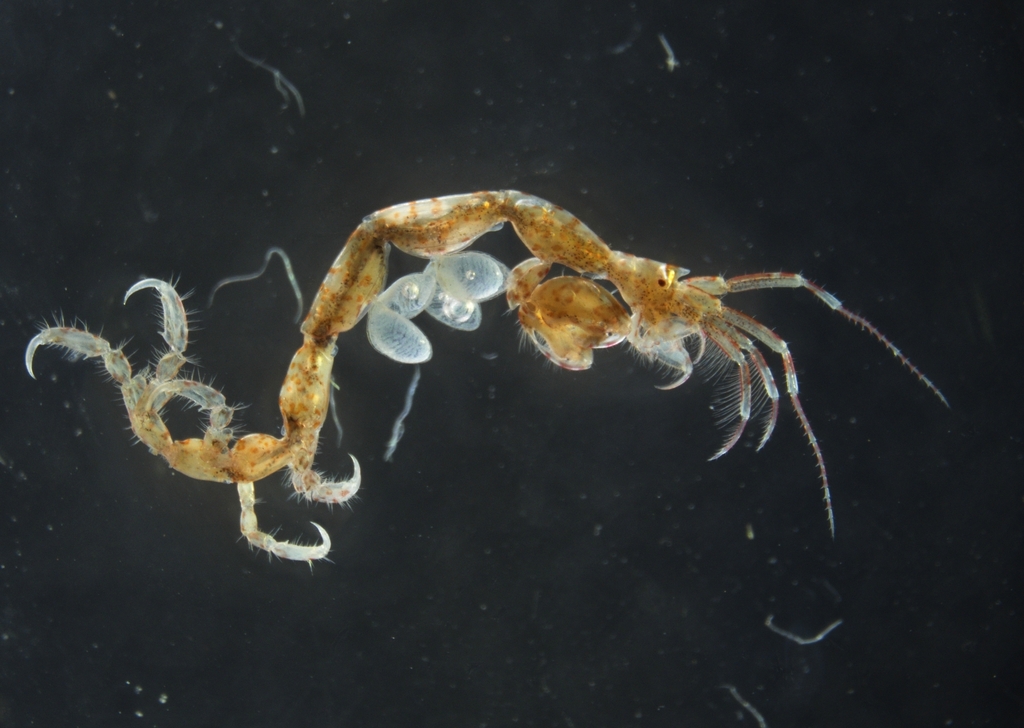
Caprella penantis
Caprella penantis is a species of skeleton shrimp in the family Caprellidae. It lives on the seabed in shallow water in many parts of the world. This species was first described in 1814 by the English zoologist William Elford Leach who named it Caprella penantis in honour of the Welsh naturalist Thomas Pennant. The type locality is Devon, England.
From the article Caprella penantis on Wikipedia (CC BY-SA), quoted section by section
Description
Like other caprellid skeleton shrimps, Caprella penantis has a cylindrical, slender body with much reduced abdominal segments. It grows to a length of about 13 mm (0.5 in). The gnathopods (feeding appendages) are hooked and the three pairs of pereiopods (walking legs) are modified for clinging on to the plants and other organisms amongst which it lives. Compared to other caprellids in similar habitats, it has a small, sharply-pointed rostrum on its head and a relatively robust body. While generally drab in colour, this skeleton shrimp may take on some of the coloration of whatever it is feeding on.
Range & habitat
Caprella penantis has a cosmopolitan distribution, being present in tropical, subtropical and temperate seas worldwide. It lives on the seabed among sea grasses and seaweeds, and is often associated with the sea whip Leptogorgia virgulata in beds of turtlegrass.
Wikipedia: “Distribution”
What it does
The sexes are separate in this species. Breeding takes place throughout the year; the male grasps the female with his hindmost pereiopod, and defends her from other males. The female produces several batches of about twenty eggs during her reproductive lifespan. The eggs are laid directly into a marsupium (brood pouch) under the female's body; the larvae do not have a planktonic phase but develop directly into juveniles which disperse by crawling away.
== References ==
Wikipedia: “Ecology”
Where it lives
Recorded sightings
—
geo-referenced records in GBIF, from museums, herbaria and field observers.
Drag the globe to turn it. Dots are where records exist, not a range map; darker means more records.
In the stacks
Searching the stacks…
Every page naming Caprella penantis in the Biodiversity Heritage Library →
This page is assembled live from iNaturalist, GBIF, Wikipedia, the Source Library and the Internet Archive. It is not yet part of the hand-edited codex. iNaturalist taxon 260712.