- Animals
- ›Arthropods
- ›Hexapods
- ›Insects
- ›Winged and Once-winged Insects
- ›Ants, Bees, Wasps, and Sawflies
- ›Narrow-waisted Wasps, Ants, and Bees
- ›Proctotrupomorpha
- ›Chalcidoid Wasps
- ›Aphelinidae
- ›Coccophaginae
- ›Pteroptricini
- ›Encarsia
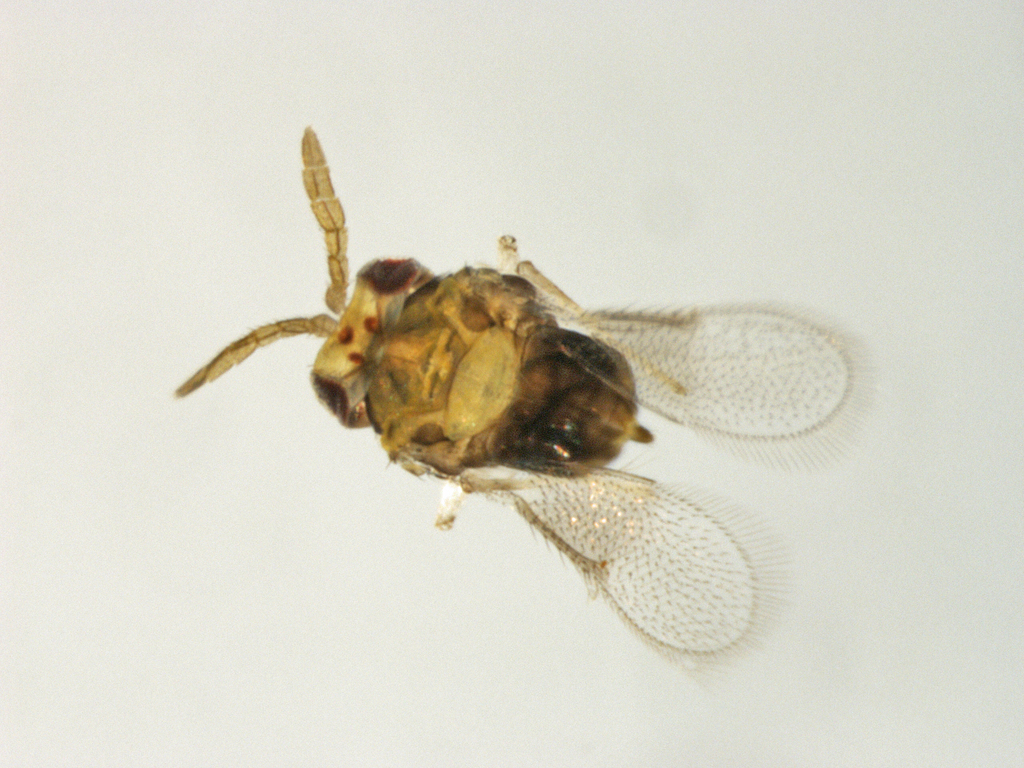
Encarsia perniciosi
Encarsia perniciosi is a tiny parasitic wasp, a parasitoid of the California red scale (Aonidiella aurantii) and the San Jose scale (Quadraspidiotus perniciosus) on citrus in California.
From the article Encarsia perniciosi on Wikipedia (CC BY-SA), quoted section by section
Description
Encarsia perniciosi is a tiny dark-coloured wasp, rather smaller than Comperiella bifasciata, another parasitoid of scale insects. E. perniciosi is common near the coast in California, and used to be present in citrus groves inland until the introduction of Aphytis melinus. The two co-exist in coastal areas but not inland, a fact that has not yet been explained.
What it does
Encarsia perniciosi is an endoparasite, the female inserting its ovipositor into a scale, either male or female, and laying an egg inside. It can use any scale stage but prefers to use second instars. The wasp larva matures rapidly and pupates inside the body of its host. On emerging from the pupa, it chews through the scale test, leaving behind a mummified second or third instar scale. On the California red scale, this wasp is thelytokous, with female offspring being produced from unfertilised eggs. On the San Jose scale however, though some females reproduce by thelytoky, other strains are arrhenotokous, with males being produced from unfertilised eggs. The males are secondary parasitoids, developing inside other Encarsia larvae, usually female, or in the larvae of other species. Research in the laboratory shows that arrhenotokous males will not mate with thelytokous females. There have been reports in the literature of the arrhenotokous form becoming thelytokous when kept under constant conditions of temperature, but the researchers in this study did not find this to be the case, and maintained arrhenotokous strains for as many as 19 generations.
== References ==
Wikipedia: “Life cycle”
Listen
Looking for field recordings…
Where it lives
Recorded sightings
—
geo-referenced records in GBIF, from museums, herbaria and field observers.
Drag the globe to turn it. Dots are where records exist, not a range map; darker means more records.
In the stacks
Searching the stacks…
Every page naming Encarsia perniciosi in the Biodiversity Heritage Library →
This page is assembled live from iNaturalist, GBIF, Wikipedia, the Source Library and the Internet Archive. It is not yet part of the hand-edited codex. iNaturalist taxon 264874.